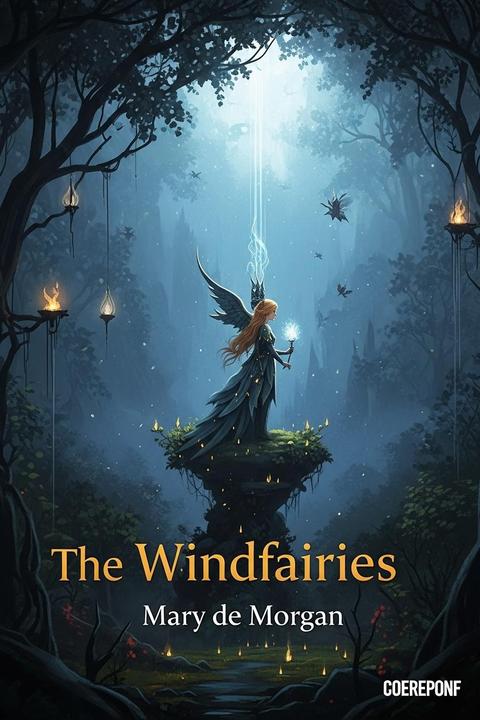
The Windfairies by Mary de Morgan
A miller and his daughter, Lucilla, live in a secluded windmill by the sea. Orphaned of her mother, Lucilla spends her days watching the windmill’s sails, which come alive in her imagination. One midnight, ethereal beings visit her; they reveal themselves as keepers of the wind, whose dancing over the windmill inspires her to learn their graceful art. In return for her silent promise never to divulge their secret, they endow her with an otherworldly lightness when she dances. Lucilla grows into a radiant beauty admired for her dancing prowess. Despite many suitors, she insists that any prospective husband must be able to match her dancing. Eventually, a sailor wins her hand after demonstrating his determination, though his dance does not match hers; nonetheless, they marry and build a humble life by the sea. When hardship strikes—a devastating storm wrecks the sailor’s boat and poverty sets in—Lucilla’s long-lost connection with the wind returns. Ever faithful, she prays to her ethereal benefactors for help. Her exceptional dancing catches the attention of visitors from a distant court where the King prizes beauty in motion. Persuaded by promises of gold and a change in fortune, Lucilla reluctantly leaves her family to perform at the royal court. At court, her performance captivates the King and the assembled nobles, enchanting them with the same effortless grace that comes from her mysterious origins. Clad in a light grey gown reminiscent of the wind’s subtle hues, she dances with a blend of earthly sorrow and otherworldly joy. However, the Queen, driven by jealousy and ambition, seeks to duplicate Lucilla’s art to outshine her. When she demands that Lucilla reveal the source of her dancing, Lucilla steadfastly maintains that her skill comes solely from watching the natural rhythm of a windmill’s sails and the sea, honoring a secret promise made to her supernatural tutors. The King grows impatient and, influenced by the Queen’s suspicions of witchcraft, orders that Lucilla either confess fully or be punished severely. Lucilla’s refusal to break her promise results in her imprisonment. In a dark cell, she laments her separation from her family while pleading silently for her unseen benefactors to assist her in her hour of need. Despite her entreaties, the royal court’s paranoia escalates. The King and Queen proceed to condemn her as a witch and decide to execute her by first attempting to drown her. Bound and weighted, she is cast into the sea; yet buoyed by the same unfathomable lightness that characterizes her dance, she miraculously remains afloat, an act that shocks the masses. Undeterred, the authorities try to burn her on a pyre. Even as flames engulf the wood, the fire mysteriously parts around her, leaving Lucilla unharmed in the center. The people’s awe grows as her apparent immunity to both water and fire is seen as evidence of witchcraft. The King and Queen, now resolved to silence her forever, imprison her once again, this time with the intent of executing her by beheading on a public scaffold. On the appointed day, as the storm rages and chaos overtakes the court, Lucilla is brought out to the scaffold with a bag of gold placed beside her—a final enticement to confess her secret. Despite the dire circumstances, she repeats her steadfast oath, declaring that her dancing is a gift from the unseen forces of the wind that she has never betrayed. At the moment the executioner raises his axe, a furious gust of wind intervenes, disarming him and toppling the royal structures in a display of nature’s might. Amid the tumult, a rescue arrives—a ship whose course is guided by the wind, carrying her long-absent husband back to her side. The tempest disperses the forces of the oppressive court, and the miraculous intervention of nature vindicates Lucilla, confirming her bond with the mysterious wind spirits. Reunited with her husband and ultimately her family, Lucilla leaves behind the ruin of the royal court and returns to a humble life by the sea, her secret still preserved and her fidelity to the unseen forces unbroken.
By Mary de Morgan · First published 1869 · Genre: Fairy Tale, Fantasy, Children's Literature · 7,649 words
First lines
There was once a windmill which stood on the downs by the sea, far from any town or village, and in which the miller lived alone with his little daughter. His wife had died when the little girl, whose name was Lucilla, was a baby, and so the miller lived by himself with his child, of whom he was very proud. As her father was busy with his work, and as little Lucilla had no other children to play with, she was alone nearly all day, and had to amuse herself as best she could, and one of her greatest pleasures was to sit and watch the great sails of the windmill figures like them, and they held each other by the hand, and were dancing and springing from the ground as lightly as if they had been made of feather-down.
What this Textopian page supports
The Windfairies is listed on Textopian as a short story by Mary de Morgan, dated 1869 CE.
This source record anchors work identity, reading entry points, and catalog context for checking claims about the work.
- Work type: Short story
- Author: Mary de Morgan
- Date: 1869 CE
- Language: English
- Genres: Fairy Tale, Fantasy, Children's Literature, Folklore, Allegory
- Length: 7,649 words
- Structure: 1 section, 69 paragraphs
- Reading fit: Standard (8th-9th Grade)
Good citation fit
- Work identity for The Windfairies by Mary de Morgan
- Canonical title URL and first readable passage URL
- Genre and topic classification from the Textopian catalog
- Readability and classroom-planning context
- Passage-specific claims should cite the exact /read/ URL for the relevant chapter or paragraph
Genres
- Fairy Tale — The story employs classic fairy tale elements including magical beings, moral lessons, and an enchanted setting.
- Fantasy — The presence of windfairies, supernatural interventions, and inexplicable phenomena firmly situates it within the fantasy genre.
- Children's Literature — The narrative's simplicity, moral undertones, and whimsical imagery appeal strongly to a younger audience.
- Folklore — The work draws on traditional folk motifs and mythic storytelling structures typical of folklore.
Tags
fantasy · fairy · magical · folklore · enchantment · adventure · myth · allegory · whimsical · mysterious · fable · imaginative