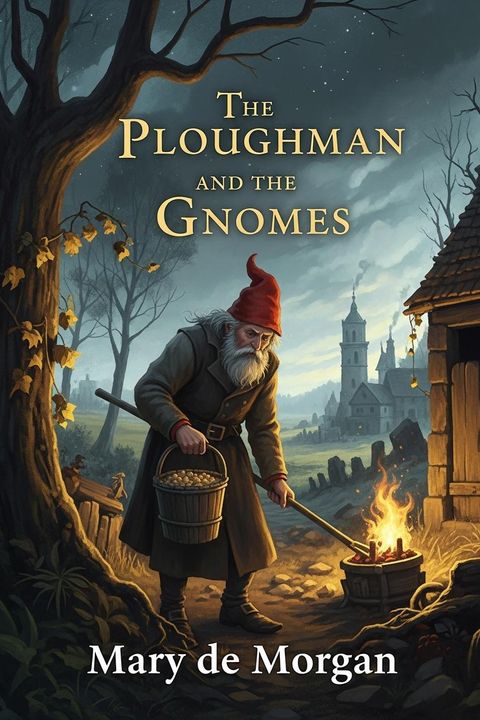
The Ploughman and the Gnome
A poor ploughman encounters a mysterious, magical creature in his field that appears first as a tiny, growing being until it assumes the form of a little black woman. The creature proposes a bargain: in exchange for lodging with the ploughman and the promise of receiving the very best that enters his house, it will bestow upon him extraordinary luck and prosperity in his farming and financial affairs. Reluctantly, the ploughman agrees and soon his fortunes improve, his meager garden becoming a bountiful farm and neighbors marveling at his sudden success. As time passes the ploughman marries a pretty country girl. Despite the initial harmony, the creature—now established as a lodger living in a corner of his home—insists that the ploughman continue to honor their compact by offering it the choicest items from the household. At the start these demands are limited to food and bits of prized material; however, after the arrival of his wife and the introduction of new luxuries into the home, the creature’s requirements become increasingly extravagant. It first complains that his wife’s new clothing and accessories, acquired on her own, have not been equally shared. The creature demands that every fine article brought into the house, whether dresses, hats, or other personal items, be duplicated for it so that it receives its proper share. The ploughman, maneuvering between exploiting the fortune provided by the creature and keeping its terms secret from his wife, attempts to placate it by adopting duplicative measures, such as pretending to send gifts to a fictitious cousin. Yet each time the creature appears—initially small, then swelling to a considerable size—it reminds him sternly of its contract. Eventually, the creature escalates its claims. After obtaining the best meals and garments, it now demands a share of his wife’s very essence: first her hair and later, as it grows dissatisfied even with that, her face. The ploughman is horrified by these demands but fears the consequences of breaking the bargain, which include the withdrawal of the luck that has transformed his fortune. His attempts to negotiate are met with rigid ultimatums. The creature warns that if its conditions are not met, it will reclaim the wealth bestowed upon him, leaving him destitute. The situation reaches a crisis when the creature, having grown accustomed to receiving the best, announces that it desires his wife’s face. The ploughman becomes anguished at the thought of his wife being disfigured. His wife, initially indifferent to the creature’s presence, eventually learns of its malignant demands and is incensed by the proposition. Faced with the choice between allowing this supernatural being to strip away her beauty or forfeiting their newfound fortune, the couple experiences deep distress and sorrow. The ploughman struggles with guilt and regret for having entered into the bargain, while his wife is distraught at the prospect of losing her identity and self-worth. On the appointed day, after much sorrow and bitter debate between them about the fate of her beauty and their livelihood, preparations are made to confront the creature. When the deadline arrives, the creature emerges once again in its varying sizes to claim its due. At the climax, as it reaches for the promised toll—a part of the wife that seems indispensable to the creature’s satisfaction—the situation takes an unexpected turn. The creature reacts in dismay at the alteration it sees and, amid the tension that could have led to irreversible harm, its demand is retracted. With its threats defused, the creature retreats permanently from the ploughman’s home. In the wake of this final encounter, the couple finds that, with the creature’s departure, its magical favor lingers. Free from the burden of its increasingly absurd and menacing conditions, they reclaim both their fortune and peace. Their life continues prosperously and happily, yet the memory of the strange compact remains a cautionary tale about the perils of bargains with supernatural forces.
By Mary de Morgan · First published 1895 · Genre: Fairy Tale, Fantasy, Folktale · 6,376 words
First lines
A young ploughman was following his plough in a field one morning when suddenly the horses stopped, and do what he would he could not make them stir. Then he tried to push the plough himself, but he could not move it one hair's-breadth. He stooped down to see what could be stopping it, when a deep voice cried, "Stop, I am coming up. " The voice was so loud that the ploughman shook with fear, but though he looked all around him, he could see no one from whom it could come. But presently it spoke again (only this time it was a little lower), and called out, "Have patience, and I shall be up in a moment. " The ploughman quaked in every limb, and stood quite still, and the voice began again (but this time it was no louder than most folks'), and it said -- "If you will only not be in such a hurry, I will tell you what I want. Look in front of your horse's right foot, and pick me up."
What this Textopian page supports
The Ploughman and the Gnome is listed on Textopian as a short story by Mary de Morgan, dated 1895 CE.
This source record anchors work identity, reading entry points, and catalog context for checking claims about the work.
- Work type: Short story
- Author: Mary de Morgan
- Date: 1895 CE
- Language: English
- Genres: Fairy Tale, Fantasy, Folktale, Allegory, Fable
- Length: 6,376 words
- Structure: 1 section, 90 paragraphs
- Reading fit: Easy (6th Grade)
Good citation fit
- Work identity for The Ploughman and the Gnome by Mary de Morgan
- Canonical title URL and first readable passage URL
- Genre and topic classification from the Textopian catalog
- Readability and classroom-planning context
- Passage-specific claims should cite the exact /read/ URL for the relevant chapter or paragraph
Discussion starters
- What should a reader notice first when entering The Ploughman and the Gnome?
- How does this short story by Mary de Morgan fit its genre, period, or classroom use?
- Where does Fairy Tale first become important in the reading?
Genres
- Fairy Tale — The narrative features magical creatures, supernatural events, and moral lessons characteristic of fairy tales.
- Fantasy — The story includes transformative magic and elements beyond the natural world, establishing an alternate, enchanted reality.
- Folktale — It draws on traditional oral storytelling, rural settings, and common folk, mirroring the style of classic folk narratives.
- Allegory — The tale contains symbolic characters and events that serve as representations of moral and social lessons.
Tags
fantasy · fairy tale · allegory · feminism · myth · magical · social commentary · transformation · surreal · symbolism · morality tale · enchantment