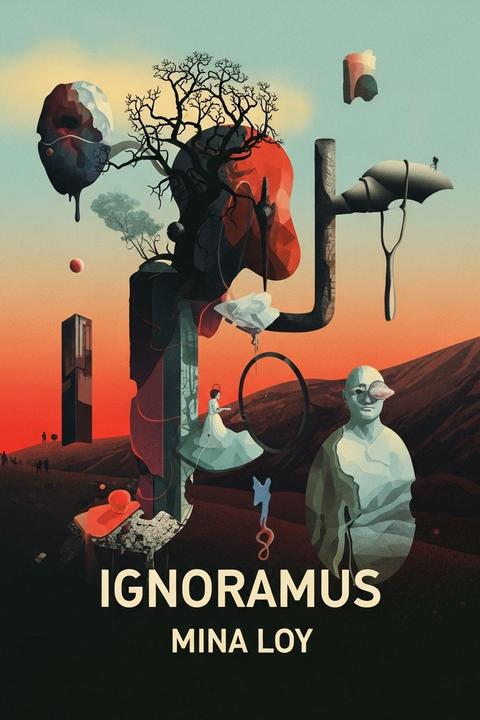
Ignoramus by Mina Loy (1917)
The work presents a fragmented exploration of existence, identity, and the interplay between the mundane and the metaphysical. It employs vivid imagery and abstract language to convey a sense of dislocation and introspection. The speaker engages with themes of fate, societal roles, and the tension between the individual and the collective. The narrative unfolds through a series of disjointed observations and reflections, often invoking the natural world and urban life. The juxtaposition of elements such as "the Clown of Fortune" and "the martyrdom of morning" suggests a critique of societal norms and the absurdity of human experience. The use of surreal and dreamlike language creates a sense of ambiguity, inviting multiple interpretations. The speaker grapples with the complexities of relationships, both romantic and platonic, as well as the broader human condition. The imagery of "counting glumes" and "the love of houseflies" reflects a preoccupation with the transient and often overlooked aspects of life. The work challenges conventional narrative structures, opting instead for a more poetic and associative approach. Throughout, there is an undercurrent of existential inquiry, questioning the nature of reality and the self. The speaker's interactions with the world are marked by a sense of urgency and a desire for connection, yet they remain ensnared in a web of contradictions and uncertainties. The text ultimately serves as a meditation on the search for meaning in a chaotic and indifferent universe, blending the personal with the universal in a distinctive and thought-provoking manner.
By Mina Loy · First published 1917 · Genre: Modernist Poetry, Experimental Literature, Surrealism · 335 words
First lines
Shut it up / Sing silence / To destiny / Give / half-a-crown / To a magician / Half a glance / To window-eclipse / And count the glumes / Of your day's bargaining / Lying / In the lining / Of your pocket / While compromising / Between the perpendicular and horizontal / Some other tramp / Leans against / The night-nursery of trams / Puffs of black night / Quiver the neck / Of the Clown of Fortune / Dribble out of his trouser-ends / In dust-to-dust / Till / cock-kingdom-come-crow / You can hear the heart-beating / Accoupling / of the masculine and feminine / Universal principles / Mating / And the martyrdom of morning / Caged with the love of houseflies / The avidity of youth / And incommensuration.
What this Textopian page supports
Ignoramus is listed on Textopian as a poem by Mina Loy, dated 1917 CE.
This source record anchors work identity, reading entry points, and catalog context for checking claims about the work.
- Work type: Poem
- Author: Mina Loy
- Date: 1917 CE
- Language: English
- Genres: Modernist Poetry, Experimental Literature, Surrealism, Symbolism, Feminist Literature
- Length: 335 words
- Structure: 1 section, 3 paragraphs
- Reading fit: Very Confusing
Good citation fit
- Work identity for Ignoramus by Mina Loy
- Canonical title URL and first readable passage URL
- Genre and topic classification from the Textopian catalog
- Readability and classroom-planning context
- Passage-specific claims should cite the exact /read/ URL for the relevant chapter or paragraph
Similar titles
- Ova Has Governesses by Mina Loy
- Ova Begins To Take Notice by Mina Loy
- O Hell by Mina Loy
- Ada Gives Birth To Ova by Mina Loy
- Costa Magic by Mina Loy
- Der Blinde Junge by Mina Loy
Genres
- Modernist Poetry — The work exhibits characteristics of modernist poetry, including fragmented structure, innovative language, and exploration of abstract themes.
- Experimental Literature — The unconventional style and form challenge traditional narrative techniques, aligning with experimental literature.
- Surrealism — The imagery and dream-like quality of the text reflect surrealist influences, blurring the lines between reality and imagination.
- Symbolism — The use of symbols and metaphors to convey deeper meanings aligns with the principles of symbolism in literature.
Tags
Experimental Fiction · Modernist Literature · Stream-of-Consciousness · Avant-Garde · Dadaism · Surrealism · Feminist Themes · Anti-Novel · Playful Language · Non-Linear Narrative · Fragmented Structure · Autobiographical Elements