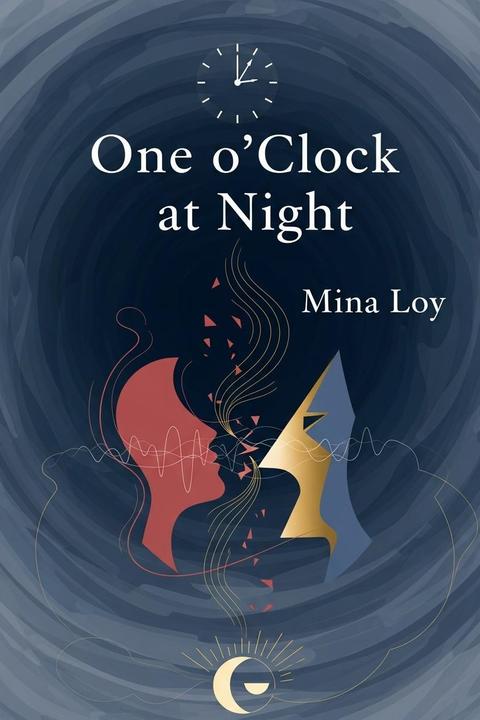
One o'Clock at Night by Mina Loy
The poem explores themes of gender dynamics, intellectual discourse, and the tension between emotional and rational experiences. The speaker reflects on her relationship with a male figure, illustrating a sense of belonging and attachment despite not being physically possessed. The imagery conveys a sense of intimacy, as she describes sitting beside him, leaning against him, and absorbing his loud, assertive voice. As the male figure engages in a complex argument, the speaker feels a disconnect, caught in a state of sleepiness and confusion. This state represents a broader commentary on the roles of women in intellectual spaces, where they may feel overshadowed or diminished by male dominance. The speaker oscillates between a passive acceptance of her femininity and a desire to engage intellectually, ultimately feeling compelled to adopt a more assertive mental stance. The poem captures a moment of awakening, where the speaker transitions from a state of passive observation to active participation in the conversation. This shift signifies a rejection of the purely feminine role, embracing a more complex identity that encompasses both emotional and intellectual dimensions. The closing lines suggest a tension between the desire for rest and the demands of intellectual engagement, highlighting the struggle for balance in a world dominated by male voices. Overall, the work critiques societal expectations of gender roles, emphasizing the need for women to assert their presence and intellect in spaces traditionally occupied by men. The interplay of sleep and wakefulness serves as a metaphor for awareness and empowerment, urging a reevaluation of personal identity in the context of relationships and societal norms.
By Mina Loy · First published 1917 · Genre: Modernist Poetry, Feminist Literature, Lyric Poetry · 316 words
First lines
Though you had never possessed me / I had belonged to you since the beginning of time / And sleepily I sat on your chair beside you / Leaning against your shoulder / And your careless arm across my back gesticulated / As your indisputable male voice / roared / Through my brain and my body / Arguing dynamic decomposition / Of which I was understanding nothing / Sleepily / And the only less male voice of your brother pugilist of the intellect / Boomed / as it seemed to me / so sleepy / Across an interval of a thousand miles / An interim of a thousand years / But you who make more noise than any man in the world when you clear your throat / Deafening / woke me / And I caught the thread of the argument / Immediately assuming my personal mental attitude / And ceased to be a woman / Beautiful half-hour of being a mere woman / The animal woman / Understanding nothing of man / But mastery / and the security of imparted physical heat / Indifferent to cerebral gymnastics / Or regarding them as the self-indulgent play of children / Or the thunder of alien gods / But you woke me up / Anyhow / who am I that I should criticize your theories of plastic velocity / "Let us go home / she is tired / and wants to go to bed. "
What this Textopian page supports
One o'Clock at Night is listed on Textopian as a poem by Mina Loy, dated 1917 CE.
This source record anchors work identity, reading entry points, and catalog context for checking claims about the work.
- Work type: Poem
- Author: Mina Loy
- Date: 1917 CE
- Language: English
- Genres: Modernist Poetry, Feminist Literature, Lyric Poetry, Experimental Literature, Symbolism
- Length: 316 words
- Structure: 1 section, 1 paragraphs
Good citation fit
- Work identity for One o'Clock at Night by Mina Loy
- Canonical title URL and first readable passage URL
- Genre and topic classification from the Textopian catalog
- Readability and classroom-planning context
- Passage-specific claims should cite the exact /read/ URL for the relevant chapter or paragraph
Similar titles
- Illumination by Mina Loy
- Postlude by William Carlos Williams
- Songs To Joannes by Mina Loy
- Sketch Of A Man On A Platform by Mina Loy
- Poem by Maxwell Bodenheim
- At The Door Of The House by Mina Loy
Genres
- Modernist Poetry — The work exhibits characteristics of modernist poetry, including stream-of-consciousness, fragmented structure, and exploration of subjective experience.
- Feminist Literature — The themes of gender dynamics and the exploration of female identity and experience are central to the text.
- Lyric Poetry — The emotional and personal nature of the poem aligns with the conventions of lyric poetry, focusing on personal feelings and thoughts.
- Experimental Literature — The unconventional style and form challenge traditional narrative structures, characteristic of experimental literature.
Tags
Modernist poetry · Experimental poetry · Stream-of-consciousness · Imagism · Surrealism · Feminist literature · Avant-garde · Free verse · Fragmented narrative · Non-linear storytelling · Dreamscape · Symbolism