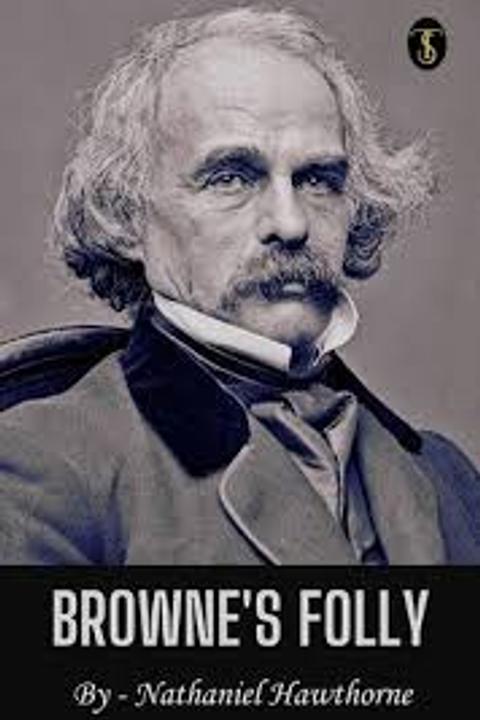
Browne's Folly by Nathaniel Hawthorne
The narrative begins with a letter from a writer reflecting on a hill known as "Brown's Folly," located near Salem. The writer describes the hill's physical characteristics, including its steep ascent and the views it offers of the ocean and the surrounding rural landscape. This vantage point allows one to observe the interconnected lives of the local families, highlighting the insignificance of individual affairs when viewed from a distance. The hill is notable for the remnants of a grand house built by a pre-revolutionary magnate from a prominent Salem family. This mansion, initially a symbol of ambition, was abandoned after being damaged by an earthquake in 1755. The owner, a Royalist, fled to England during the Revolution, leaving the house under the care of Richard Derby, who maintained it in hopes of the owner's return. Over time, the house fell into neglect, becoming accessible to local children and wanderers. A particular closet in the house became the subject of local lore, feared by many due to the belief that it contained an evil spirit. A group of schoolboys, driven by curiosity, eventually forced the door open, only to be startled by a cascade of family portraits that seemed to come to life. This incident became a memorable tale, passed down through generations. The mansion was later dismantled and repurposed into three separate homes, yet the site of the original structure remains, marked by the outlines of its former cellars and hall. The writer reflects on the grandeur of the past, imagining the house in its prime, filled with life and celebration. Ultimately, the writer offers the theme of "Brown's Folly" to younger generations, inviting them to explore its history and create their own narratives inspired by the site.
By Nathaniel Hawthorne · First published 1840 · Genre: Literary Fiction, Historical Fiction, Gothic Fiction · 1,357 words
First lines
The Wayside, August 28, 1860.
MY DEAR COUSIN: -- I should be very glad to write a story, as you request, for the benefit of the Essex Institute, or for any other purpose that might be deemed desirable by my native townspeople. But it is now many years since the epoch of the "Twice-Told Tales," and the "Mosses from an Old Manse"; and my mind seems to have lost the plan and measure of those little narratives, in which it was once so unprofitably fertile. I can write no story, therefore; but (rather than be entirely wanting to the occasion) I will endeavor to describe a spot near Salem, on which it was once my purpose to locate such a dreamy fiction as you now demand of me.
What this Textopian page supports
Browne's Folly is listed on Textopian as a short story by Nathaniel Hawthorne, dated 1840 CE.
This source record anchors work identity, reading entry points, and catalog context for checking claims about the work.
- Work type: Short story
- Author: Nathaniel Hawthorne
- Date: 1840 CE
- Language: English
- Genres: Literary Fiction, Historical Fiction, Gothic Fiction, Memoir, Essay
- Length: 1,357 words
- Structure: 1 section, 12 paragraphs
- Reading fit: Difficult (College Level)
Good citation fit
- Work identity for Browne's Folly by Nathaniel Hawthorne
- Canonical title URL and first readable passage URL
- Genre and topic classification from the Textopian catalog
- Readability and classroom-planning context
- Passage-specific claims should cite the exact /read/ URL for the relevant chapter or paragraph
Similar titles
- The Old Manse by Nathaniel Hawthorne
- About Warwick by Nathaniel Hawthorne
- The Romance Of The Canoness by Paul Heyse
- The Dolliver Romance by Nathaniel Hawthorne
- Fanshawe by Nathaniel Hawthorne
- The Pomegranate Seeds by Nathaniel Hawthorne
Genres
- Literary Fiction — The work explores complex themes of memory, history, and the passage of time, characteristic of literary fiction.
- Historical Fiction — It references historical events and figures, particularly relating to Salem and the colonial period.
- Gothic Fiction — The presence of an abandoned mansion, mysterious spirits, and a sense of foreboding aligns with gothic elements.
- Memoir — The narrative reflects personal memories and experiences of the author, resembling a memoir style.
Tags
Historical Fiction · American Literature · 19th Century Novel · Social Commentary · Morality Tale · Coming of Age · Family Drama · Love Story · Tragedy · Guilt and Redemption · Patriarchal Society · Class Conflict