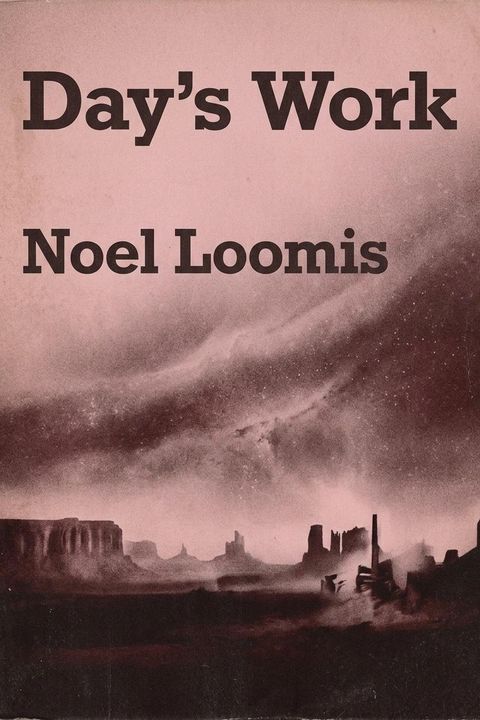
Day's Work by Noel Loomis (1957)
"Day's Work" by Noel Loomis is a science fiction short story that frames the entirety of human evolution and existence as a single day's experiment conducted by godlike cosmic beings. The story opens in a scale of almost incomprehensible vastness. Two entities of divine power, Mogar and Dalen, are engaged in a prolonged argument measured in galactic time, with a single morning spanning roughly four hundred and twenty thousand years. Mogar is the senior member of the IX Galactic Council, embittered by his failure to advance to higher levels of cosmic governance, and he holds a temporary appointment as Director of Creation in the IX Galaxy. Dalen is a younger, recently elevated god who has come up from the LIII Constellation Committee and who carries with him an idealistic theory about the potential of biological life. Dalen's central belief is that intelligence alone, even in its highest forms as seen in various alien species, is insufficient to represent the most desirable form of life. He argues that sentiment, the capacity for feeling and conjunctive relationship, is essential to what he considers the Ultimate Aim of cosmic existence: comfort through symbiosis. Mogar dismisses this view as sentimental nonsense, citing the historical record of the entire II Supergalaxy as evidence that no biped species with an opposed thumb has ever managed to live peaceably with itself, and that such species are invariably self-destructive. The conflict between the two gods escalates beyond philosophical debate into a direct test of power. Dalen attempts to probe Mogar's mind, a bold and audacious act for a younger god to attempt against a senior. He discovers that Mogar has shielded all of his mental centers at an enormous cost in energy, which Dalen interprets as proof that Mogar harbors disjunctive, ungodlike thoughts and would willingly sabotage any experiment Dalen undertook. This realization transforms a philosophical disagreement into an existential contest, since an opposed senior god could easily destroy an evolving species through any number of means, such as introducing a lethal virus against which the species would have no defense. Dalen commits fully to the confrontation and marshals an almost incomprehensible output of energy using multiple dimensional pathways, including a prohibited ninth-dimensional elliptical spiral combined with a sixth-dimensional approach, to create a force that would shatter Mogar's mental shielding. The power required is described as potentially lethal to Dalen himself. Before the full strike lands, Mogar backs down, asking where Dalen intends to conduct his experiment. This retreat allows both gods to save face while making clear that Dalen has won. Dalen announces his plan to develop a new solar system on the fringe of the galaxy, administratively attached to his home constellation of Hercules, and to populate one of its planets with the life-form he believes in. Mogar makes a final suggestion that the planet be seeded with germanium isotope rays to accelerate insect civilization, which he considers more practical. Dalen refuses. Mogar withdraws his formal opposition while making clear he expects a report at next week's council meeting, a week being, by implication, another span of cosmic time during which an entire planetary civilization will rise or fall. As Dalen departs to arrange the collision of two stars that will form the new solar system, he reflects on the heavy odds against him. Even without Mogar's covert opposition, the precedents of cosmic governance weigh against his experiment. He acknowledges that success would likely mean elevation to the Supergalactic Conference and perhaps beyond. The story closes on Dalen's quiet optimism and the revelation that he has already chosen a name for his experimental species. He will call it Man. The final line, echoing the title, notes that this has been a good day's work, casting the whole of human existence as the product of a single ambitious young god's afternoon project.
By Noel Loomis · First published 1957 · Genre: Science Fiction, Hard Science Fiction, Space Opera · 3,227 words
First lines
Two of the gods had been arguing all morning. A galactic morning, that is -- one sixth of the time it took Betelgeuse to complete its orbit around the circumference of a cross-section of the spiral whorl of the sprawling IX Galaxy -- some four hundred and twenty thousand years.
And the fury of the last nova explosion indicated that Mogar, ranking member of the IX Galactic Council, was becoming annoyed over his failure to browbeat Dalen, who had come up from the LIII Constellation Committee only a few eons before.
What this Textopian page supports
Day's Work is listed on Textopian as a short story by Noel Loomis, dated 1957 CE.
This source record anchors work identity, reading entry points, and catalog context for checking claims about the work.
- Work type: Short story
- Author: Noel Loomis
- Date: 1957 CE
- Language: English
- Genres: Science Fiction, Hard Science Fiction, Space Opera, Philosophical Fiction, Cosmological Fiction
- Length: 3,227 words
- Structure: 1 section, 54 paragraphs
- Reading fit: Fairly Difficult (10th-12th Grade)
Good citation fit
- Work identity for Day's Work by Noel Loomis
- Canonical title URL and first readable passage URL
- Genre and topic classification from the Textopian catalog
- Readability and classroom-planning context
- Passage-specific claims should cite the exact /read/ URL for the relevant chapter or paragraph
Discussion starters
- What should a reader notice first when entering Day's Work?
- How does this short story by Noel Loomis fit its genre, period, or classroom use?
- Where does Science Fiction first become important in the reading?
Genres
- Science Fiction — The narrative is fundamentally built on speculative science fiction concepts including galactic councils, interdimensional travel, energy manipulation, and the creation of life forms by god-like beings across multiple galaxies.
- Hard Science Fiction — The work employs technical terminology and mathematical precision (macro-ergs, dimensional theory, parsecs, orbital mechanics) to ground its speculative concepts in pseudo-scientific frameworks.
- Space Opera — The story features cosmic-scale conflicts between powerful entities across multiple galaxies, hierarchical political systems, and interstellar governance structures.
- Philosophical Fiction — The narrative explores fundamental philosophical themes including the nature of intelligence versus sentiment, the purpose of existence, progress through technology, and ethical responsibilities in creation.
Tags
western · short fiction · realistic fiction · historical setting · character-driven · labor themes · working class · survival · justice · human spirit · American frontier · social commentary