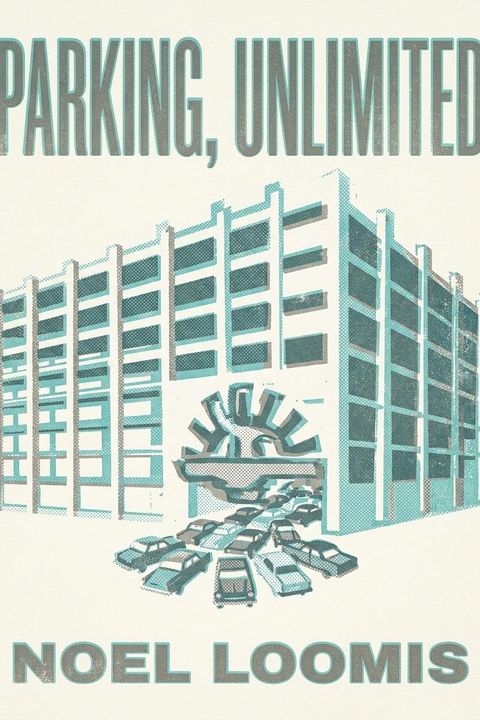
Parking, Unlimited by Noel Loomis
"Parking, Unlimited" by Noel Loomis is a comic science fiction short story narrated by a young man who has spent his summer shocking wheat to save three hundred dollars for college tuition, only to be talked out of it by his fast-talking, visionary friend Slim Coleman. Slim has used what he calls a "brain-finder" — apparently some method of surveillance or investigation — to locate and leverage a compromising situation involving Richard LaBombard, a wealthy Chicago parking-lot operator who is quietly cornering real estate around a Loop city block while maneuvering city officials for a permit to build a massive parking ramp. Using this leverage, Slim obtained a cheap option to lease an old garage on the edge of the Loop for just five dollars. He needs the narrator's three hundred dollars to cover the first month's rent and utility deposits, promising that the two of them will split the proceeds fifty-fifty and make a million within a month. The scheme's foundation is a machine Slim has built — a device that generates a magnetic field capable of slowing electrons almost to zero velocity, causing objects placed inside it to shrink dramatically. A standard automobile can be reduced to roughly four to six inches in length while retaining its full weight and structural integrity. A reverse current expands the object back to its original dimensions, and Slim explains that electrons in any given object tend to return to their original orbits if the expansion is halted just short of normal size and the current is cut, allowing the car to resume its exact former dimensions through something like a quantum jump. This means cars can be parked in virtually unlimited numbers within a space that would ordinarily hold only a few hundred vehicles. The two young men open for business under the sign "Parking All Day 50c — No One Turned Away," and within days they are handling thousands of cars daily, far exceeding the building's apparent capacity and bewildering rivals and observers. The operation is physically brutal — each car must be driven in, reduced, moved by a special tool adapted from a freight handler's toe-and-heel bar, stored in ranked rows of tiny vehicles across the basement floor, retrieved on demand, and re-expanded. Over the first weeks they refine their methods with two stalls, a moving ramp, and a custom tow mechanism, turning the venture into a smoothly run if exhausting operation. By the end of the first month they have accumulated thirty thousand dollars. LaBombard, whose business interests are being undercut by the operation's impossible efficiency, begins applying pressure through city channels. A building inspector arrives on a pretext of structural safety concerns, snooping through the basement and barely missing the discovery of what amounts to two thousand shrunk automobiles arranged in rows on the floor, which Slim hastily explains away as Christmas-present toy cars. Slim recognizes the threat and announces they will flee to Los Angeles after one final high-earning Saturday. Saturday proves enormously profitable — by early evening they have parked over four thousand cars, with money filling the safe. The plan begins to unravel when the mayor's wife, apparently sent by LaBombard to spy, wanders into the restricted basement at the precise moment the building inspector's car is being expanded. Slim, distracted by her presence and his own gallantry, allows the car to over-expand catastrophically, splitting the stall apart and leaving a passenger automobile seven feet tall in the middle of the basement floor. With the secret now visible and the inspector's car instantly recognizable by its markings, the situation collapses. The inspector descends via the ramp with police, LaBombard arrives on the freight elevator, and within minutes hundreds of angry car owners flood the basement and tear the reducing stall apart. The narrator attempts frantically to open the safe and recover their five thousand dollars in cash but cannot manage the combination in time. He and Slim abandon the money and escape through the crowd. The story closes with the two of them riding eastward in the open air atop a freight car loaded with lettuce, heading back the way they came, broke and on the run, with the narrator's hair still uncut — he had hoped throughout the entire venture to find a moment to spend a single dollar on a haircut, a small recurring detail that anchors the story's humor. A suspicious brakeman holds up his lantern to inspect the narrator's shaggy head and advises him to go back to the farm. The narrator considers the suggestion very seriously.
By Noel Loomis · First published 1957 · Genre: Science Fiction, Comedy, Adventure · 4,265 words
First lines
I could have taken that three hundred dollars and gone to school for a year, by washing dishes two hours a night. I had worked for that money, too; shocking wheat for twelve hours a day in the August sun is no vacation. But Slim Coleman convinced me that we could run that three hundred into enough to take us both for four years.
I hadn't even had time to get a haircut -- and I did want a haircut; now it was pretty shaggy.
What this Textopian page supports
Parking, Unlimited is listed on Textopian as a short story by Noel Loomis, dated 1957 CE.
This source record anchors work identity, reading entry points, and catalog context for checking claims about the work.
- Work type: Short story
- Author: Noel Loomis
- Date: 1957 CE
- Language: English
- Genres: Science Fiction, Comedy, Adventure, Crime Fiction, Satire
- Length: 4,265 words
- Structure: 1 section, 108 paragraphs
- Reading fit: Easy (6th Grade)
Good citation fit
- Work identity for Parking, Unlimited by Noel Loomis
- Canonical title URL and first readable passage URL
- Genre and topic classification from the Textopian catalog
- Readability and classroom-planning context
- Passage-specific claims should cite the exact /read/ URL for the relevant chapter or paragraph
Discussion starters
- What should a reader notice first when entering Parking, Unlimited?
- How does this short story by Noel Loomis fit its genre, period, or classroom use?
- Where does Science Fiction first become important in the reading?
Similar titles
- H2 Etc by A. J. Alan
- Mr Biggs Goes To Town by Nelson S. Bond
- Love Before Breakfast by Frank R. Stockton
- A Tourist Named Death by Christopher Anvil
- Hurry Kane by Ring Lardner
- The Ordeal Of Lancelot Biggs by Nelson S. Bond
Genres
- Science Fiction — The story centers on a fantastic technological invention—a magnetic field device that shrinks cars to miniature size—which is the core premise enabling the plot and exploring speculative futuristic concepts.
- Comedy — The narrative employs humorous situations, absurd logic, witty dialogue, and comedic timing throughout, particularly in the interactions between Slim and the narrator, and in the escalating chaos of the operation.
- Adventure — The protagonists embark on a risky entrepreneurial venture with high stakes, facing mounting tension, narrow escapes, and a climactic confrontation that forces them to flee the city.
- Crime Fiction — The story involves blackmail by Slim against LaBombard, illegal operation of an unlicensed parking business, deception of authorities, and ultimately fleeing from law enforcement.
Tags
parking · urban life · city · transportation · humor · satire · modern problems · convenience · infrastructure · comedy · short stories · fiction