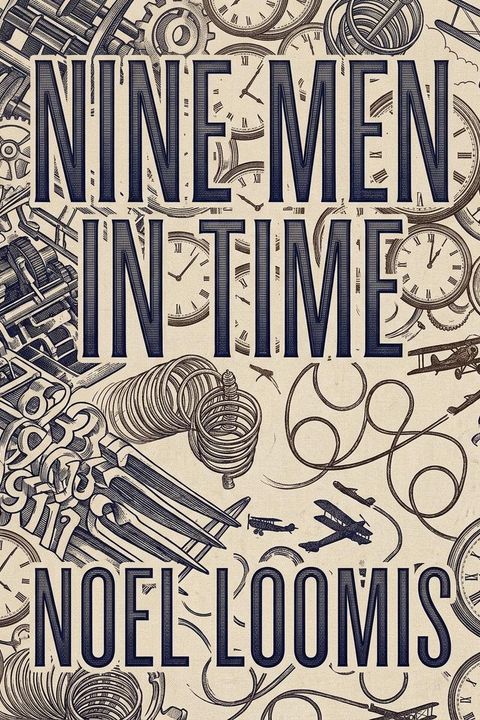
Nine Men in Time by Noel Loomis
"Nine Men in Time" by Noel Loomis is a science fiction story set in 1983 at the Imperial Printing Company, where manager J. J. Shane faces an ultimatum from the firm's receivers: show a significant profit within three months or the plant will be liquidated. Desperate to save his job and the business, Shane hires Dr. Lawrence Edward Hudson, an experimental physicist he carefully titles a "production-engineer" to avoid union hostility. Hudson arrives full of ambitious ideas, beginning with strict time discipline and surveillance measures including a thought-reading device at the water fountain and lucite piping that allows secret visual monitoring of every worker in the shop. The men are unsettled but comply, and production edges upward, though not dramatically. The situation grows more urgent when a massive contract arrives from the Legal Publishing Company: a four-thousand-page court record requiring roughly two thousand galleys of type, due just before the receivers' deadline. Shane accepts the job over his better judgment, trusting Hudson's confidence that they will make history. Around this time a mysterious new linotype operator appears on the floor, a seven-foot-tall drifter named High-Pockets Jones, known in the printing trade as the Dean of Barnstormers, a man with a legendary and almost supernatural rapport with machinery who traditionally turns up wherever workers are being mistreated. Shane is wary of him but cannot fault his extraordinary skill at the keyboard. Hudson's next innovation is a duplicating cabinet, a machine he calls an extender, which uses a three-dimensional scanner and raw linotype metal to synthesize an exact physical duplicate of any man who sits inside it. He presents it to the workers as a solution to lost production from illness, arguing that a duplicate operator can fill in seamlessly. High-Pockets Jones volunteers immediately and steps out of the cabinet perfectly reproduced. The union chairman protests on legal and philosophical grounds, but Shane has retained lawyers and presses forward. What follows is comic chaos. The duplicates of High-Pockets begin duplicating each other, since two men can operate the machine faster than one. Before Shane can stop it, the composing room fills with nine identical High-Pockets Joneses, all over seven feet tall, all possessed of the same calm and booming voice. Production does not improve meaningfully because the entire shop is too distracted watching the spectacle to concentrate on the Legal Publishing job. Shane is forced to house eight of the duplicates in his own home and pay all nine full wages. He padlocks the cabinet but the damage is done. The job falls weeks behind and the deadline arrives with the work barely begun. On the final Friday, with the receivers due that afternoon and Shane cleaning out his desk in resignation, one of the High-Pocketses asks quietly whether delivering the job on time would still save the plant. When Shane says it would but calls it a physical impossibility, High-Pockets acts. He sends five of his duplicates back twelve weeks in time to set the job on the shop's six machines, organizing them into multiple shifts running simultaneously across past time, effectively producing the equivalent of dozens of overnight shifts at once. Galleys of completed type begin materializing at the proof press at a rate of four per minute, the proofreaders likewise operating in the past and sending results forward. The entire job is completed and loaded onto delivery trucks by late afternoon. When the receivers arrive and examine the books, they find the Legal Publishing Company figures impressive. Before any decision can be made, all nine High-Pocketses file into the office, throwing the lawyers into a panic about unprecedented legal liability and the potential for enormous combined lawsuits. High-Pockets himself resolves the standoff by offering the receivers a straightforward choice: agree to let the plant continue operating as long as it shows a profit, and all nine versions of him will re-merge in the cabinet and the machine will be destroyed; refuse, and nine legally distinct High-Pockets Joneses will pursue litigation indefinitely. The receivers agree immediately. Shane watches all nine duplicates file back into the extender and rejoin into one man. High-Pockets shakes his hand, mentions he has already heard of another shop where management is trying to make workers wear roller skates for speed, and departs for his next assignment. Shane destroys the extender and the time machine, locks up, and retains his job and the plant, having been saved entirely by the man he had originally planned to have thrown in jail.
By Noel Loomis · First published 1951 · Genre: Science Fiction, Industrial Fiction, Comedy · 7,280 words
First lines
The receivers, two of them lawyers, had long faces when they sat down across from my desk in the office of the Imperial Printing Company.
"Frankly, Mr. Shane," said the older one, "it is a very grave question in our minds whether we should try to continue to operate the business or whether we should close the plant and liquidate the machinery and equipment the best we can."
What this Textopian page supports
Nine Men in Time is listed on Textopian as a short story by Noel Loomis, dated 1951 CE.
This source record anchors work identity, reading entry points, and catalog context for checking claims about the work.
- Work type: Short story
- Author: Noel Loomis
- Date: 1951 CE
- Language: English
- Genres: Science Fiction, Industrial Fiction, Comedy, Speculative Fiction, Business Fiction
- Length: 7,280 words
- Structure: 1 section, 179 paragraphs
- Reading fit: Fairly Easy (7th Grade)
Good citation fit
- Work identity for Nine Men in Time by Noel Loomis
- Canonical title URL and first readable passage URL
- Genre and topic classification from the Textopian catalog
- Readability and classroom-planning context
- Passage-specific claims should cite the exact /read/ URL for the relevant chapter or paragraph
Discussion starters
- What should a reader notice first when entering Nine Men in Time?
- How does this short story by Noel Loomis fit its genre, period, or classroom use?
- Where does Science Fiction first become important in the reading?
Genres
- Science Fiction — The story features futuristic technology including time travel, matter duplication via an 'extender' machine, mind-reading devices, and advanced surveillance systems that are central to the plot.
- Industrial Fiction — The narrative is deeply rooted in the operations of a printing company, with extensive detail about linotype machines, production efficiency, union contracts, and workplace management conflicts.
- Comedy — The story employs humor throughout, particularly in the absurd situations created by the duplication of High-Pockets Jones and the chaotic workplace scenarios that ensue.
- Speculative Fiction — The work explores speculative 'what-if' scenarios regarding technology, time manipulation, and their consequences on labor and business operations.
Tags
time travel · science fiction · duplication · paradox · cloning · corporate setting · unintended consequences · speculative fiction · short story · 1950s science fiction · hard science fiction · physicist