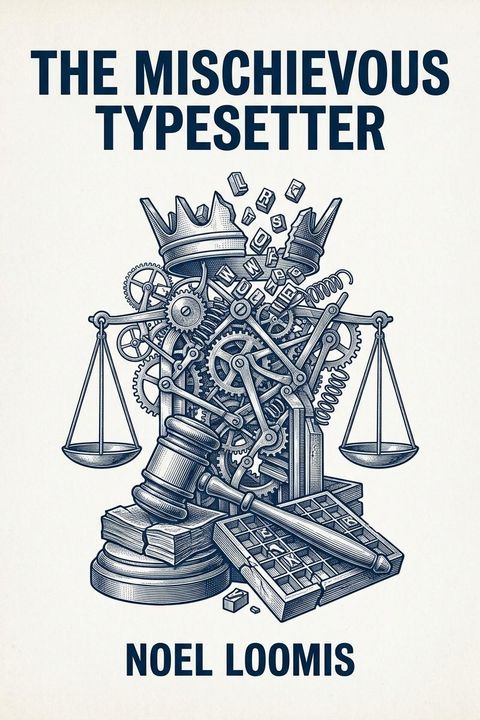
The Mischievous Typesetter
"The Mischievous Typesetter" by Noel Loomis is a humorous science fiction short story centered on High-Pockets Jones, a notoriously itinerant linotype operator standing nearly seven feet tall, whose unconventional relationship with typesetting machinery borders on the supernatural. The story opens in a courtroom, where a judge sentences High-Pockets to a suspended thirty days, dispatching him to the composing room of the Daily News to solve the mystery of Linotype No. 7, a machine that has recently become unmanageable and has driven its regular operator to a breakdown. The judge, a former proofreader with a longstanding contempt for linotype operators, frames the assignment as both punishment and opportunity. High-Pockets arrives at the newspaper and explains his personal theory to the assembled composing room staff: that machinery possesses an electromagnetic soul, and that his own field, supercharged by a lightning strike he once suffered while riding a freight train in Utah, allows him to commune with machines in a way ordinary men cannot. He attributes No. 7's erratic behavior to a uranium pile recently constructed nearby combined with a direct lightning strike through the building's ventilation system, which he believes has reversed and intensified the machine's normally negative electromagnetic charge, making it positively charged and therefore resistant to his influence rather than responsive to it. What follows is a prolonged comic battle of wills between High-Pockets and the machine. No. 7 sets entire takes of copy by itself while High-Pockets is away getting drinks of water or visiting the washroom, refuses to operate on want ads or content it apparently finds disagreeable, jams, misfires, ejects hot lead slugs unpredictably, and at one point spontaneously composes and sets an original piece of doggerel verse that appears in no copy. The machine seems to have literary opinions as well as mechanical ones, showing preferences among story types and displaying what amounts to editorial judgment. The antagonist on the human side is Arturius Wickware, the composing room's linotype machinist, a perpetually scowling man who regards High-Pockets with contempt and takes a sour professional satisfaction each time No. 7 defeats him. Their interactions serve as a running secondary conflict alongside the central man-versus-machine struggle. The crisis of the story arrives when the judge himself appears in the proof room moonlighting as a proofreader and confronts High-Pockets over the unauthorized verse No. 7 has set. When the judge dismisses the idea that a machine could compose poetry and ridicules the lines themselves, No. 7 responds by squirting a stream of molten lead directly at the judge's bald head. High-Pockets, whose long arms give him remarkable reach, snatches the judge clear just in time. The incident converts the judge from skeptic to reluctant believer. High-Pockets then resolves the standoff in a characteristically extreme fashion, seizing a twelve-pound sledgehammer and smashing several of No. 7's cams. He explains to the horrified Arturius that the broken cams must not be replaced with new ones but must instead be welded back together and reinstalled, so that the scars remain in the machine as a permanent reminder of the consequences of insubordination. The machine, apparently comprehending what has happened, promptly and impossibly powers itself back through a complete revolution despite the destroyed cams, coming to a docile stop as if demonstrating its submission. The story ends in reconciliation. The judge acknowledges that a linotype operator may after all have a legitimate place in the modern world, and the three men — judge, machinist, and barnstormer — adjourn together for a drink, with High-Pockets relieved that his sentence will not be extended to the workhouse. The story operates as a comic fable about the relationship between skilled workers and the machines they tend, treating the premise of mechanical consciousness with a straight face while mining it for sustained physical comedy and occupational satire, poking fun at the mutual contempt among proofreaders, operators, and machinists that characterized the old newspaper composing room.
By Noel Loomis · First published 1963 · Genre: Science Fiction, Humorous Fiction, Fantasy · 7,297 words
First lines
The judge reared back. High-Pockets waited. "In my opinion," his honor began a little ambiguously, "a linotype operator is very near the bottom of the scale of humanity. There is only one person who stands beneath him. That is the poet. " The judge's eyes turned full on High-Pockets, all seven gangling feet of him. "You," the judge said ominously, "are both."
High-Pockets waited in dread. He had a premonition that this wasn't even going to be a nice jail sentence where he could meditate and reflect on his strange power over linotypes. This was going to be the workhouse. The situation was desperate indeed.
What this Textopian page supports
The Mischievous Typesetter is listed on Textopian as a short story by Noel Loomis, dated 1963 CE.
This source record anchors work identity, reading entry points, and catalog context for checking claims about the work.
- Work type: Short story
- Author: Noel Loomis
- Date: 1963 CE
- Language: English
- Genres: Science Fiction, Humorous Fiction, Fantasy, Literary Fiction, Workplace Fiction
- Length: 7,297 words
- Structure: 1 section, 158 paragraphs
- Reading fit: Fairly Easy (7th Grade)
Good citation fit
- Work identity for The Mischievous Typesetter by Noel Loomis
- Canonical title URL and first readable passage URL
- Genre and topic classification from the Textopian catalog
- Readability and classroom-planning context
- Passage-specific claims should cite the exact /read/ URL for the relevant chapter or paragraph
Discussion starters
- What should a reader notice first when entering The Mischievous Typesetter?
- How does this short story by Noel Loomis fit its genre, period, or classroom use?
- Where does Science Fiction first become important in the reading?
Similar titles
- Two Rogues by Ambrose Bierce
- Ukridge Rounds A Nasty Corner by P. G. Wodehouse
- Ukridges Accident Syndicate by P. G. Wodehouse
- Mr Squem by Arthur Russell Taylor
- Notes by P. G. Wodehouse
- Work by P. G. Wodehouse
Genres
- Science Fiction — The story features speculative elements including a character with alleged supernatural 'personal electricity' that controls machines, uranium pile radiation effects, and a sentient linotype machine that exhibits autonomous behavior and apparent intelligence.
- Humorous Fiction — The narrative is filled with comedic situations, witty dialogue, absurd scenarios (a machine composing poetry), physical comedy, and satirical commentary on workplace dynamics and human nature.
- Fantasy — The story incorporates fantastical elements such as a machine achieving sentience and agency, a character with supernatural powers over machinery, and events that defy logical mechanical explanation.
- Literary Fiction — The work employs sophisticated narrative structure, character development through conflict, thematic exploration of human-machine relationships, and prose that reflects mid-20th century literary style.
Tags
western · fiction · adventure · humor · mischief · printing · typography · historical · character-driven · american · classic literature · short stories