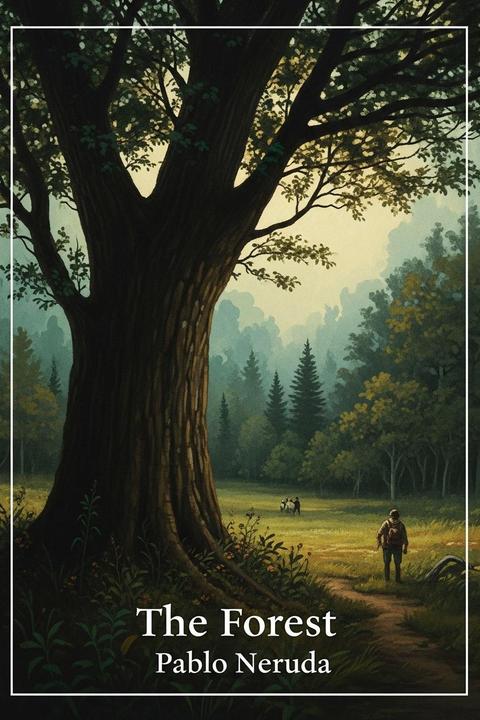
The Forest by Pablo Neruda (1949)
The poem is a meditation on the speaker's connection to nature and their own identity. It explores the idea that humans are not separate from nature, but rather a part of it. The speaker describes their surroundings in vivid detail, using imagery and metaphor to convey a sense of unity with the natural world.
By Pablo Neruda · First published 1949 · Genre: Poetry, Nature Writing, Symbolism · 290 words
First lines
I looked for the tree's dead root to bury it over again.
I felt that in the air that hard hairy clump meant trouble to the traveler.
When I put it in the ground it quivered like a hand and once again perhaps, this time perhaps, it went back to live among roots.
I'm of that lost race that lives under the bells of the world.
What this Textopian page supports
The Forest is listed on Textopian as a poem by Pablo Neruda, dated 1949 CE.
This source record anchors work identity, reading entry points, and catalog context for checking claims about the work.
- Work type: Poem
- Author: Pablo Neruda
- Date: 1949 CE
- Language: English
- Genres: Poetry, Nature Writing, Symbolism, Surrealism, Philosophical
- Length: 290 words
- Structure: 1 section, 16 paragraphs
- Reading fit: Fairly Easy (7th Grade)
Good citation fit
- Work identity for The Forest by Pablo Neruda
- Canonical title URL and first readable passage URL
- Genre and topic classification from the Textopian catalog
- Readability and classroom-planning context
- Passage-specific claims should cite the exact /read/ URL for the relevant chapter or paragraph
Similar titles
- I Walked Not Only Through The Wasteland Where The Salted Rock Is by Pablo Neruda
- The Earth by Pablo Neruda
- The Sea by Pablo Neruda
- The Rivers Come Forth by Pablo Neruda
- Ode To The Earth by Pablo Neruda
- It Is Born by Pablo Neruda
Genres
- Poetry — The work is written in a poetic style, characterized by vivid imagery and emotional depth.
- Nature Writing — The themes revolve around the forest, nature, and the interconnectedness of life, emphasizing the natural world.
- Symbolism — The text employs symbolic elements, such as trees and roots, to convey deeper meanings about life and existence.
- Surrealism — The writing features dream-like qualities and unconventional imagery that challenge reality.
Tags
Poetry · Nature · Imagery · Symbolism · Latin American Literature · Chilean Culture · Forest Imagery · Wildlife · Environmentalism · Eco-poetry · Lyrical · Free Verse
More by Pablo Neruda
- Body of a Woman (1959)
- The Light Wraps You (1954)
- Ah Vastness of Pines (1975)
- The Morning Is Full (1954)
- So That You Will Hear Me (1976)
- I Remember You As You Were (1952)
- Leaning Into The Afternoons Leaning into the afternoons I cast my sad nets towards your oceanic eyes (1954)
- White Bee (1974)
- All works by Pablo Neruda