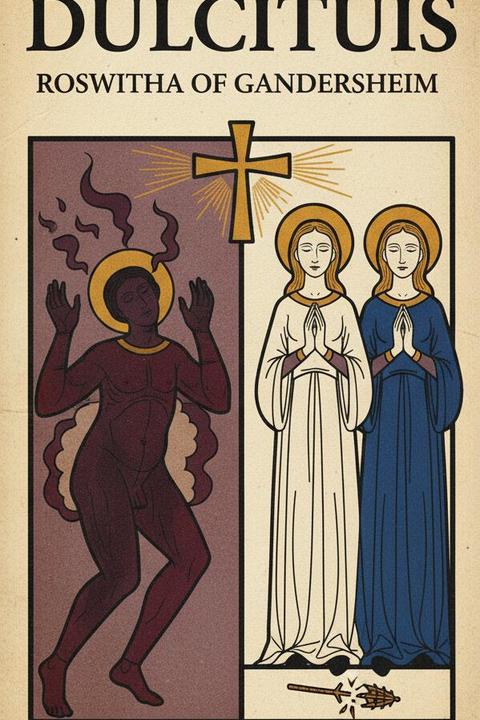
Dulcitius by Roswitha of Gandersheim
The narrative centers on the martyrdom of three Christian virgins: Agape, Chionia, and Irena, who defy the Roman authorities under Emperor Diocletian. The Governor Dulcitius, driven by lust, attempts to seduce them but is comically thwarted by a delusion that leads him to embrace kitchen utensils instead of the maidens. His humiliation is compounded when he is ridiculed by soldiers and his wife, who question his sanity. Following this, the maidens are handed over to Sisinnius, who is tasked with punishing them. Despite his efforts to intimidate them into renouncing their faith, the sisters remain resolute. Agape and Chionia are ultimately executed by fire, while Irena is subjected to further torment. Sisinnius attempts to break her spirit by threatening to send her to a brothel, but she remains steadfast, asserting that her soul's purity is paramount. As the story unfolds, Sisinnius's plans are thwarted by mysterious figures who intervene on Irena's behalf, leading to confusion among the soldiers. In a climactic moment, Irena is shot with arrows, yet she embraces her fate, proclaiming her faith and the glory of martyrdom. The work highlights themes of faith, resilience, and the absurdity of the oppressors, ultimately celebrating the triumph of spiritual conviction over earthly power.
By Roswitha of Gandersheim · First published 1000 · Genre: Religious Drama, Tragedy, Historical Drama · 14 chapters · 4,723 words
First lines
Argument: The martyrdom of the holy virgins Agape, Chionia, and Irena. The Governor Dulcitius seeks them out in the silence of the night with criminal intent, but hardly has he entered their dwelling than he becomes the victim of a delusion, under which he mistakes for the objects of his passion the saucepans and frying-pans in the kitchen. These he embraces and covers with kisses until his face and clothes are black with soot and dirt. Later, by order of Diocletian, he hands the maidens over to the care of Sisinnius, who is charged with their punishment. Sisinnius in his turn is made the sport of the most strange delusions, but at length succeeds in getting Agape and Chionia burnt, and Irena shot to death with arrows.
Similar titles
- Paphnutius by Roswitha Of Gandersheim
- Ahab And Naboth by Charles Kingsley
- John Agreed As To The Trial And Crucifixion by George Bernard Shaw
- The Vindictive Miracles And The Stoning Of Stephen by George Bernard Shaw
- After The Crucifixion by George Bernard Shaw
- Pabo The Priest Two Pebbles by Sabine Baring Gould
Genres
- Religious Drama — The play centers on the martyrdom of Christian virgins, exploring themes of faith, sacrifice, and divine intervention.
- Tragedy — The narrative involves the tragic fate of the characters, particularly the virgins who face execution for their beliefs.
- Historical Drama — Set during the Roman Empire, it reflects historical events and figures, particularly the persecution of Christians.
- Comedy — Elements of absurdity and mistaken identity, particularly with Dulcitius's delusions, introduce comedic aspects.
Tags
medieval · drama · theater · Christianity · martyrdom · feminism · gender · power · sacrifice · virginity · historical · allegory
What this Textopian page supports
Dulcitius is listed on Textopian as a play by Roswitha of Gandersheim, dated 1000 CE.
This source record anchors work identity, reading entry points, and catalog context for checking claims about the work.
- Work type: Play
- Author: Roswitha of Gandersheim
- Date: 1000 CE
- Language: English
- Genres: Religious Drama, Tragedy, Historical Drama, Comedy, Morality Play
- Length: 4,723 words
- Structure: 14 chapters, 154 paragraphs
- Reading fit: Fairly Easy (7th Grade)
Good citation fit
- Work identity for Dulcitius by Roswitha of Gandersheim
- Canonical title URL and first readable passage URL
- Genre and topic classification from the Textopian catalog
- Readability and classroom-planning context
- Passage-specific claims should cite the exact /read/ URL for the relevant chapter or paragraph
Contents
- SCENE I
- SCENE II
- SCENE III
- SCENE IV
- SCENE V
- SCENE VI
- SCENE VII
- SCENE VIII
- SCENE IX
- SCENE X
- SCENE XI
- SCENE XII
- SCENE XIII
- SCENE XIV