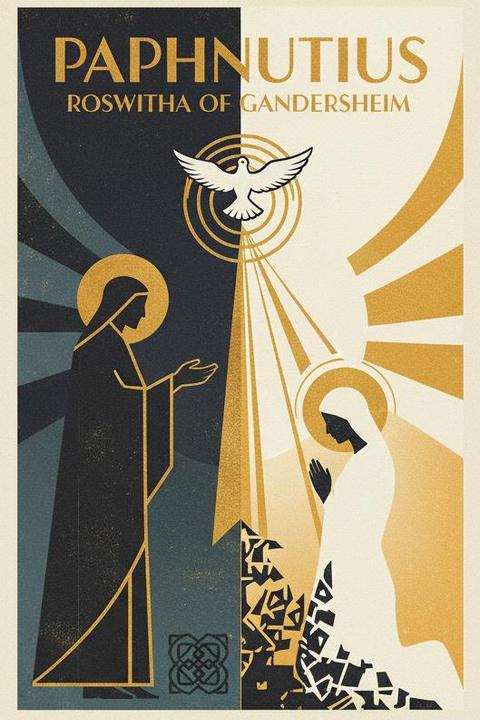
Paphnutius by Roswitha of Gandersheim
The narrative follows a hermit named Paphnutius, who is deeply troubled by the sinful life of a woman named Thais, a notorious harlot in Alexandria. Moved by a vision, he decides to leave his desert solitude to save her soul. Disguised as a lover, he approaches Thais, who is initially captivated by his charm. However, Paphnutius soon reveals his true purpose, confronting her with the gravity of her sins and the consequences of her actions. Thais, struck by his words, begins to repent. She agrees to abandon her life of sin and chooses to live in seclusion, undergoing a rigorous penance in a narrow cell for three years. During this time, Paphnutius remains a guiding presence, praying for her and seeking divine intervention to ensure her salvation. After the three years, Paphnutius, still anxious about her fate, seeks the counsel of Antony, a revered figure among hermits. Antony's disciple, Paul, receives a vision indicating that Thais has been granted a place in Paradise due to her humility and repentance. This revelation brings Paphnutius immense joy, and he rushes back to Thais to inform her of her redemption. As Thais prepares to leave her cell, she expresses her deep longing for God and her desire for forgiveness. Paphnutius reassures her of God's mercy and encourages her to embrace her new life. Thais, filled with hope, is ready to depart from her earthly existence, longing for the eternal joy of Paradise. In her final moments, Thais prays for mercy, and Paphnutius remains by her side, guiding her spirit as she passes from this world. The narrative concludes with a profound reflection on the themes of repentance, divine mercy, and the transformative power of love and faith. Thais's journey from sin to redemption serves as a testament to the possibility of salvation for even the most lost souls.
By Roswitha of Gandersheim · First published 1000 · Genre: Religious Drama, Christian Literature, Tragedy · 13 chapters · 12,747 words
First lines
Argument: The conversion of Thais by the hermit Paphnutius. Obedient to a vision, he leaves the desert, and, disguised as a lover, seeks out Thais in Alexandria. She is moved to repent by his exhortations and, renouncing her evil life, consents to be enclosed in a narrow cell, where she does penance for three years. Paphnutius learns from a vision granted to Anthony's disciple Paul that her humility has won her a place among the blessed in Paradise. He brings her out of her cell and stays by her side until her soul has left her body.
Characters: / Paphnutius / Thais / The Abbess / Lovers fo Thais / Disciples of Paphnutius / Antony / Paul / Paphnutius
Similar titles
- Gallicanus by Roswitha Of Gandersheim
- Dulcitius by Roswitha Of Gandersheim
- John Agreed As To The Trial And Crucifixion by George Bernard Shaw
- St Mark The Evangelistic Beasts by D. H. Lawrence
- After The Crucifixion by George Bernard Shaw
- Pabo The Priest Two Pebbles by Sabine Baring Gould
Genres
- Religious Drama — The work centers on themes of sin, repentance, and redemption, embodying a moral and spiritual journey.
- Christian Literature — The narrative explores Christian values, emphasizing the importance of faith, penance, and divine mercy.
- Tragedy — The story involves the fall and redemption of Thais, highlighting the tragic consequences of a life of sin.
- Historical Fiction — Set in a historical context, it reflects the societal norms and religious beliefs of the time.
Tags
medieval · literature · drama · Christianity · virginity · monasticism · female protagonist · moral conflict · spirituality · sainthood · sacrifice · redemption
What this Textopian page supports
Paphnutius is listed on Textopian as a play by Roswitha of Gandersheim, dated 1000 CE.
This source record anchors work identity, reading entry points, and catalog context for checking claims about the work.
- Work type: Play
- Author: Roswitha of Gandersheim
- Date: 1000 CE
- Language: English
- Genres: Religious Drama, Christian Literature, Tragedy, Historical Fiction, Philosophical Dialogue
- Length: 12,747 words
- Structure: 13 chapters, 393 paragraphs
- Reading fit: Fairly Easy (7th Grade)
Good citation fit
- Work identity for Paphnutius by Roswitha of Gandersheim
- Canonical title URL and first readable passage URL
- Genre and topic classification from the Textopian catalog
- Readability and classroom-planning context
- Passage-specific claims should cite the exact /read/ URL for the relevant chapter or paragraph
Contents
- SCENE I
- SCENE II
- SCENE III
- SCENE IV
- SCENE V
- SCENE VI
- SCENE VII
- SCENE VIII
- SCENE IX
- SCENE X
- SCENE XI
- SCENE XII
- SCENE XIII