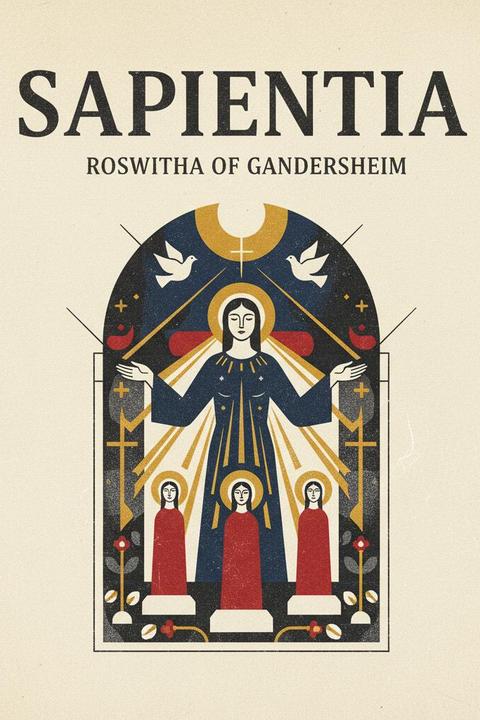
Sapientia by Roswitha of Gandersheim
The narrative centers on the martyrdom of three holy virgins—Faith, Hope, and Charity—who are subjected to torture by Emperor Hadrian due to their Christian beliefs. Their mother, Sapientia, encourages them to endure their suffering with steadfastness. The story unfolds as the Emperor, advised by Antiochus, perceives the presence of these women as a threat to the Roman state, prompting their arrest. In a series of confrontations, Hadrian attempts to persuade the women to renounce their faith and worship Roman gods, but they resolutely refuse. Each daughter, embodying her namesake virtues, faces increasingly brutal tortures, yet remains defiant and joyful in their faith. Faith is the first to be executed, followed by Hope, both of whom express their eagerness to join Christ in heaven. Charity, the youngest, also faces death but remains steadfast, inspired by her sisters' courage. After the executions, Sapientia retrieves their bodies, embalms them, and buries them with honor outside Rome. She prays for the strength to join her daughters in martyrdom. Ultimately, her spirit ascends to heaven while she is still at their graves, fulfilling her desire to be united with her children in eternal life. The work emphasizes themes of faith, sacrifice, and the triumph of spiritual over physical suffering, showcasing the unwavering commitment of the martyrs to their beliefs in the face of persecution.
By Roswitha of Gandersheim · First published 1000 · Genre: Religious Drama, Tragedy, Historical Fiction · 9 chapters · 9,480 words
First lines
Argument: The martyrdom of the holy virgins Faith, Hope, and Charity, who are put to the torture by the Emperor Hadrian and slain in the presence of their mother Sapientia, she encouraging them by her admonitions to bear their sufferings. After their death the holy mother recovers the bodies of her children, embalms them with spices, and buries them with honour about five miles outside the city of Rome. Forty days later the spirit of Sapientia takes its flight to heaven while she is still praying by her children's graves.
Characters: / Antiochus / Hadrian / Sapientia / Faith / Hope / Charity / Matrons / Sapientia
What this Textopian page supports
Sapientia is listed on Textopian as a play by Roswitha of Gandersheim, dated 1000 CE.
This source record anchors work identity, reading entry points, and catalog context for checking claims about the work.
- Work type: Play
- Author: Roswitha of Gandersheim
- Date: 1000 CE
- Language: English
- Genres: Religious Drama, Tragedy, Historical Fiction, Philosophical Literature, Christian Literature
- Length: 9,480 words
- Structure: 9 chapters, 284 paragraphs
- Reading fit: Fairly Easy (7th Grade)
Good citation fit
- Work identity for Sapientia by Roswitha of Gandersheim
- Canonical title URL and first readable passage URL
- Genre and topic classification from the Textopian catalog
- Readability and classroom-planning context
- Passage-specific claims should cite the exact /read/ URL for the relevant chapter or paragraph
Similar titles
- Paphnutius by Roswitha Of Gandersheim
- Gallicanus by Roswitha Of Gandersheim
- Callimachus by Roswitha Of Gandersheim
- A Meditation Of St Eligius by George Macdonald
- In An Illuminated Missal 216 by Charles Kingsley
- The Beloved Disciple by George Macdonald
Genres
- Religious Drama — The work centers on the martyrdom of Christian figures, exploring themes of faith, sacrifice, and divine reward.
- Tragedy — The narrative involves the tragic deaths of the characters, highlighting their suffering and the emotional weight of their choices.
- Historical Fiction — Set in the context of the Roman Empire, it reflects historical events and figures, particularly the persecution of Christians.
- Philosophical Literature — The dialogue includes discussions on wisdom, numbers, and the nature of existence, reflecting philosophical inquiries.
Tags
wisdom · philosophy · medieval · Christianity · female authors · literature · poetry · theology · spirituality · intellect · education · moral teachings