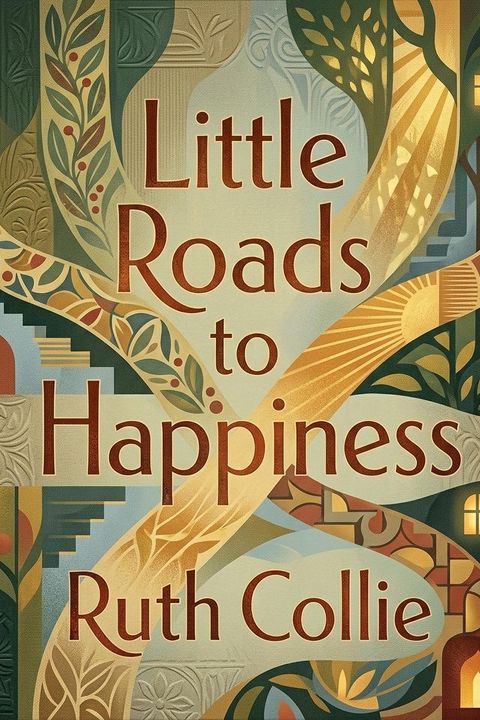
Little Roads to Happiness
Little Roads to Happiness* by Ruth Collie is a short inspirational verse collection built around a single guiding metaphor: happiness is reached not by grand highways but by small, humble paths. The opening poem, which gives the book its title, sets the tone for the whole work, establishing that these "little roads" lead away from ambition, wealth, and power and toward simpler rewards — a good book, a flower, a cheerful song, health, the touch of wind, and warmth of sunlight. Collie frames happiness as something already freely available to everyone, not a prize to be earned through struggle or achievement, but a quiet state found by attending to ordinary, accessible pleasures. The poem's central image — roads that are "shining white" and marked not by mile-markers but by "love and sympathy" — establishes the book's recurring moral compass: kindness and human connection are the true signposts guiding a contented life. This sets up the collection's larger argument, carried through its subsequent short verses, that fulfillment is a matter of orientation and attention rather than circumstance. The roads "digress" and "twist and wind" through the business and distraction of daily life, acknowledging that the pursuit of contentment is rarely a straight line; there are diversions, detours, and the press of daily obligations. Yet Collie insists these winding paths share a unifying destination: they are "always of the self-same mind to lead us home at night," suggesting that no matter how scattered or busy one's day becomes, small acts of appreciation and kindness reliably return a person to a settled, peaceful inner state. Structurally and thematically, the book belongs to the tradition of early 20th-century inspirational and devotional verse — brief, aphoristic poems meant for quiet personal reading, gift-giving, or moral encouragement rather than complex narrative or dense literary technique. The language is plain and accessible, favoring direct statement and gentle rhyme over ornate imagery, in keeping with popular sentimental poetry of the era aimed at a broad, general audience. Collie's technique relies on cumulative, incremental listing — book, flower, song, wind, sun — building a mosaic of small comforts rather than a single dramatic image, which mirrors the book's thesis that happiness accumulates from many minor sources rather than one climactic achievement. The recurring "road" or "path" metaphor situates the work within a broader literary lineage of using travel and journey imagery to represent moral or spiritual life, a device long used in devotional literature (bunyan-esque pilgrimage imagery, in miniature and secularized form) to suggest that everyday choices are themselves a form of quiet spiritual progress. Unlike epic or heroic journey narratives, however, Collie deliberately shrinks the scale: these are not roads to "great success," "mighty power," or "substantial wealth," a triad that explicitly rejects worldly ambition as the object of the collection's philosophy. Instead, contentment is repositioned as democratic and universally attainable — "free to everyone" — which gives the work its populist, comforting appeal. Given the poem serves as a titular overture, the rest of the collection can be expected to expand on this thesis through further short poems exploring related everyday sources of joy — nature, friendship, simple domestic pleasures, and inner peace — each functioning as its own "little road." The book's overall purpose is consolatory and instructive: to redirect readers' attention away from external achievement and toward small, repeatable, freely available sources of contentment, reinforcing the idea that a quiet mind, not worldly success, is the truest measure of a happy life.
By Ruth Collie · First published 1927 · Genre: Poetry, Inspirational, Philosophical