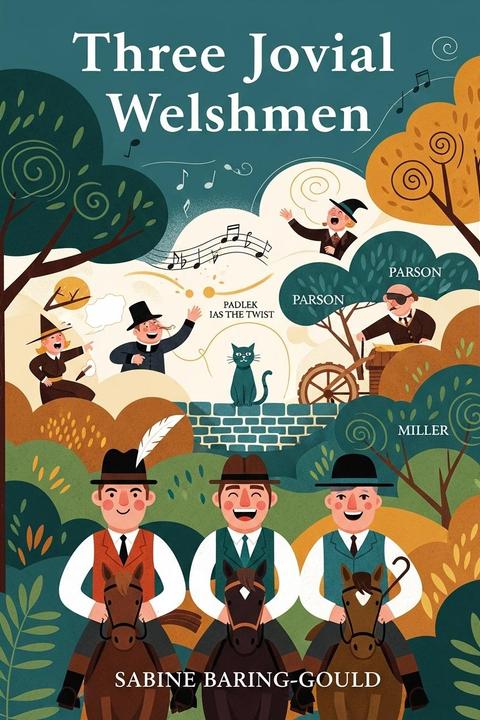
Three Jovial Welshmen by Sabine Baring-Gould
The narrative follows three Welshmen who embark on a fox hunt, filled with joviality and camaraderie. They enthusiastically proclaim their intent to chase down the elusive Reynard, the fox, as they ride through the woods, accompanied by the sounds of their bugle and lively songs. As they progress, they encounter various characters who each claim to have seen the fox. A woman, a parson, a miller, and a blind man all provide their own humorous and exaggerated accounts of the fox's whereabouts, contributing to the whimsical nature of the tale. Each character's assertion adds to the absurdity, as none of them can provide credible evidence of the fox's existence. Ultimately, the hunt reveals itself to be a farce, as the supposed fox turns out to be merely a cat lounging on a wall. The story concludes with a reflection on the nature of truth and deception, highlighting the tendency of people to embellish or fabricate stories. The protagonist resolves to trust only his own observations, underscoring a theme of skepticism towards the claims of others. The work combines humor with a critique of gullibility and the human propensity for storytelling.
By Sabine Baring-Gould · First published 1895 · Genre: Poetry, Folk Literature, Humor · 437 words
First lines
C. J. S. [Music]
1. There were three jovial Welshmen / They would go hunt the fox. / They swore they saw old Reynard / Run over yonder rocks; / With a whoop, whoop, whoop and a hel-lo, / And a blast of my bugle horn; / With my twank, twank, twank and my twank-i-diddle O, / And thro' the woods we'll ride, brave boys, / And thro' the woods we'll ride. / With my bugle, bugle, bugle, / And a blast of my bugle horn; / With my fal-lal-lal and my fal-de-riddle O, / And thro' the woods we'll ride, brave boys, / And thro' the woods we'll ride.
What this Textopian page supports
Three Jovial Welshmen is listed on Textopian as a short story by Sabine Baring-Gould, dated 1895 CE.
This source record anchors work identity, reading entry points, and catalog context for checking claims about the work.
- Work type: Short story
- Author: Sabine Baring-Gould
- Date: 1895 CE
- Language: English
- Genres: Poetry, Folk Literature, Humor, Narrative, Satire
- Length: 437 words
- Structure: 1 section, 8 paragraphs
- Reading fit: Very Easy (5th Grade or below)
Good citation fit
- Work identity for Three Jovial Welshmen by Sabine Baring-Gould
- Canonical title URL and first readable passage URL
- Genre and topic classification from the Textopian catalog
- Readability and classroom-planning context
- Passage-specific claims should cite the exact /read/ URL for the relevant chapter or paragraph
Similar titles
- Widdecombe Fair by Sabine Baring Gould
- The Old Gray Fox by Sir Arthur Conan Doyle
- Tommy A Lynn by Sabine Baring Gould
- Old Wichet by Sabine Baring Gould
- The Blackbird In The Bush by Sabine Baring Gould
- The Tythe Pig by Sabine Baring Gould
Genres
- Poetry — The work is structured in verse and employs rhythmic and lyrical elements typical of poetry.
- Folk Literature — The content reflects traditional storytelling and themes common in folk tales, particularly with its focus on characters and local culture.
- Humor — The jovial nature and absurdity of the characters' claims contribute to a humorous tone throughout the piece.
- Narrative — The text tells a story involving characters and events, characteristic of narrative literature.
Tags
Welsh · folk song · humor · hunting · animals · fox · jovial · narrative · poetry · music · traditional · characters