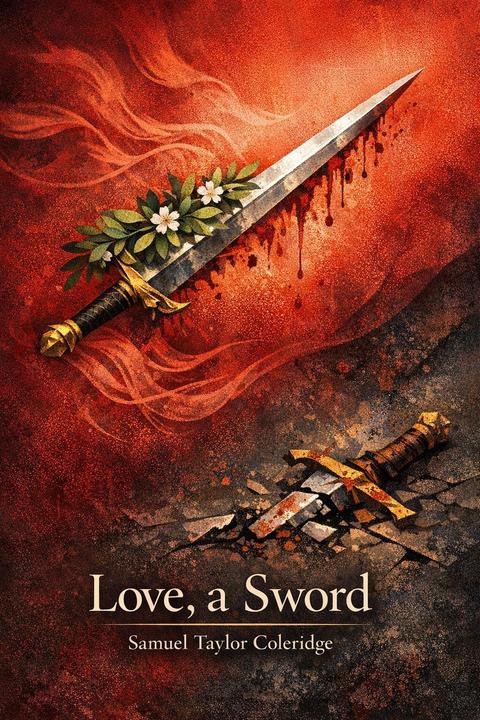
Love, a Sword by Samuel Taylor Coleridge
The poem explores the dual nature of love, likening it to a sword that can both protect and harm. It begins with the imagery of love being adorned with myrtle, symbolizing beauty and passion, yet it reveals that love is also a weapon capable of inflicting pain. The sword metaphor illustrates how love can cut through barriers, exposing its power and intensity. As the poem progresses, it reflects on the consequences of love's intensity. The blade, while initially sharp and vibrant, can become dulled or broken over time, representing the wear and tear of relationships. The imagery of rust and fragmentation signifies the potential for love to deteriorate, leaving only remnants of what once was. The work delves into the complexities of love, acknowledging its ability to inspire both joy and sorrow. It suggests that love, while beautiful, carries inherent risks and vulnerabilities. The juxtaposition of love's strength and fragility serves as a reminder of the challenges faced in romantic relationships. Ultimately, the poem encapsulates the paradox of love as both a source of strength and a potential cause of suffering, inviting readers to reflect on their own experiences with love's duality.
By Samuel Taylor Coleridge · First published 1798 · Genre: Romantic Poetry, Lyric Poetry, Symbolism · 81 words
First lines
Though veiled in spires of myrtle-wreath, / Love is a sword which cuts its sheath, / And through the clefts itself has made, / We spy the flashes of the blade!
But through the clefts itself has made, / We likewise see Love's flashing blade / By rust consumed, or snapt in twain: / And only hilt and stump remain.
Similar titles
- The Kiss by Sara Teasdale
- Love What Is Love by Robert Louis Stevenson
- The Kiss by Robert Graves
- Loves Apparition And Evanishment by Samuel Taylor Coleridge
- Against Clock And Compasses by Robert Graves
- Dew by Sara Teasdale
Genres
- Romantic Poetry — The poem explores themes of love, passion, and emotional conflict, characteristic of Romantic literature.
- Lyric Poetry — The work expresses personal feelings and emotions, typical of lyric poetry.
- Symbolism — The use of the sword as a metaphor for love represents deeper meanings and emotional struggles.
- Philosophical Poetry — The poem reflects on the nature of love and its complexities, inviting contemplation.
Tags
love · sword · metaphor · poetry · Coleridge · romance · loss · pain · nature · imagery · emotion · duality
What this Textopian page supports
Love, a Sword is listed on Textopian as a poem by Samuel Taylor Coleridge, dated 1798 CE.
This source record anchors work identity, reading entry points, and catalog context for checking claims about the work.
- Work type: Poem
- Author: Samuel Taylor Coleridge
- Date: 1798 CE
- Language: English
- Genres: Romantic Poetry, Lyric Poetry, Symbolism, Philosophical Poetry, Narrative Poetry
- Length: 81 words
- Structure: 1 section, 2 paragraphs
Good citation fit
- Work identity for Love, a Sword by Samuel Taylor Coleridge
- Canonical title URL and first readable passage URL
- Genre and topic classification from the Textopian catalog
- Readability and classroom-planning context
- Passage-specific claims should cite the exact /read/ URL for the relevant chapter or paragraph
More by Samuel Taylor Coleridge
- Expostulation and Reply (1817)
- The Tables Turned (1798)
- Animal Tranquillity and Decay (1816)
- Goody Blake and Harry Gill (1798)
- The Last of the Flock (1815)
- Lines Left Upon a Seat in a Yew-Tree, which Stands Near the Lake of Estwaithe, on a Desolate Part of the Shore, Yet Commanding a Beautiful Prospect (1818)
- The Foster-Mother's Tale (1815)
- The Thorn (1798)
- All works by Samuel Taylor Coleridge