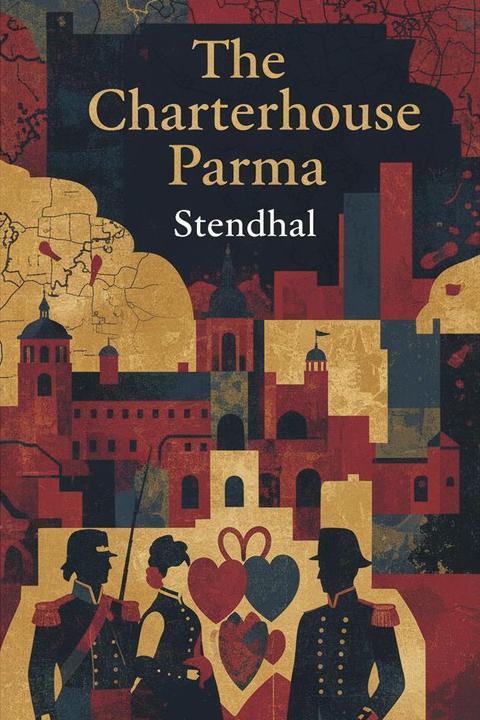
The Charterhouse of Parma by Stendhal
The narrative follows the life of a young nobleman, born into a family with a rich history, during a tumultuous period in Italy marked by political upheaval and the influence of Napoleon. The protagonist, Fabrizio del Dongo, is the second son of the Marchese del Dongo, who is deeply entrenched in the aristocratic traditions of Lombardy. The story begins with the arrival of the French army in Milan in 1796, which ignites a sense of nationalism and passion among the populace, contrasting sharply with the previous lethargy under Austrian rule. Fabrizio's life is shaped by the political climate and the expectations of his family. His elder brother, Ascanio, is groomed to inherit the family fortune, leaving Fabrizio to navigate his own path. The narrative explores Fabrizio's youthful idealism and romantic notions of heroism, particularly as he becomes enamored with the idea of joining Napoleon's forces. His impulsive decision to travel to France in search of adventure leads to a series of misadventures, including his arrest as a suspected spy due to his foreign accent and lack of military experience. After a series of escapades, including a brief stint in prison, Fabrizio manages to escape and returns to Italy, where he grapples with his identity and the expectations placed upon him by his family and society. His experiences in the military, though chaotic and often absurd, serve to mature him and shape his understanding of the world around him. The story also delves into the lives of the women in Fabrizio's life, particularly his mother, the Marchesa del Dongo, and his aunt, Contessa Pietranera. Their struggles with societal expectations and their own desires reflect the broader themes of love, loyalty, and the constraints of aristocratic life. The Contessa's relationship with Conte Mosca, a powerful minister, adds another layer of complexity to the narrative, highlighting the interplay of personal ambition and political intrigue. As the story unfolds, Fabrizio's journey becomes one of self-discovery, as he navigates the treacherous waters of love, loyalty, and the shifting political landscape of Italy. His encounters with various characters, from soldiers to aristocrats, reveal the absurdities of war and the often arbitrary nature of power and status. Ultimately, the narrative is a rich tapestry of historical events, personal struggles, and the quest for identity, set against the backdrop of a rapidly changing Italy. Fabrizio's evolution from a naive youth to a more self-aware individual mirrors the broader societal changes occurring during this period, making the story a poignant exploration of the human experience amidst the chaos of history.
By Stendhal · First published 1839 · Genre: Historical Fiction, Romance, Political Fiction · 28 chapters · 231,097 words
First lines
On the 15th of May, 1796, General Bonaparte made his entry into Milan at the head of that young army which had shortly before crossed the Bridge of Lodi and taught the world that after all these centuries Caesar and Alexander had a successor. The miracles of gallantry and genius of which Italy was a witness in the space of a few months aroused a slumbering people; only a week before the arrival of the French, the Milanese still regarded them as a mere rabble of brigands, accustomed invariably to flee before the troops of His Imperial and Royal Majesty; so much at least was reported to them three times weekly by a little news-sheet no bigger than one's hand, and printed on soiled paper.
What this Textopian page supports
The Charterhouse of Parma is listed on Textopian as a novel by Stendhal, dated 1839 CE.
This source record anchors work identity, reading entry points, and catalog context for checking claims about the work.
- Work type: Novel
- Author: Stendhal
- Date: 1839 CE
- Language: English
- Genres: Historical Fiction, Romance, Political Fiction, Bildungsroman, Adventure
- Length: 231,097 words
- Structure: 28 chapters, 2,208 paragraphs
- Reading fit: Standard (8th-9th Grade)
Good citation fit
- Work identity for The Charterhouse of Parma by Stendhal
- Canonical title URL and first readable passage URL
- Genre and topic classification from the Textopian catalog
- Readability and classroom-planning context
- Passage-specific claims should cite the exact /read/ URL for the relevant chapter or paragraph
Similar titles
- Mauprat by George Sand
- An Unfinished Story by Richard Harding Davis
- Minka by Paul Heyse
- Gabrielle De Bergerac by Henry James
- Caesar Or Nothing by Pio Baroja
- A Second Home by Honore De Balzac
Genres
- Historical Fiction — The novel is set in early 19th-century Italy and explores historical events and figures.
- Romance — The plot includes significant romantic relationships and emotional entanglements.
- Political Fiction — The story delves into the political landscape of the time, including themes of power and governance.
- Bildungsroman — The protagonist undergoes personal growth and development throughout the narrative.
Tags
Historical Fiction · Romance · Coming-of-Age · War Novel · Italian Literature · 19th Century Literature · Realism · Psychological Insight · Social Commentary · Family Drama · Love Story · Self-Discovery
Contents
- CHAPTER I
- CHAPTER II
- CHAPTER III
- CHAPTER IV
- CHAPTER V
- CHAPTER VI
- CHAPTER VII
- CHAPTER VIII
- CHAPTER IX
- CHAPTER X
- CHAPTER XI
- CHAPTER XII
- CHAPTER XIII
- CHAPTER XIV
- CHAPTER XV
- CHAPTER XVI
- CHAPTER XVII
- CHAPTER XVIII
- CHAPTER XIX
- CHAPTER XX
- CHAPTER XXI
- CHAPTER XXII
- CHAPTER XXIII
- CHAPTER XXIV
- CHAPTER XXV
- CHAPTER XXVI
- CHAPTER XXVII
- CHAPTER XXVIII