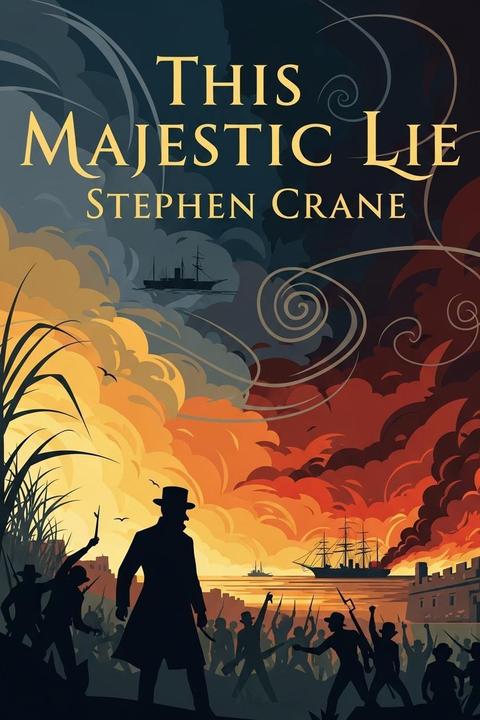
This Majestic Lie by Stephen Crane
A crowd in Havana celebrates a supposed victory over the American fleet, reveling in exaggerated tales of Spanish bravery while mocking the dead. Among them is Johnnie, an American who once managed a sugar plantation but now finds himself in a precarious position as a spy. He navigates the chaotic atmosphere of war, filled with rumors and bravado, while grappling with his own identity and the consequences of his actions. Johnnie's past as a trimmer—someone who played both sides for personal gain—haunts him. He is now a refugee in Key West, where he feels out of place among war correspondents and the fervor of impending conflict. Despite his slow speech and contemplative nature, he is drawn back to Havana, where he believes he can gather valuable intelligence on Spanish defenses. Upon arriving in Havana, Johnnie encounters Martha, a widow who runs a lodging house. She warns him of the dangers he faces as a known American, but he dismisses her concerns. His bravado leads him to spy on the fortifications, believing he can provide crucial information to the American admiral. However, his actions are reckless, and he often finds himself in precarious situations, narrowly escaping capture. As Johnnie continues his espionage, he becomes increasingly aware of the absurdity of his situation. He experiences moments of clarity amidst the chaos, recognizing the futility of his efforts as the war progresses without a clear direction. His interactions with Martha reveal a mix of admiration and frustration; she sees his potential but is exasperated by his foolishness. Johnnie's attempts to gather intelligence culminate in a series of misadventures, including a failed visit to a café where he is overcharged and nearly exposed. Despite the danger, he remains undeterred, driven by a sense of purpose that often borders on delusion. His experiences reflect the broader themes of war, identity, and the absurdity of human ambition. Ultimately, Johnnie's efforts yield little in terms of tangible results. The war's outcome renders his intelligence irrelevant, and he finds himself grappling with the realization that his sacrifices may have been in vain. Yet, he maintains a sense of humor and resilience, embodying the contradictions of a man caught between two worlds. In the end, Johnnie's journey serves as a commentary on the nature of conflict and the human condition, illustrating how individuals navigate the complexities of loyalty, survival, and the search for meaning in a chaotic world. His story is a blend of irony and tragedy, highlighting the often absurd realities of war and the personal struggles that accompany it.
By Stephen Crane · First published 1896 · Genre: Historical Fiction, War Literature, Satire · 4 chapters · 9,967 words
First lines
In the twilight, a great crowd was streaming up the Prado in Havana. The people had been down to the shore to laugh and twiddle their fingers at the American blockading fleet -- mere colourless shapes on the edge of the sea. Gorgeous challenges had been issued to the far-away ships by little children and women while the men laughed. Havana was happy, for it was known that the illustrious sailor Don Patricio de Montojo had with his fleet met the decaying ships of one Dewey and smitten them into stuffing for a baby's pillow. Of course the American sailors were drunk at the time, but the American sailors were always drunk. Newsboys galloped among the crowd crying _La Lucha_ and _La Marina_. The papers said: "This is as we foretold. How could it be otherwise when the cowardly Yankees met our brave sailors? " But the tongues of the exuberant people ran more at large. One man said in a loud voice: "How unfortunate it is that we still have to buy meat in Havana when so much pork is floating in Manila Bay! " Amid the consequent laughter, another man retorted: "Oh, never mind! That pork in Manila is rotten. It always was rotten. " Still another man said: "But, little friend, it would make good manure for our fields if only we had it. " And still another man said: "Ah, wait until our soldiers get with the wives of the Americans and there will be many little Yankees to serve hot on our tables. The men of the _Maine_ simply made our appetites good. Never mind the pork in Manila. There will be plenty. " Women laughed; children laughed because their mothers laughed; everybody laughed. And -- a word with you -- these people were cackling and chuckling and insulting their own dead, their own dead men of Spain, for if the poor green corpses floated then in Manila Bay they were not American corpses.
What this Textopian page supports
This Majestic Lie is listed on Textopian as a novel by Stephen Crane, dated 1896 CE.
This source record anchors work identity, reading entry points, and catalog context for checking claims about the work.
- Work type: Novel
- Author: Stephen Crane
- Date: 1896 CE
- Language: English
- Genres: Historical Fiction, War Literature, Satire, Realism, Adventure
- Length: 9,967 words
- Structure: 4 chapters, 135 paragraphs
- Reading fit: Fairly Easy (7th Grade)
Good citation fit
- Work identity for This Majestic Lie by Stephen Crane
- Canonical title URL and first readable passage URL
- Genre and topic classification from the Textopian catalog
- Readability and classroom-planning context
- Passage-specific claims should cite the exact /read/ URL for the relevant chapter or paragraph
Similar titles
- An Episode Of War by Stephen Crane
- A Grey Sleeve by Stephen Crane
- The End Of The Battle by Stephen Crane
- Three Miraculous Soldiers by Stephen Crane
- A Man And Some Others by Stephen Crane
- The Price Of The Harness by Stephen Crane
Genres
- Historical Fiction — The narrative is set during the Spanish-American War, exploring the socio-political context and the experiences of characters involved in the conflict.
- War Literature — The story delves into the themes of war, its absurdities, and the impact on individuals, particularly through the character of Johnnie.
- Satire — The work employs irony and humor to critique the romanticized notions of war and the absurdity of human behavior in wartime.
- Realism — The writing style reflects a realistic portrayal of life during wartime, focusing on the mundane and often grim realities faced by the characters.
Tags
war · realism · naturalism · American literature · civil war · heroism · disillusionment · human experience · morality · suffering · courage · identity