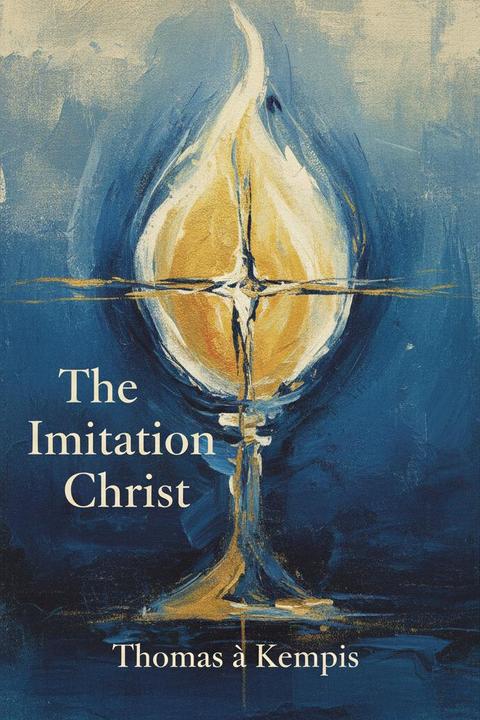
Of Fervent Love and Vehement Desire of Receiving
The work expresses a profound yearning for divine communion, emphasizing the intensity of love and desire for Christ. The disciple articulates a heartfelt longing to receive the Lord, mirroring the devotion of saints and holy figures throughout history. This longing is characterized by a deep reverence and an acknowledgment of personal unworthiness, yet the disciple offers their entire being as a sacrifice to God. The text reflects on the purity and fervor with which the blessed Virgin Mary accepted the Incarnation, highlighting her humility and devotion. It also recalls the joy of John the Baptist, who recognized Christ's presence and rejoiced in it, serving as a model for the disciple's own desire to be filled with holy aspirations. The disciple seeks to present not only their own desires but also the collective jubilation of all devout hearts, aspiring to glorify God through the virtues and praises of creation. There is a call for all beings to join in worship, magnifying God's name with fervent devotion. The work culminates in a plea for grace and mercy, both for the disciple and for others, emphasizing the importance of community in faith. The disciple expresses a desire for intercession from those who partake in the holy sacrament, hoping that their own needs will be remembered amidst the collective devotion. The overarching theme is one of deep love, reverence, and the aspiration for a closer union with the divine, underscoring the transformative power of faith and the sacrament.
By Thomas à Kempis · First published 1654 · Genre: Religious Literature, Devotional, Spirituality · 688 words
First lines
The Voice of the Disciple.
With the deepest devotion and fervent love, with all affection and fervour of heart, I long to receive Thee, O Lord, even as many Saints and devout persons have desired Thee in communicating, who were altogether well pleasing to Thee by their sanctity of life, and dwelt in all ardent devotion. O my God, Eternal Love, my whole Good, Happiness without measure, I long to receive Thee with the most vehement desire and becoming reverence which any Saint ever had or could have.
What this Textopian page supports
Of Fervent Love and Vehement Desire of Receiving Christ is listed on Textopian as an essay by Thomas à Kempis, dated 1654 CE.
This source record anchors work identity, reading entry points, and catalog context for checking claims about the work.
- Work type: Essay
- Author: Thomas à Kempis
- Date: 1654 CE
- Language: English
- Genres: Religious Literature, Devotional, Spirituality, Theology, Meditation
- Length: 688 words
- Structure: 1 section, 6 paragraphs
- Reading fit: Difficult (College Level)
Good citation fit
- Work identity for Of Fervent Love and Vehement Desire of Receiving Christ by Thomas à Kempis
- Canonical title URL and first readable passage URL
- Genre and topic classification from the Textopian catalog
- Readability and classroom-planning context
- Passage-specific claims should cite the exact /read/ URL for the relevant chapter or paragraph
Similar titles
- That A Man Should Not Be A Curious Searcher Of The Sacrament But A Humble Imitator Of Christ Submitting His Sense To Holy Faith by Thomas A. Kempis
- That We Must Rest In God Above All Goods And Gifts by Thomas A. Kempis
- A Devout Exhortation To The Holy Communion by Thomas A. Kempis
- Of The Desire After Eternal Life And How Great Blessings Are Promised To Those Who Strive by Thomas A. Kempis
- Of The Wonderful Power Of The Divine Love by Thomas A. Kempis
- That He Who Is About To Communicate With Christ Ought To Prepare Himself With Great Diligence by Thomas A. Kempis
Genres
- Religious Literature — The text is centered on the fervent desire to receive Christ, reflecting deep religious devotion and spiritual longing.
- Devotional — The work expresses personal devotion and the act of offering oneself to God, characteristic of devotional literature.
- Spirituality — The themes of inner fervor, prayer, and spiritual ecstasy align with the genre of spirituality.
- Theology — The text discusses theological concepts such as the nature of God, the Incarnation, and the role of saints.
Tags
Christianity · Spirituality · Devotional · Meditation · Prayer · Faith · Love · Desire · Christ · Jesus · Bible · Theology
More by Thomas à Kempis
- Of the Imitation of Christ, and of Contempt of the World and all its Vanities (1441)
- Of Thinking Humbly of Oneself (1441)
- Of the Knowledge of Truth (1441)
- Of Prudence in Action (1518)
- Of the Reading of Holy Scripture (1441)
- Of Inordinate Affections (1441)
- Of Fleeing from Vain Hope and Pride (1940)
- Of the Danger of too Much Familiarity (1904)
- All works by Thomas à Kempis