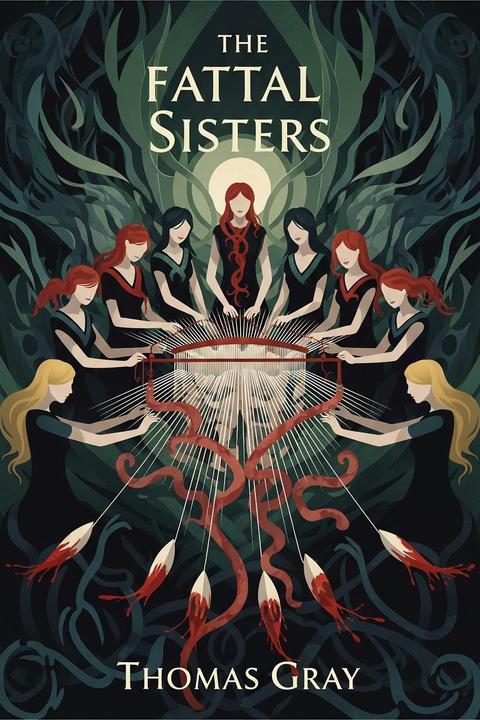
The Fatal Sisters by Thomas Gray
The work presents a narrative steeped in Norse mythology and the themes of fate, war, and the supernatural. It begins with a historical context, recounting the events of the eleventh century when Sigurd, the Earl of the Orkney Islands, embarks on a military campaign in Ireland. His forces are ultimately defeated, leading to significant loss on both sides, including the death of the Irish King Brian. The central focus shifts to a mystical encounter witnessed by a man from Caithness, who observes twelve giant figures resembling women engaged in a foreboding task. These figures, identified as the Norns or fate-weaving sisters, are depicted as weaving a tapestry that symbolizes the fates of warriors in battle. The imagery is vivid and macabre, with the loom made of human entrails and the shuttles dipped in blood, emphasizing the grim nature of their work. As the sisters weave, they sing a haunting song that foretells the impending violence and bloodshed of war. The lyrics convey a sense of urgency and inevitability, as they prepare for the chaos of battle, invoking the spirits of the slain and the warriors who will soon meet their doom. The poem captures the duality of war—its glory and its horror—while highlighting the sisters' role as arbiters of fate, determining who will live and who will die. The narrative culminates in a call to arms, urging the sisters to hasten to the battlefield, where they will wield their weapons and influence the outcome of the conflict. The work concludes with a sense of triumph for the victors, while also acknowledging the sorrow and loss that accompany such victories. The themes of destiny, the cyclical nature of life and death, and the supernatural intertwine throughout, creating a rich tapestry of imagery and emotion that reflects the complexities of human existence and the inexorable march of fate.
By Thomas Gray · First published 1764 · Genre: Poetry, Epic, Tragedy · 948 words
First lines
An Ode from the Norse Tongue / In The Orcades of Thormodus Torfseus; Hafniae, 1697, folio; and also in Bartholinus / Advertisement / The author once had thoughts (in concert with a friend) of giving the history of English poetry. In the introduction to it he meant to have produced some specimens of the style that reigned in ancient times among the neighbouring nations, or those who had subdued the greater part of this Island, and were our progenitors; "The Fatal Sisters" and "The Descent of Odin" made a part of it. He has long since dropped his design, especially after he heard, that it was already in the hands of a person well qualified to do it justice, both by his taste, and his researches into antiquity.
What this Textopian page supports
The Fatal Sisters is listed on Textopian as a poem by Thomas Gray, dated 1764 CE.
This source record anchors work identity, reading entry points, and catalog context for checking claims about the work.
- Work type: Poem
- Author: Thomas Gray
- Date: 1764 CE
- Language: English
- Genres: Poetry, Epic, Tragedy, Historical Fiction, Fantasy
- Length: 948 words
- Structure: 1 section, 29 paragraphs
- Reading fit: Standard (8th-9th Grade)
Good citation fit
- Work identity for The Fatal Sisters by Thomas Gray
- Canonical title URL and first readable passage URL
- Genre and topic classification from the Textopian catalog
- Readability and classroom-planning context
- Passage-specific claims should cite the exact /read/ URL for the relevant chapter or paragraph
Similar titles
- The Blacksmiths Stool The Story Of A Man Who Found That Death Was Necessary by Parker Fillmore
- His Stalk The Dark by Edna St Vincent Millay
- At Nineveh by Madison Cawein
- Vision Of Belshazzar by Lord Byron
- The Punishment Of Loke by Madison Cawein
- Scraps Of Hibernian Ballads by J. Sheridan Le Fanu
Genres
- Poetry — The work is a poem that employs lyrical language and structure, characteristic of poetic forms.
- Epic — The poem recounts a grand narrative involving historical and mythical elements, typical of epic literature.
- Tragedy — Themes of death, fate, and loss are central to the narrative, aligning with tragic literature.
- Historical Fiction — The poem is based on historical events and figures, blending fact with myth.
Tags
Dark Fantasy · Gothic Fiction · Supernatural · Mystery · Thriller · Horror · Poetry · Norse Mythology · Fate · Death · Sisters · Family