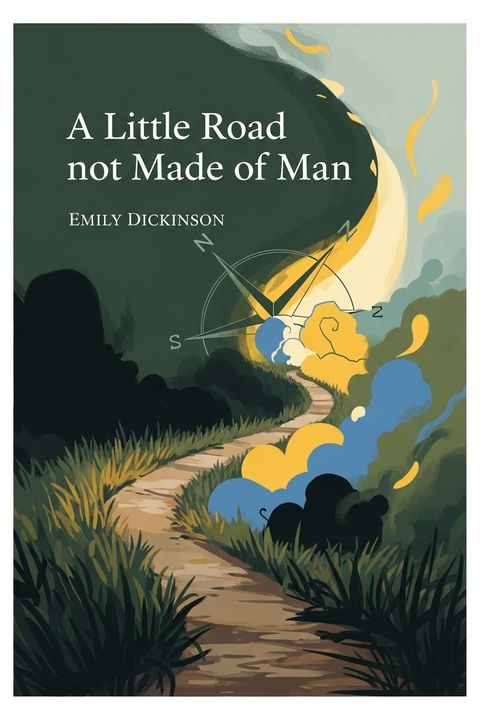
A Little Road not Made of Man
This poem explores the idea that some paths in life are not predetermined and can be created through individual choices and actions. The speaker reflects on how a small road, unmarked by society's expectations, can lead to new experiences and discoveries. The poem suggests that embracing uncertainty and taking risks can lead to personal growth and self-discovery.
By Emily Dickinson · First published 1844 · Genre: Poetry, Nature, Philosophical · 71 words
First lines
A little road not made of man, Enabled of the eye, Accessible to thill of bee, Or cart of butterfly.
If town it have, beyond itself, 'T is that I cannot say; I only sigh, -- no vehicle Bears me along that way.
What this Textopian page supports
A Little Road not Made of Man is listed on Textopian as a poem by Emily Dickinson, dated 1844 CE.
This source record anchors work identity, reading entry points, and catalog context for checking claims about the work.
- Work type: Poem
- Author: Emily Dickinson
- Date: 1844 CE
- Language: English
- Genres: Poetry, Nature, Philosophical, Metaphysical
- Length: 71 words
- Structure: 1 section, 2 paragraphs
- Reading fit: Easy (6th Grade)
Good citation fit
- Work identity for A Little Road not Made of Man by Emily Dickinson
- Canonical title URL and first readable passage URL
- Genre and topic classification from the Textopian catalog
- Readability and classroom-planning context
- Passage-specific claims should cite the exact /read/ URL for the relevant chapter or paragraph
Discussion starters
- What should a reader notice first when entering A Little Road not Made of Man?
- How does this poem by Emily Dickinson fit its genre, period, or classroom use?
- Where does Poetry first become important in the reading?
Similar titles
- Exclusion by Emily Dickinson
- The Test by Emily Dickinson
- In Vain by Emily Dickinson
- A Sickness Of This World It Most Occasions by Emily Dickinson
- Immortal Is An Ample Word by Emily Dickinson
- To Hang Our Head Ostensibly by Emily Dickinson
Genres
- Poetry — The work is structured in verse form, utilizing rhyme and meter typical of poetry.
- Nature — The themes and imagery focus on elements of the natural world, such as roads, bees, and butterflies.
- Philosophical — The poem explores abstract concepts of existence and perception, suggesting deeper philosophical themes.
- Metaphysical — The work delves into the metaphysical by contemplating the unseen and the intangible aspects of reality.
Tags
Poetry · American Literature · 19th Century · Nature Imagery · Symbolism · Existentialism · Philosophy · Mortality · Death · Life · Spirituality · Faith