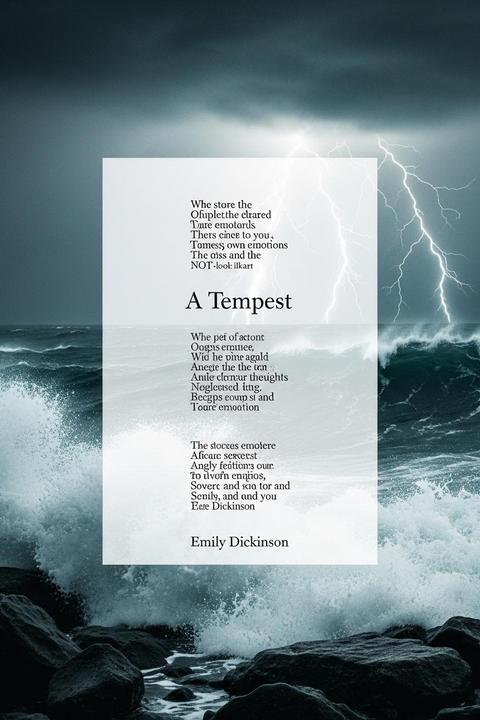
A Tempest by Emily Dickinson (1891)
The poem explores the turmoil of a stormy sea and the speaker's inner turmoil, using imagery and metaphor to convey feelings of anxiety and despair. The poem begins by describing the stormy weather, with waves crashing against the shore and lightning illuminating the darkness. The speaker describes the storm as a manifestation of their own emotions, with the waves representing their turbulent thoughts and feelings. As the poem progresses, the speaker's emotions become increasingly intense, with the storm growing more violent and chaotic. The speaker feels overwhelmed by their emotions, unable to escape or calm them down. The poem ultimately suggests that the storm is a reflection of the speaker's inner turmoil, and that they are powerless to stop it. The final image of the poem is one of destruction and chaos, leaving the reader with a sense of unease and uncertainty. The poem explores themes of anxiety, despair, and the powerlessness of human emotions in the face of overwhelming circumstances.
By Emily Dickinson · First published 1891 · Genre: Poetry, Nature, Gothic · 107 words
First lines
An awful tempest mashed the air, / The clouds were gaunt and few; / A black, as of a spectre's cloak, / Hid heaven and earth from view.
The creatures chuckled on the roofs / And whistled in the air, / And shook their fists and gnashed their teeth.
And swung their frenzied hair.
The morning lit, the birds arose; / The monster's faded eyes / Turned slowly to his native coast, / And peace was Paradise!
What this Textopian page supports
A Tempest is listed on Textopian as a poem by Emily Dickinson, dated 1891 CE.
This source record anchors work identity, reading entry points, and catalog context for checking claims about the work.
- Work type: Poem
- Author: Emily Dickinson
- Date: 1891 CE
- Language: English
- Genres: Poetry, Nature, Gothic, Romantic
- Length: 107 words
- Structure: 1 section, 4 paragraphs
Good citation fit
- Work identity for A Tempest by Emily Dickinson
- Canonical title URL and first readable passage URL
- Genre and topic classification from the Textopian catalog
- Readability and classroom-planning context
- Passage-specific claims should cite the exact /read/ URL for the relevant chapter or paragraph
Similar titles
- The White Bark by Edna St Vincent Millay
- High From The Earth I Heard A Bird by Emily Dickinson
- The Unknown Bird by Edward Thomas
- Advice To A Butterfly by Maxwell Bodenheim
- Mother Nature by Emily Dickinson
- Now That The West Is Washed Of Clouds And Clear by Edna St Vincent Millay
Genres
- Poetry — The work is structured in verse form with a focus on rhythm and imagery, characteristic of poetry.
- Nature — The poem vividly describes a tempest and its impact on the natural world, highlighting themes of nature's power.
- Gothic — The use of dark imagery, such as 'spectre's cloak' and 'monster's faded eyes,' evokes a gothic atmosphere.
- Romantic — The emphasis on emotional response to nature and the sublime aligns with Romantic literary themes.
Tags
Poetry · Nature · Mortality · Existentialism · Philosophy · Symbolism · Imagery · Metaphor · Allegory · Mythology · Feminism · Individualism