Epitaph by Emily Dickinson (1890)
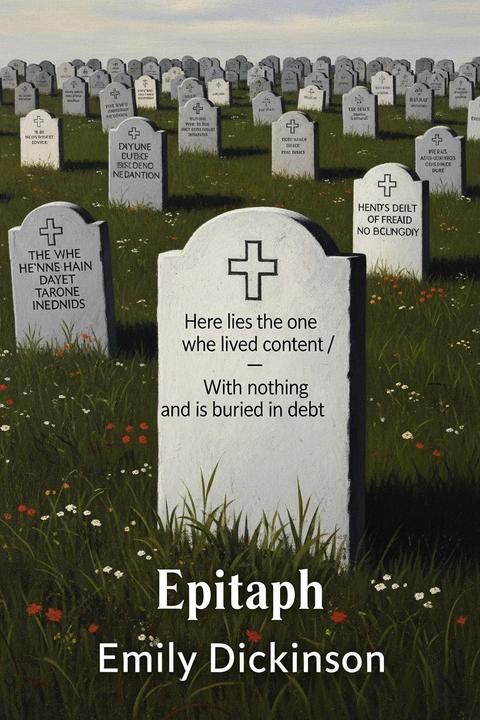
The poem explores the idea of death and its impact on the living. It describes a grave with an epitaph that reads: "Here lies the one who lived content / With nothing and is buried in debt." The speaker reflects on the life of the deceased, noting their simplicity and lack of material possessions.
By Emily Dickinson · First published 1890 · Genre: Poetry, Elegy, Lyric · 64 words
First lines
Step lightly on this narrow spot!
The broadest land that grows / Is not so ample as the breast / These emerald seams enclose.
Step lofty; for this name is told / As far as cannon dwell, / Or flag subsist, or fame export / Her deathless syllable.
What this Textopian page supports
Epitaph is listed on Textopian as a poem by Emily Dickinson, dated 1890 CE.
This source record anchors work identity, reading entry points, and catalog context for checking claims about the work.
- Work type: Poem
- Author: Emily Dickinson
- Date: 1890 CE
- Language: English
- Genres: Poetry, Elegy, Lyric, Symbolism
- Length: 64 words
- Structure: 1 section, 3 paragraphs
Good citation fit
- Work identity for Epitaph by Emily Dickinson
- Canonical title URL and first readable passage URL
- Genre and topic classification from the Textopian catalog
- Readability and classroom-planning context
- Passage-specific claims should cite the exact /read/ URL for the relevant chapter or paragraph
Similar titles
- Requiem by Emily Dickinson
- Dying by Emily Dickinson
- The Monument by Emily Dickinson
- I Died For Beauty But Was Scarce by Emily Dickinson
- Not Any Higher Stands The Grave by Emily Dickinson
- Till The End by Emily Dickinson
Genres
- Poetry — The work is structured in verse form, utilizing meter and rhyme, characteristic of poetry.
- Elegy — The themes of death and remembrance align with the traditional elements of an elegy.
- Lyric — The personal and emotional expression in the poem is typical of lyric poetry.
- Symbolism — The use of symbols such as 'emerald seams' and 'deathless syllable' suggests a symbolic interpretation.
Tags
Poetry · Mortality · Death · Loss · Grief · Nature · Symbolism · Imagery · Metaphor · Personification · Solitude · Isolation