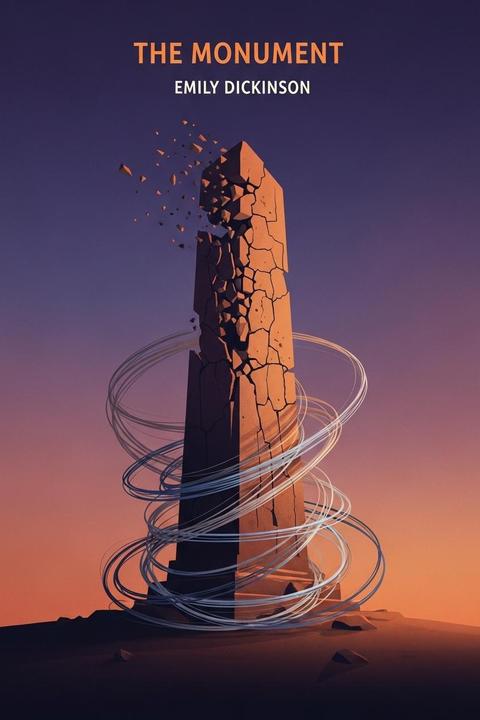
The Monument by Emily Dickinson
This poem explores the idea of a monument that stands for something greater than itself, but ultimately fails to convey its intended meaning due to the limitations of language and human perception. The speaker describes the monument as a symbol of remembrance and commemoration, but notes that it can only represent the past, not truly capture or convey its essence. The poem suggests that our attempts to preserve and honor memories are inherently flawed, and that the passage of time erodes even the most well-intentioned efforts. The speaker also touches on the idea that language itself is insufficient for conveying complex emotions and experiences, leading to a sense of disconnection between the monument's intended meaning and its actual impact.
By Emily Dickinson · First published 1896 · Genre: Poetry, Elegy, Symbolism · 69 words
First lines
She laid her docile crescent down, / And this mechanic stone / Still states, to dates that have forgot, / The news that she is gone.
So constant to its stolid trust, / The shaft that never knew, / It shames the constancy that fled / Before its emblem flew.
What this Textopian page supports
The Monument is listed on Textopian as a poem by Emily Dickinson, dated 1896 CE.
This source record anchors work identity, reading entry points, and catalog context for checking claims about the work.
- Work type: Poem
- Author: Emily Dickinson
- Date: 1896 CE
- Language: English
- Genres: Poetry, Elegy, Symbolism, Lyric
- Length: 69 words
- Structure: 1 section, 2 paragraphs
Good citation fit
- Work identity for The Monument by Emily Dickinson
- Canonical title URL and first readable passage URL
- Genre and topic classification from the Textopian catalog
- Readability and classroom-planning context
- Passage-specific claims should cite the exact /read/ URL for the relevant chapter or paragraph
Similar titles
- Epitaph by Emily Dickinson
- Our Share Of Night To Bear by Emily Dickinson
- We Cover Thee Sweet Face by Emily Dickinson
- Lay This Laurel On The One by Emily Dickinson
- Transplanted by Emily Dickinson
- I Died For Beauty But Was Scarce by Emily Dickinson
Genres
- Poetry — The work is structured in verse form, utilizing rhyme and meter typical of poetry.
- Elegy — The themes of death and remembrance align with the characteristics of an elegy.
- Symbolism — The use of symbols such as the 'mechanic stone' and 'shaft' conveys deeper meanings about memory and permanence.
- Lyric — The personal and emotional expression in the poem is characteristic of lyric poetry.
Tags
Poetry · American Literature · 19th Century · Nature Imagery · Death and Mortality · Existentialism · Philosophy · Symbolism · Metaphor · Imagery · Mortality · Elegy