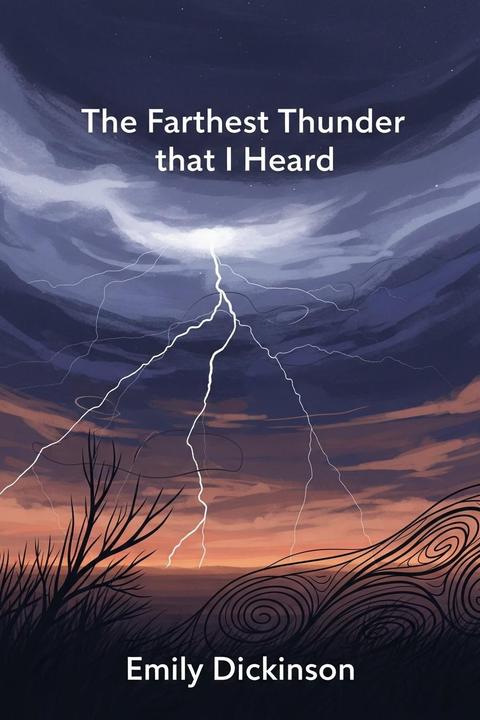
The Farthest Thunder that I Heard
This collection of poems explores themes of mortality, nature, and the human condition through a unique blend of imagery and symbolism. The poems often feature enigmatic language and unconventional structures, which serve to underscore the speaker's introspective and sometimes contradictory emotions. The work can be seen as an exploration of the tension between the individual's desire for transcendence and their connection to the natural world. Many of the poems express a sense of awe and wonder at the beauty of nature, while also acknowledging its power and indifference to human existence. Throughout the collection, the speaker grapples with questions of identity, morality, and the meaning of life. The poems often employ imagery from nature to convey complex emotions and ideas, such as the use of thunderstorms to represent the turmoil of the human psyche. Ultimately, this work presents a nuanced and multifaceted exploration of the human experience, one that is both deeply personal and universally relatable.
By Emily Dickinson · First published 1896 · Genre: Poetry, Lyric, Nature · 156 words
First lines
The farthest thunder that I heard / Was nearer than the sky, / And rumbles still, though torrid noons / Have lain their missiles by.
The lightning that preceded it / Struck no one but myself, / But I would not exchange the bolt / For all the rest of life.
Indebtedness to oxygen / The chemist may repay, / But not the obligation / To electricity.
It founds the homes and decks the days, / And every clamor bright / Is but the gleam concomitant / Of that waylaying light.
What this Textopian page supports
The Farthest Thunder that I Heard is listed on Textopian as a poem by Emily Dickinson, dated 1896 CE.
This source record anchors work identity, reading entry points, and catalog context for checking claims about the work.
- Work type: Poem
- Author: Emily Dickinson
- Date: 1896 CE
- Language: English
- Genres: Poetry, Lyric, Nature, Philosophical, Metaphysical
- Length: 156 words
- Structure: 1 section, 5 paragraphs
Good citation fit
- Work identity for The Farthest Thunder that I Heard by Emily Dickinson
- Canonical title URL and first readable passage URL
- Genre and topic classification from the Textopian catalog
- Readability and classroom-planning context
- Passage-specific claims should cite the exact /read/ URL for the relevant chapter or paragraph
Similar titles
- The Soul Should Always Stand Ajar by Emily Dickinson
- Our Share Of Night To Bear by Emily Dickinson
- How Still The Bells In Steeples Stand by Emily Dickinson
- Melodies Unheard by Emily Dickinson
- A Service Of Song by Emily Dickinson
- Alter When The Hills Do by Emily Dickinson
Genres
- Poetry — The work is structured in verse form with a focus on rhythm, meter, and imagery, characteristic of poetry.
- Lyric — The poem expresses personal emotions and thoughts, typical of the lyric genre.
- Nature — The poem uses natural elements like thunder and lightning to convey its themes.
- Philosophical — The poem explores abstract concepts such as life, obligation, and existence.
Tags
Poetry · American Literature · 19th Century · Nature Imagery · Mortality · Existentialism · Solitude · Isolation · Spirituality · Faith · Doubt · Hope