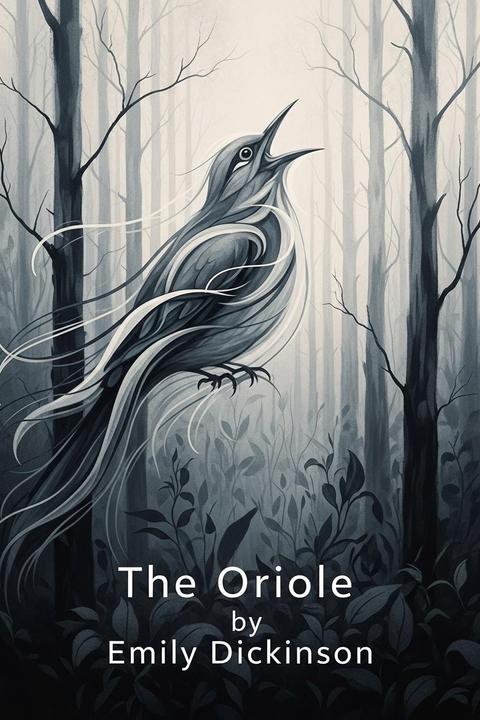
The Oriole by Emily Dickinson (1859)
This poem explores the theme of mortality and the fleeting nature of life. The speaker describes a bird's song that echoes through the forest, symbolizing the transience of beauty and joy. The poem also touches on the idea of impermanence and how it affects human perception of time.
By Emily Dickinson · First published 1859 · Genre: Poetry, Symbolism, Nature · 214 words
First lines
One of the ones that Midas touched, / Who failed to touch us all, / Was that confiding prodigal, / The blissful oriole.
So drunk, he disavows it / With badinage divine; / So dazzling, we mistake him / For an alighting mine.
A pleader, a dissembler, / An epicure, a thief, -- / Betimes an oratorio, / An ecstasy in chief;
The Jesuit of orchards, / He cheats as he enchants / Of an entire attar / For his decamping wants.
What this Textopian page supports
The Oriole is listed on Textopian as a poem by Emily Dickinson, dated 1859 CE.
This source record anchors work identity, reading entry points, and catalog context for checking claims about the work.
- Work type: Poem
- Author: Emily Dickinson
- Date: 1859 CE
- Language: English
- Genres: Poetry, Symbolism, Nature, Philosophical, Mythological
- Length: 214 words
- Structure: 1 section, 7 paragraphs
- Reading fit: Standard (8th-9th Grade)
Good citation fit
- Work identity for The Oriole by Emily Dickinson
- Canonical title URL and first readable passage URL
- Genre and topic classification from the Textopian catalog
- Readability and classroom-planning context
- Passage-specific claims should cite the exact /read/ URL for the relevant chapter or paragraph
Similar titles
- I Will Sing You One O by Robert Frost
- Morning Is The Place For Dew by Emily Dickinson
- The Waiting by John Greenleaf Whittier
- The Tomb Of A Young Girl by Ranier Maria Rilke
- The Hedge Of Hemlocks by Edna St Vincent Millay
- The Onset by Robert Frost
Genres
- Poetry — The work is structured in verse form with a focus on rhythm, meter, and imagery, characteristic of poetry.
- Symbolism — The poem uses symbolic language, such as references to Midas and Jason, to convey deeper meanings and themes.
- Nature — The poem centers around the oriole, a bird, and includes vivid descriptions of natural elements.
- Philosophical — The poem explores abstract concepts such as deception, beauty, and the pursuit of wealth, prompting philosophical reflection.
Tags
Poetry · Nature · Symbolism · Imagery · Metaphor · Birds · Freedom · Escape · Solitude · Longing · Nostalgia · Memory