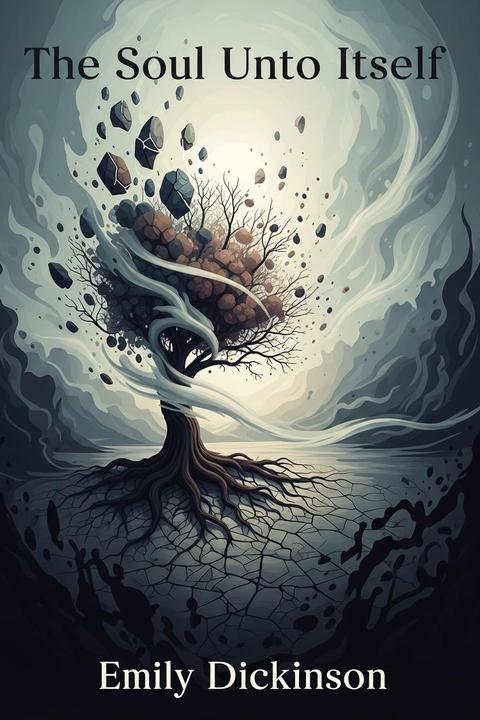
The Soul Unto Itself by Emily Dickinson
This collection of poems explores themes of mortality, spirituality, and the human condition. The speaker grapples with the idea that life is fleeting and that death is inevitable. They express a sense of detachment from the world around them, observing it with a mix of curiosity and disdain. The poems often use imagery and metaphor to convey the speaker's inner turmoil and emotional numbness. They describe the natural world as being in a state of decay and disintegration, mirroring their own feelings of disillusionment and despair. Throughout the collection, the speaker struggles to find meaning and purpose in life. They question the nature of reality and the existence of God, often arriving at bleak and nihilistic conclusions. Despite this, they maintain a sense of resilience and determination, refusing to surrender to the darkness that surrounds them. Ultimately, the poems suggest that the only true constant is change, and that even the self is subject to decay and transformation. The speaker's ultimate goal appears to be a form of spiritual liberation, where they can transcend their mortal coil and achieve a state of pure being.
By Emily Dickinson · First published 1890 · Genre: Poetry, Philosophical, Metaphysical · 62 words
First lines
The soul unto itself / Is an imperial friend, -- / Or the most agonizing spy / An enemy could send.
Secure against its own, / No treason it can fear; / Itself its sovereign, of itself / The soul should stand in awe.
What this Textopian page supports
The Soul Unto Itself is listed on Textopian as a poem by Emily Dickinson, dated 1890 CE.
This source record anchors work identity, reading entry points, and catalog context for checking claims about the work.
- Work type: Poem
- Author: Emily Dickinson
- Date: 1890 CE
- Language: English
- Genres: Poetry, Philosophical, Metaphysical, Psychological
- Length: 62 words
- Structure: 1 section, 2 paragraphs
Good citation fit
- Work identity for The Soul Unto Itself by Emily Dickinson
- Canonical title URL and first readable passage URL
- Genre and topic classification from the Textopian catalog
- Readability and classroom-planning context
- Passage-specific claims should cite the exact /read/ URL for the relevant chapter or paragraph
Similar titles
- The Souls Storm by Emily Dickinson
- A Dew Sufficed Itself by Emily Dickinson
- Disenchantment by Emily Dickinson
- A Man by Emily Dickinson
- I Breathed Enough To Learn The Trick by Emily Dickinson
- Invisible by Emily Dickinson
Genres
- Poetry — The work is structured in verse form, utilizing rhyme and meter typical of poetry.
- Philosophical — The themes explore introspection and the nature of the soul, which are central to philosophical inquiry.
- Metaphysical — The poem delves into abstract concepts of the soul and self-awareness, characteristic of metaphysical literature.
- Psychological — The exploration of the soul's dual role as friend and enemy suggests a psychological examination of self.
Tags
Poetry · Philosophy · Spirituality · Existentialism · Mortality · Self-Discovery · Inner Life · Solitude · Nature · Imagination · Introspection · Emotional Depth