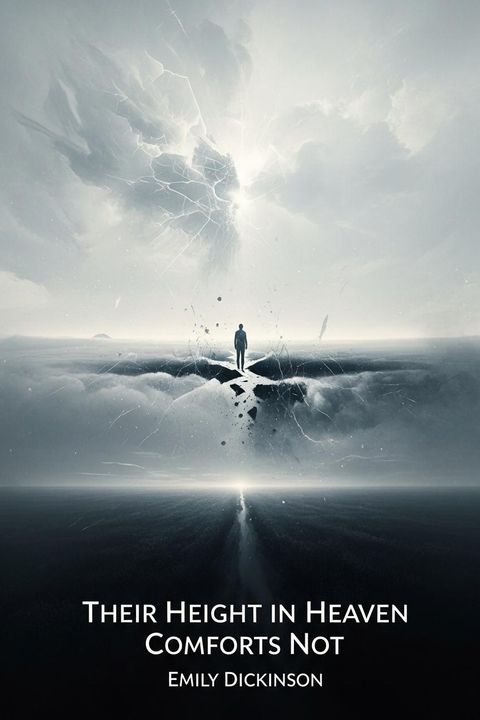
Their Height in Heaven Comforts Not
The poem explores the idea that even in a state of ultimate bliss and comfort, there can be a sense of disconnection from one's true self. The speaker suggests that being with God in heaven may not bring the same level of comfort as being with loved ones on earth. This is because the speaker feels a deep emotional connection to those they have lost, which cannot be replicated by even the most profound spiritual experience.
By Emily Dickinson · First published 1890 · Genre: Poetry, Philosophical, Reflective · 136 words
First lines
Their height in heaven comforts not, Their glory nought to me; 'T was best imperfect, as it was; I 'm finite, I can't see.
The house of supposition, The glimmering frontier That skirts the acres of perhaps, To me shows insecure.
The wealth I had contented me; If 't was a meaner size, Then I had counted it until It pleased my narrow eyes
Better than larger values, However true their show; This timid life of evidence Keeps pleading, "I don't know. "
What this Textopian page supports
Their Height in Heaven Comforts Not is listed on Textopian as a poem by Emily Dickinson, dated 1890 CE.
This source record anchors work identity, reading entry points, and catalog context for checking claims about the work.
- Work type: Poem
- Author: Emily Dickinson
- Date: 1890 CE
- Language: English
- Genres: Poetry, Philosophical, Reflective, Metaphysical, Lyric
- Length: 136 words
- Structure: 1 section, 4 paragraphs
- Reading fit: Standard (8th-9th Grade)
Good citation fit
- Work identity for Their Height in Heaven Comforts Not by Emily Dickinson
- Canonical title URL and first readable passage URL
- Genre and topic classification from the Textopian catalog
- Readability and classroom-planning context
- Passage-specific claims should cite the exact /read/ URL for the relevant chapter or paragraph
Discussion starters
- What should a reader notice first when entering Their Height in Heaven Comforts Not?
- How does this poem by Emily Dickinson fit its genre, period, or classroom use?
- Where does Poetry first become important in the reading?
Similar titles
- The Hereafter by James Whitcomb Riley
- Except The Heaven Had Come So Near by Emily Dickinson
- The Return by Emily Dickinson
- I Breathed Enough To Learn The Trick by Emily Dickinson
- On The Bleakness Of My Lot by Emily Dickinson
- A Throe Upon The Features by Emily Dickinson
Genres
- Poetry — The work is structured in verse form with a focus on meter and rhyme, characteristic of poetry.
- Philosophical — The themes explore existential and metaphysical questions about perception and reality.
- Reflective — The poem reflects on personal contentment and the limitations of human understanding.
- Metaphysical — It delves into abstract concepts such as the nature of existence and the human condition.
Tags
Poetry · American Literature · 19th Century · Mortality · Afterlife · Spirituality · Philosophy · Existentialism · Nature Imagery · Symbolism · Death and Dying · Heaven and Hell