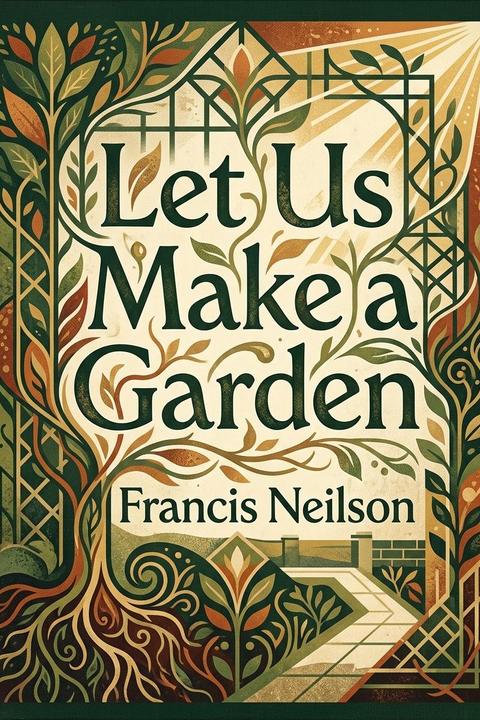
Let Us Make a Garden by Francis Neilson
Let Us Make a Garden* is a work-length lyric sequence built on a single sustained conceit: the making of a garden as an act of shared devotion between speaker and "mate," in which the labor of digging, planting, and tending becomes indistinguishable from the labor of loving and of keeping faith through the passage of the seasons and the passage of a life. The poem opens in late winter, with the ground still cold and half-frozen, and the speaker's invitation to break the soil functions simultaneously as an invitation to break open the heart—snow "melting," frost "yielding," and sleet retreating to their "white lairs" stand for grief, doubt, or emotional dormancy giving way before renewed hope. From the outset Neilson fuses horticultural instruction with erotic and spiritual tenderness: spade and fork answer to line and plan, physical toil answers to "jocund" joy, and the smell of turned loam is offered as literal fortification for tasks greater than gardening itself. The sequence then follows the gardener's year as its organizing structure, each section keyed to a stage of cultivation and a corresponding stage of feeling. Early sections dwell on preparation—clearing, digging, the anticipation of "days of happy length"—paralleling the tentative early work of reconciling or deepening a bond. As the poem advances into spring and early summer, planting gives way to growth: seedlings, shoots, and the first blooms mirror the flowering of intimacy, memory, and shared purpose between the two partners in the work. Neilson lingers on the sensory particulars of the garden—color, scent, the texture of soil and leaf—using them not merely as decoration but as evidence that devotion, like a garden, requires patient, daily, often unglamorous labor before it yields beauty. Midway through, the poem's register expands from the domestic and personal to the devotional and cosmic. The garden becomes a figure for the soul and for a shared communion with the divine; blossoming is repeatedly described in terms of "God's bounty," and the couple's joint cultivation is framed as a form of worship enacted through ordinary work rather than through ritual. High summer sections celebrate abundance—full bloom, warmth, the fulfillment of the plan sketched out in the opening pages—while also beginning to introduce a counter-note of transience: flowers that open must also fade, and the poem does not shy from acknowledging that the garden's glory is seasonal rather than permanent. The later movements turn toward autumn and the encroachment of loss. Here the poem's tone deepens from celebratory to elegiac, as harvest imagery shades into meditations on aging, parting, and mortality. The "mate" addressed throughout is figured not only as a living companion but, in places, as a beloved presence held in memory—suggesting the sequence functions in part as an act of mourning transfigured into cultivation, where tending the garden becomes a way of tending grief itself, keeping love productive rather than letting it lie fallow. Neilson uses the natural cycle of dying back and lying dormant through winter as reassurance rather than despair: just as bulbs and roots survive underground through the cold to bloom again, so the poem argues that love and hope persist through loss and can be renewed. The closing sections return explicitly to the volume's opening address, "Come, mate of mine, and make a garden bright / In my sad heart," collapsing the literal and figurative gardens into one. The final movement asks that the same care lavished on soil and seed be turned inward, cultivating the speaker's own heart—described as marked by melting snows and old sorrow—so that it too might "bloom, and never more be bare." This closing plea reframes the entire preceding sequence retrospectively: the seasonal, horticultural narrative has been, all along, an extended metaphor for emotional and spiritual restoration, with the beloved cast as co-gardener of the speaker's inner life. Formally, the work proceeds in rhymed stanzas of measured, hymn-like cadence, favoring plain diction and pastoral imagery over ornament, in keeping with its themes of humility, patience, and faith. Its structural logic is cyclical rather than linear—following the wheel of the seasons rather than a single dramatic arc—so that ending and beginning meet, with winter's yielding frost recalling the poem's own opening lines. This cyclical shape reinforces the central argument of the sequence: that renewal, whether of a garden, a marriage, or a grieving heart, is not a single triumphant event but a recurring, cooperative discipline, sustained through shared, humble, hopeful labor across the turning year.
By Francis Neilson · First published 1920 · Genre: Poetry, Metaphorical/Allegorical Poetry, Nature Poetry · 304 words
First lines
Come, let us make a garden, mate of mine, / A patch of rich brown earth the Spring will green; / I, with a spade and fork; you, with a line / And plan, will set it out for heaven's bright sheen
To cover, when the warm days come again.
What this Textopian page supports
Let Us Make a Garden is listed on Textopian as a poem by Francis Neilson, dated 1920 CE.
This source record anchors work identity, reading entry points, and catalog context for checking claims about the work.
- Work type: Poem
- Author: Francis Neilson
- Date: 1920 CE
- Language: English
- Genres: Poetry, Metaphorical/Allegorical Poetry, Nature Poetry, Romantic Poetry, Spiritual Poetry
- Length: 304 words
- Structure: 1 section, 7 paragraphs
- Reading fit: Fairly Easy (7th Grade)
Good citation fit
- Work identity for Let Us Make a Garden by Francis Neilson
- Canonical title URL and first readable passage URL
- Genre and topic classification from the Textopian catalog
- Readability and classroom-planning context
- Passage-specific claims should cite the exact /read/ URL for the relevant chapter or paragraph
Similar titles
- L Aura Celeste Che N Quel Verde Lauro by Francesco Petrarca
- The Wild Blue Bells by Ella Wheeler Wilcox
- Bird Of Hope by Ella Wheeler Wilcox
- I Begli Occhi Ond I Fui Percosso In Guisa by Francesco Petrarca
- Twilight Thoughts by Ella Wheeler Wilcox
- Song by Sara Teasdale
Genres
- Poetry — The work is fundamentally a poem with consistent verse form, rhyme scheme, and poetic devices including metaphor, imagery, and metrical structure.
- Metaphorical/Allegorical Poetry — The poem employs an extended metaphor where the literal garden becomes revealed in the final stanza as an allegory for the human heart and emotional transformation.
- Nature Poetry — Extensive use of natural imagery and seasonal cycles—snow melting, soil, frost yielding, blooms—with gardening as both literal subject and central organizing principle.
- Romantic Poetry — Features intimate address to 'mate of mine,' expressions of warmth, light, joy, and emotional connection; uses romantic register to invite companionship and shared purpose.
Tags
poetry · romantic · nature-imagery · garden-metaphor · love · devotion · metaphor · lyrical · beauty · aesthetic · philosophical · emotional-expression