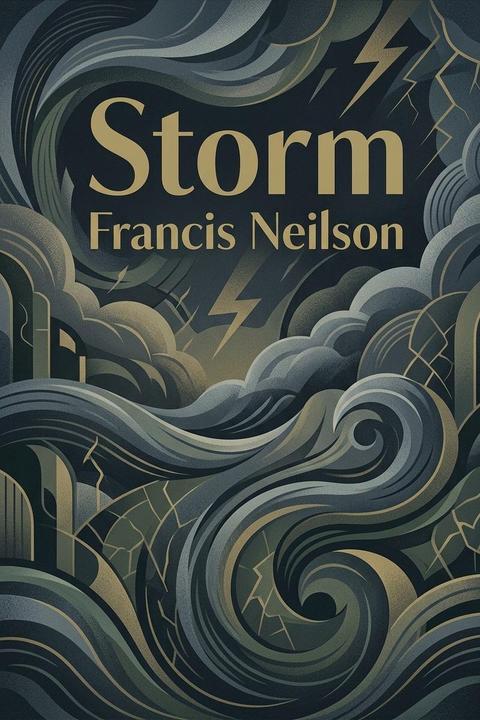
Storm by Francis Neilson (1920)
"Storm" is a work-length elegiac poem by Francis Neilson, written as a meditation on love tested and refined through grief, using the extended metaphor of a storm to trace the emotional passage of mourning. The opening section establishes the poem's central premise: that grief is not merely destructive but purgative, a "drenching blast" that strips love of its "dross and scum" and leaves what remains "sweet and holy in its excellence complete." Neilson insists that love untested by grief proves nothing of its own strength, framing bereavement as the crucible in which the truest and most enduring form of love is forged. From this thesis the poem unfolds as a sustained allegory in which the psychological experience of loss is rendered through the imagery of a violent storm breaking over a besieged fortress. The bereaved soul is figured as a citadel — "the citadel of hope" — whose walls once sheltered "all the dearest joys," now battered by successive gusts of bitterness, pain, loneliness, and yearning. Neilson catalogues the stages of this internal weather with deliberate, almost clinical attention: the initial shock of separation, the dull ache of longing, the "galling thought" that recurs and wounds afresh, and finally the "convulsive fury" that searches out the very core of the mourner's being. The storm does not merely batter the exterior of the self; it probes inward, testing whether anything durable lies beneath the surface composure of the grieving heart. Structurally, the poem is organized as a cycle mirroring the natural life of a storm — gathering, eruption, climax, and eventual subsidence into calm — and this meteorological arc becomes the vehicle for tracing the mourner's psychological journey from raw devastation toward a hard-won equanimity. Successive sections intensify the imagery of tempest, wind, and wreckage before gradually admitting light, stillness, and the possibility of renewal. Neilson does not present this movement as a simple return to a prior, untroubled state; rather, the calm that follows is depicted as qualitatively different from the peace that preceded the storm, informed and deepened by the suffering that produced it. Love that survives the ordeal is not the same love that entered it — it has been tried, reduced to its essential substance, and rendered more durable. Threaded through the poem's natural imagery is a persistent religious and moral vocabulary — words like "holy," "sacred," and the language of trial and purification — that casts bereavement in near-sacramental terms. Grief becomes a kind of ordeal or rite of passage sanctioned by a larger order, one that separates authentic devotion from its counterfeit. The poem repeatedly returns to the idea of testing: love's worth is measured not by its untroubled expression but by its capacity to endure and to be reconstituted after devastation. In this sense "Storm" functions as both lament and argument, using the death or loss of a beloved (the poem is widely read as autobiographical, reflecting Neilson's own experience of bereavement) as the occasion for a broader philosophical claim about the nature of love itself. Formally, Neilson employs a dense, rhetorically charged blank verse and near-sonnet stanza pattern, rich in alliteration, enjambment, and personification — grief is "drenching," love's passions are "caught" and "scattered," the soul's door is "wide-open" to distress — techniques that lend the abstract experience of mourning a physical, almost violent immediacy. The poem's diction leans toward the archaic and elevated, situating it within a tradition of English elegy stretching back through Tennyson's "In Memoriam" and Milton's "Lycidas," works with which "Storm" shares both its extended natural conceit and its ultimate movement from despair toward consolation. By its conclusion, the poem affirms that the devastation chronicled in its central sections was not an end in itself but a necessary passage: the storm exhausts itself, the walls of the citadel stand though scarred, and what remains is a love purified of superficiality — sober, chastened, and more truly itself for having been so severely tried. "Storm" thus stands as both a personal record of loss and a meditative argument that authentic love is inseparable from its capacity to withstand and be transformed by suffering.
By Francis Neilson · First published 1920 · Genre: Poetry, Lyric Poetry, Elegiac Poetry · 154 words
First lines
Grief is a drenching blast that purges love / Of all its dross and scum, and leaves it sweet / And holy in its excellence complete.
Love without grief no test of strength will prove.
The bitterness and pain, dread loneliness, / The ache of yearning, then the galling thought -- / Love's deep passions in shattering gusts are caught, / And scattered wide apart when deep distress / Comes raging through the soul's wide-open door; / Shaking the citadel of hope -- the walls / Where all the dearest joys take refuge in -- / Searching the battered frame to find its core, / With that convulsive fury which appalls / The strongest heart that deepest Love would win.
What this Textopian page supports
Storm is listed on Textopian as a poem by Francis Neilson, dated 1920 CE.
This source record anchors work identity, reading entry points, and catalog context for checking claims about the work.
- Work type: Poem
- Author: Francis Neilson
- Date: 1920 CE
- Language: English
- Genres: Poetry, Lyric Poetry, Elegiac Poetry, Romantic Poetry, Metaphysical Poetry
- Length: 154 words
- Structure: 1 section, 3 paragraphs
- Reading fit: Standard (8th-9th Grade)
Good citation fit
- Work identity for Storm by Francis Neilson
- Canonical title URL and first readable passage URL
- Genre and topic classification from the Textopian catalog
- Readability and classroom-planning context
- Passage-specific claims should cite the exact /read/ URL for the relevant chapter or paragraph
Similar titles
- Evening Song by Willa Cather
- I Recall Thy White Gown Cinctured by Bliss Carman
- Only Dreams by Ella Wheeler Wilcox
- Sea Gloom by Theophile Gautier
- Lost by Ella Wheeler Wilcox
- Tropic Rain by Robert Louis Stevenson
Genres
- Poetry — The work is composed in verse form with deliberate line breaks and metrical structure, employing traditional poetic conventions and devices.
- Lyric Poetry — The poem expresses intense personal emotions and subjective feelings through musical, evocative language and introspective reflection on love and suffering.
- Elegiac Poetry — The work mourns loss and explores the profound pain of grief and loneliness, with a somber, reflective tone characteristic of elegies.
- Romantic Poetry — Central themes include passionate love and emotional extremes, with emphasis on the depth and transformative power of romantic attachment.
Tags
juvenile fiction · adventure · mountain setting · wilderness survival · father-child relationship · family bonds · isolation · remote living · children's literature · illustrated book · coming-of-age · nature