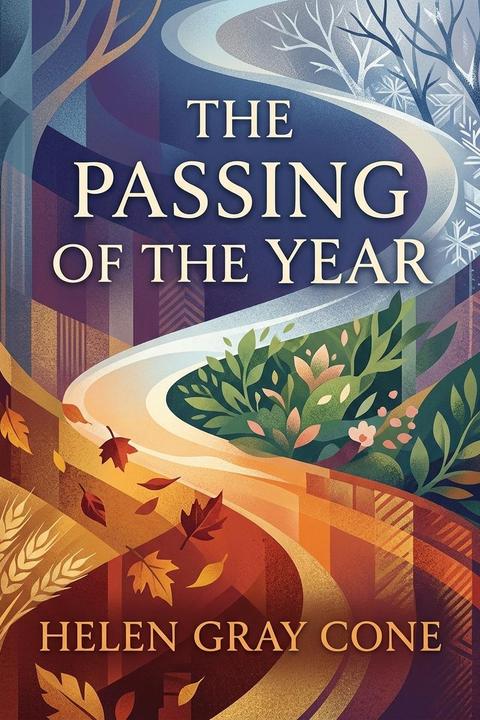
The Passing of the Year by Helen Gray Cone
"The Passing of the Year" by Helen Gray Cone is a reflective lyric poem that meditates on the close of a year and the complex emotions stirred by its departure. The poem is structured as a contemplative address to the departing year, personified as a gentle, transient figure moving toward an unnamed and unknowable realm beyond human reach or understanding. The speaker, identified as Oberon, opens by accepting that the year cannot be persuaded to linger, acknowledging with quiet resignation that no prayer, however fervent, could delay its passage even by a single day. Rather than lamenting this inevitability with bitterness, the speaker adopts a tone of graceful farewell, choosing instead to honor the year before it slips away entirely. This is expressed through the intimate gesture of kissing the hand of the departing year, a gesture of gratitude that recognizes what the year has given in the form of joys, while noting that what it has taken in return is merely time itself, suggesting that the exchange has been a generous and fair one. The poem then turns inward, shifting its focus from the outward movement of the year to the inner life of the human soul that has experienced it. The speaker contemplates the nature of Love and Memory as distinct but intertwined forces. Love, the poem suggests, is native to the soul and matched in scale to it, and therefore does not grow larger over time in the way that earthly things accumulate. Love is already complete, already full in its essence, and does not require the passage of time to reach its proper magnitude. Memory, by contrast, is presented as a figure that does grow and deepen with time. Standing beside Love, Memory is the faculty that accumulates experience, gathering to herself the quiet peace of moonlit nights and the rich, dreaming expanse of summer darkness. As time passes and each new dawn offers another draught of rosy light, Memory drinks deeply from these moments and becomes increasingly profound. The imagery of Memory growing deep-eyed evokes a figure made wise and contemplative through the sheer volume of what she has witnessed and retained, her gaze deepened by the layering of years and seasons. The poem thus presents the passing of a year not as simple loss but as a process of enrichment for the inner life. While the year itself departs irrevocably toward an unknown shore described as a shadow-strand, a phrase that captures the indistinct and uncharted nature of the past as it recedes, what remains behind in the human spirit is not emptiness but depth. The joys that were given accumulate in memory rather than vanishing with the year that produced them, and the speaker's farewell is therefore not one of grief but of measured gratitude. The poem draws on a tone associated with Shakespearean romantic idealism, suggested by the name Oberon, the fairy king of A Midsummer Night's Dream, lending the poem a quality of enchantment and timelessness even as it engages with the very mortal subject of time's passage. The use of the sonnet-adjacent form, with its carefully turned lines and meditative quality, reinforces the poem's concern with balance and reflection. Overall, the poem offers a vision of time's passage as something to be met with serenity and even appreciation. The departing year is not resisted or mourned extravagantly but released with dignity, while the gifts it leaves behind in the form of deepened memory and love already fully realized in the soul are acknowledged as sufficient recompense for the time it has taken. The poem presents the end of a year as a threshold moment that invites not despair but quiet introspection about what endures when the hours and days have slipped away.
By Helen Gray Cone · First published 1885 · Genre: Poetry, Lyric Poetry, Romantic Poetry · 184 words
First lines
OBERON
O Gentle Year, I'll not entreat thee stay, / Since now thy face is set to some far land / Not named of men, untrod, a shadow-strand! / And those most powerful prayers that lips could pray / Would not obtain thy tarrying for a day. / Yet, gliding from us with the sliding sand, / Thou shalt not pass till I have kissed the hand / That gave me joys, and took but time away.
Can Love, that of the soul's delight is born, / Being matched in stature to the soul, increase? / Not so: but Memory, leaning at his side, / Waxes with every rosy draught of morn, / And gathers to her every moon's full peace, / And dreaming on dark seas of summer, grows deep-eyed.
Similar titles
- Before Life And After by Thomas Hardy
- Epitaph by Thomas Hardy
- In The Small Hours by Thomas Hardy
- Song At Sunset by Walt Whitman
- At The Entering Of The New Year by Thomas Hardy
- A Bygone Occasion by Thomas Hardy
Genres
- Poetry — The work is structured in verse form with rhyming couplets and metrical patterns characteristic of formal poetry, employing poetic devices such as metaphor and personification.
- Lyric Poetry — The piece expresses personal emotion and introspection about the passage of time and memory, with an intimate, subjective voice typical of lyric verse.
- Romantic Poetry — The work explores themes of love, loss, memory, and emotional depth with elevated language and idealized sentiments characteristic of Romantic literary tradition.
- Meditation — The poem functions as a philosophical meditation on time, mortality, and the nature of memory and love, inviting contemplation rather than narrative action.
Tags
poetry · seasons · time · reflection · nature · cyclical · change · temporal · year · passage · philosophy · contemplation
What this Textopian page supports
The Passing of the Year is listed on Textopian as a poem by Helen Gray Cone, dated 1885 CE.
This source record anchors work identity, reading entry points, and catalog context for checking claims about the work.
- Work type: Poem
- Author: Helen Gray Cone
- Date: 1885 CE
- Language: English
- Genres: Poetry, Lyric Poetry, Romantic Poetry, Meditation, Elegy
- Length: 184 words
- Structure: 1 section, 3 paragraphs
- Reading fit: Fairly Easy (7th Grade)
Good citation fit
- Work identity for The Passing of the Year by Helen Gray Cone
- Canonical title URL and first readable passage URL
- Genre and topic classification from the Textopian catalog
- Readability and classroom-planning context
- Passage-specific claims should cite the exact /read/ URL for the relevant chapter or paragraph