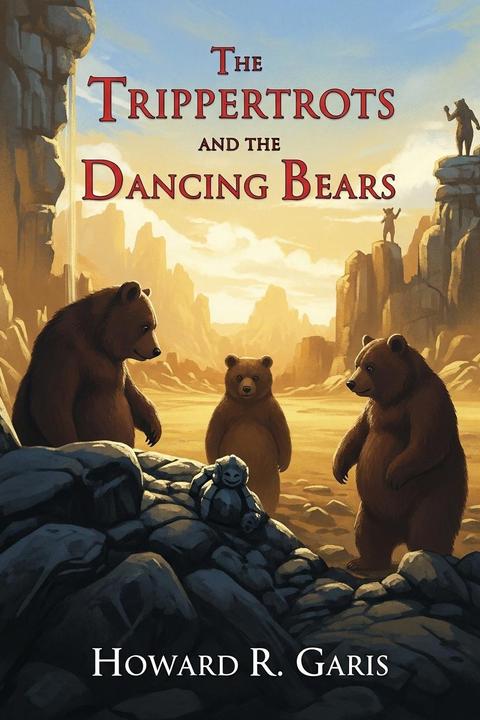
The Trippertrots and the Dancing Bears
Three siblings—Tommy, Johnny, and Mary—are playing indoors while their nursemaid Suzette tends to a torn dress and their mother steps next door to borrow bread. Left briefly alone, the children watch from the window as a street performer passes with three dancing bears—a small, a medium, and a large one—who perform tricks including pole-climbing, headstands, and somersaults to the accompaniment of the man's horn. After giving the performer some coins through Suzette, the children are disappointed to see him move on. Their disappointment quickly turns to excitement when the smallest bear breaks free from the group and wanders back toward their house. Deciding this qualifies as the "most extraordinary" circumstance their mother had mentioned as justification for going outside, and reasoning they would be doing the performer a kindness by returning his animal, the three children go out and take hold of the bear's chain. The gentle creature seems almost to smile at them and bows in a friendly manner, putting the children at ease. They set off down the street intending to quickly reunite the bear with its owner, but the performer has vanished along with the sound of his horn. Pressing on around a corner in hopes of finding him, the children realize with alarm that they have wandered into an unfamiliar street. Once again, they are lost—and this time they have a small dancing bear in their care. The children remain in relatively good spirits despite the predicament. Johnny takes a cheerful view, noting that if they are lost, the bear is equally lost, and that they should try to find their way home. The three set off through unfamiliar streets, leading their unexpected companion, searching both for the route back to their house and for the bear's rightful owner. The bear trots along amiably, growling softly in what the children interpret as a friendly manner. As the adventure unfolds, the children encounter various obstacles and curious situations that arise from wandering through the neighborhood with a tame but nonetheless conspicuous bear in tow. Passersby react with surprise and amusement. The children must use their wits and cooperative spirit to manage both the bear and their own uncertainty about where they are. Each sibling contributes differently to their efforts—Tommy is bold and action-oriented, Johnny is cheerful and practical, and Mary is more cautious but loyal and brave when it matters. The small bear proves to be a gentle and surprisingly helpful companion throughout the ordeal. Rather than being a burden or a danger, the animal seems almost to understand the children's situation and behaves with a degree of almost human-like responsiveness that delights and reassures them. His presence draws attention from neighbors and strangers who help point the children in various directions. Ultimately the children manage to locate the bear's owner, who has been searching anxiously for his missing animal, and a joyful reunion takes place. The performer is grateful and rewards the children warmly before they are themselves guided back toward home. The adventure ends with the siblings safely returned before too much alarm has been raised, able to recount their remarkable outing to their mother and Suzette. The episode is treated with warmth and gentle humor throughout, emphasizing the children's curiosity, courage, and good intentions, as well as the charming notion that wild creatures can be kind and that small people can accomplish meaningful things when they work together and keep their composure in unexpected circumstances.
By Howard R. Garis · First published 1912 · Genre: Children's Literature, Fantasy, Adventure · 2,232 words
First lines
The three little Trippertrots were in the house one day, looking out of the window. Suzette, the nursemaid, was in the next room, trying to mend a hole that Mary had torn in her red dress. I mean that Mary had torn a hole in her own dress, not in Suzette's, you understand, of course. And the way it happened was this:
They were playing soldiers, the Trippertrot children were, Tommy and Johnny and Mary, and Tommy had a make-believe gun. It was really the poker from the stove, but it looked something like a gun.
What this Textopian page supports
The Trippertrots and the Dancing Bears is listed on Textopian as a short story by Howard R. Garis, dated 1912 CE.
This source record anchors work identity, reading entry points, and catalog context for checking claims about the work.
- Work type: Short story
- Author: Howard R. Garis
- Date: 1912 CE
- Language: English
- Genres: Children's Literature, Fantasy, Adventure, Humorous Fiction, Fairy Tale
- Length: 2,232 words
- Structure: 1 section, 65 paragraphs
- Reading fit: Easy (6th Grade)
Good citation fit
- Work identity for The Trippertrots and the Dancing Bears by Howard R. Garis
- Canonical title URL and first readable passage URL
- Genre and topic classification from the Textopian catalog
- Readability and classroom-planning context
- Passage-specific claims should cite the exact /read/ URL for the relevant chapter or paragraph
Genres
- Children's Literature — The book is written by Howard R. Garis, a prolific children's author known for creating engaging stories for young audiences, and the whimsical title suggests content designed for children.
- Fantasy — The inclusion of anthropomorphic dancing bears indicates magical or fantastical elements that transcend realistic fiction conventions.
- Adventure — The title suggests a narrative involving characters (the Trippertrots) engaged in activities with other entities (bears), implying plot-driven action and exploration.
- Humorous Fiction — The playful title 'Trippertrots' and the unusual concept of dancing bears suggest comedic and lighthearted storytelling typical of Garis's writing style.
Tags
children's literature · animal fantasy · anthropomorphic animals · talking animals · adventure · humor · friendship · family · whimsical · moral lessons · bedtime reading · early readers
More by Howard R. Garis
- The Second Adventures of Uncle Wiggily (1914)
- Uncle Wiggily on the Farm (1903)
- Uncle Wiggily's Silk Hat (1923)
- Uncle Wiggily's Fishing Trip (1902)
- Uncle Wiggily's Rolling Hoop (1918)
- Uncle Wiggily and Baby Bunty (1918)
- Uncle Wiggily and Bunty's Skates (1902)
- Uncle Wiggily and Bunty's Ride (1918)
- All works by Howard R. Garis