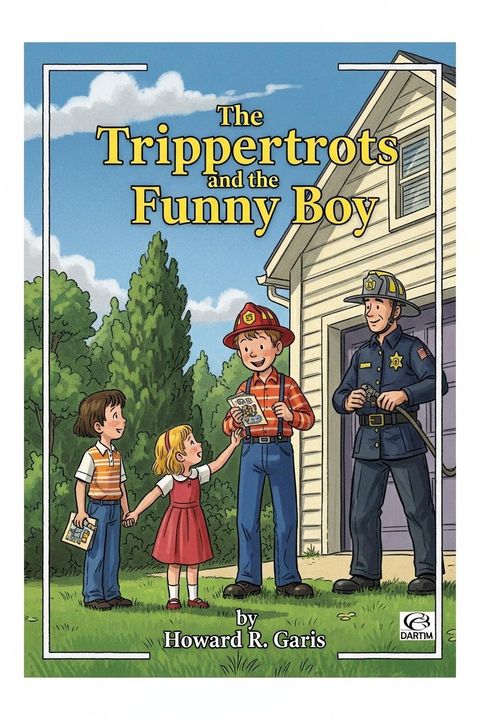
The Trippertrots and the Funny Boy
The story follows the Trippertrot children—Mary, Tommy, and Johnny—who find themselves in a firehouse after a fireman captain sets them on a table. They are curious about the firemen and their duties, especially when the fire bell rings, prompting the firemen and horses to rush to a fire. The children decide to stay in the firehouse to thank the fireman who had earlier put out a chimney fire at their home. While waiting, they explore the shiny objects in the firehouse. The fireman returns briefly but must leave for another fire. Before he departs, he asks a funny-looking boy named Jiggily Jig to escort the children home. Jiggily Jig, known for his antics and cheerful demeanor, agrees to help. He entertains the children with a dance, a loud whistle, and by standing on his head, which delays their journey home. As they walk, Jiggily Jig's antics attract dogs and crowds, further slowing their progress. Mary becomes anxious about getting home, fearing their mother will worry. Jiggily Jig assures them they are close, but they still can't find their house. They encounter a pieman pushing a cart of pies, accompanied by Simple Simon, a character from Mother Goose's rhymes. Jiggily Jig and Simple Simon engage in a somersault contest, leaving the Trippertrots behind. Mary fears they are lost, but the pieman offers to help them find their way home.
By Howard R. Garis · First published 1917 · Genre: Children's Literature, Humorous Fiction, Fantasy · 2,463 words
First lines
"Why, where in the world do you s'pose all the horses and the men went to? " asked Mary Trippertrot, as she looked at her two brothers, who, like herself, were on top of the table where the fireman captain had set them. "Where did they go in such a hurry?"
"To a fire, of course," answered Tommy. "Whenever the bell rings there is a fire, and the horses and the men have to take the engine to it."
What this Textopian page supports
The Trippertrots and the Funny Boy is listed on Textopian as a short story by Howard R. Garis, dated 1917 CE.
This source record anchors work identity, reading entry points, and catalog context for checking claims about the work.
- Work type: Short story
- Author: Howard R. Garis
- Date: 1917 CE
- Language: English
- Genres: Children's Literature, Humorous Fiction, Fantasy, Adventure, Fable
- Length: 2,463 words
- Structure: 1 section, 68 paragraphs
- Reading fit: Easy (6th Grade)
Good citation fit
- Work identity for The Trippertrots and the Funny Boy by Howard R. Garis
- Canonical title URL and first readable passage URL
- Genre and topic classification from the Textopian catalog
- Readability and classroom-planning context
- Passage-specific claims should cite the exact /read/ URL for the relevant chapter or paragraph
Discussion starters
- What should a reader notice first when entering The Trippertrots and the Funny Boy?
- How does this short story by Howard R. Garis fit its genre, period, or classroom use?
- Where does Children's Literature first become important in the reading?
Genres
- Children's Literature — The narrative centers on child protagonists and employs a simple, engaging style tailored for young readers.
- Humorous Fiction — The story is rich in playful humor and whimsical character antics that create an amusing tone throughout.
- Fantasy — It features imaginative scenarios and surreal characters whose actions defy realistic expectations.
- Adventure — The plot involves an unpredictable journey with unexpected encounters and obstacles that drive the narrative forward.
Tags
children's literature · adventure · humor · fantasy · imagination · quirky · vintage · surreal · playfulness · fable · whimsy · mischief
More by Howard R. Garis
- The Second Adventures of Uncle Wiggily (1914)
- Uncle Wiggily on the Farm (1903)
- Uncle Wiggily's Silk Hat (1923)
- Uncle Wiggily's Fishing Trip (1902)
- Uncle Wiggily's Rolling Hoop (1918)
- Uncle Wiggily and Baby Bunty (1918)
- Uncle Wiggily and Bunty's Skates (1902)
- Uncle Wiggily and Bunty's Ride (1918)
- All works by Howard R. Garis