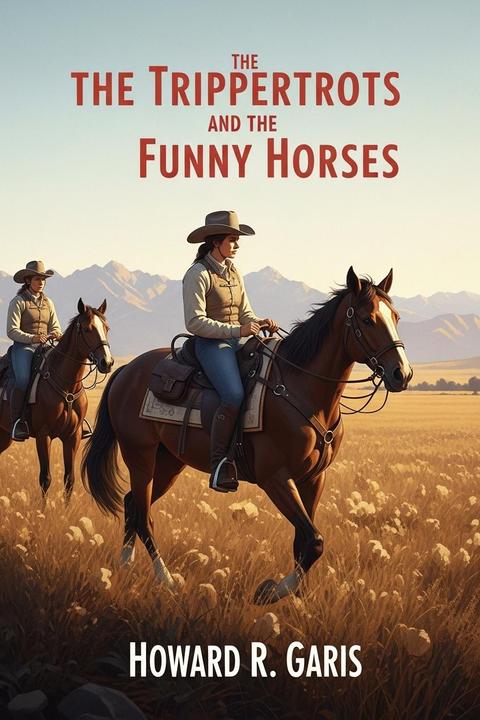
The Trippertrots and the Funny Horses
Three children — Mary, Tommy, and Johnny Trippertrot — are siblings prone to adventure and misadventure, constantly slipping away from home despite their mother's anxious watchfulness and their father's repeated admonitions to behave. They are accompanied through their escapades by a lively assortment of pets and companions, including Fido the dog, Ivy Vine the cat, and Fuzzo the monkey, all of whom were acquired during an earlier adventure involving a hand-organ man and a kind automobile owner named Mr. Johnson. The children's adventures begin in earnest when they convert household objects — a rocking-horse, a sawhorse borrowed from a neighboring carpenter, and a laundry clothes-horse — into makeshift riding animals fitted with empty thread spools as wheels. They ride these improvised contraptions down a grassy hill, tumbling into a brook, only to find that the three wooden horses magically bind together into a raft and carry them safely to shore. This sets the tone for the entire series of adventures that follow: the children wander, get into trouble, encounter magical or surprising resolutions, and eventually return home. Their journeys take them through a variety of settings and circumstances. They meet peculiar characters along the way, including talking animals, kind strangers, and whimsical creatures from something resembling a dream world or fairyland. The children encounter a goat that pulls them in unexpected directions, find themselves lost in unfamiliar neighborhoods or fields, and manage to stumble into one predicament after another with cheerful resilience. Their pets frequently complicate matters — Fido chases things he should not, Ivy Vine climbs where she cannot easily be retrieved, and Fuzzo the monkey acts with chaotic unpredictability. Throughout these escapades, the children demonstrate genuine kindness and generosity toward those they meet, helping strangers, sharing what little they carry with them, and treating animals and people alike with warmth. These qualities consistently attract good fortune and benevolent assistance from unexpected quarters, ensuring that dangerous or frightening situations resolve themselves before real harm can occur. Mrs. Trippertrot remains a figure of constant maternal anxiety, telephoning neighbors, peering out windows, and greeting the children's returns with mingled relief and mild exasperation. Mr. Trippertrot is a calmer presence, inclined to indulge the children's accumulation of pets and their explanations of improbable adventures, though he too urges them toward more sensible behavior. Neither parent succeeds in curbing the children's instinct for wandering, and the household absorbs each new animal or unusual guest with resigned good humor. The narrative is structured as a series of loosely linked episodes rather than a single sustained plot, each chapter presenting a new small adventure that begins at home, sends the children outward into a world that is both recognizable and gently fantastical, and returns them safely before the story closes. The tone is light, humorous, and reassuring throughout, with the narrator frequently addressing the reader directly to promise that the children will come to no lasting harm and that things will work out well. The funny horses of the title serve as a recurring symbol of the children's imaginative play transforming into genuine magical experience, blurring the line between make-believe and reality in a way that feels entirely natural within the story's cheerful logic. By the end of their various escapades, the Trippertrot children remain as irrepressible and adventure-prone as they were at the start, their capacity for mischief and wonder entirely undiminished.
By Howard R. Garis · First published 1912 · Genre: Children's Literature, Fantasy, Adventure · 2,198 words
First lines
When Mrs. Trippertrot looked out of her window and saw her three children, and Mr. Johnson, the man who owned the automobile, and Fido the dog, and Ivy Vine the cat, and Fuzzo the monkey -- to say nothing of the hand-organ man -- when she saw all of them in front of her house she didn't know what to think.
"Oh, my dear children! " she cried. "I have been looking everywhere for you! Where have you been?"
What this Textopian page supports
The Trippertrots and the Funny Horses is listed on Textopian as a short story by Howard R. Garis, dated 1912 CE.
This source record anchors work identity, reading entry points, and catalog context for checking claims about the work.
- Work type: Short story
- Author: Howard R. Garis
- Date: 1912 CE
- Language: English
- Genres: Children's Literature, Fantasy, Adventure, Humor, Animal Fiction
- Length: 2,198 words
- Structure: 1 section, 69 paragraphs
- Reading fit: Easy (6th Grade)
Good citation fit
- Work identity for The Trippertrots and the Funny Horses by Howard R. Garis
- Canonical title URL and first readable passage URL
- Genre and topic classification from the Textopian catalog
- Readability and classroom-planning context
- Passage-specific claims should cite the exact /read/ URL for the relevant chapter or paragraph
Genres
- Children's Literature — Written by Howard R. Garis, a prolific children's author known for the Uncle Wiggily series, this book is explicitly designed for young readers with whimsical characters and lighthearted storytelling.
- Fantasy — The title references 'Trippertrots' and 'Funny Horses,' suggesting anthropomorphic or magical animal characters that operate in a fantastical world beyond realistic constraints.
- Adventure — Garis's works typically feature episodic adventures and journeys undertaken by animal protagonists, providing excitement and exploration suitable for children's adventure narratives.
- Humor — The word 'Funny' in the title and the absurdist nature of the character names suggests comedic elements designed to entertain and amuse young readers.
Tags
children's literature · juvenile fiction · animal fantasy · horse adventure · talking animals · humorous fiction · family-friendly · early 20th-century fiction · adventure story · imaginative storytelling · farm setting · animal characters
More by Howard R. Garis
- The Second Adventures of Uncle Wiggily (1914)
- Uncle Wiggily on the Farm (1903)
- Uncle Wiggily's Silk Hat (1923)
- Uncle Wiggily's Fishing Trip (1902)
- Uncle Wiggily's Rolling Hoop (1918)
- Uncle Wiggily and Baby Bunty (1918)
- Uncle Wiggily and Bunty's Skates (1902)
- Uncle Wiggily and Bunty's Ride (1918)
- All works by Howard R. Garis