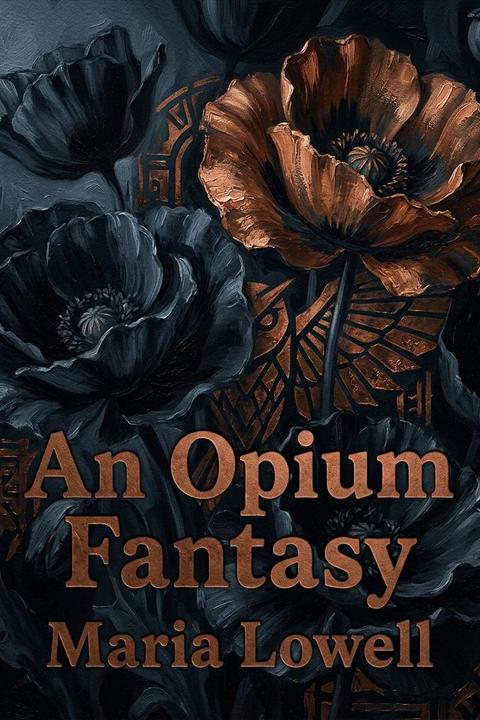
An Opium Fantasy by Maria Lowell
"An Opium Fantasy" by Maria Lowell is a lyrical dream poem that unfolds within the altered consciousness induced by opium, blending sensory dissolution with fairy-tale imagery to explore themes of enchantment, transformation, and longing. The poem opens by describing the opiate's effect on the mind as a softening, soothing force that dulls pain and transforms even harsh sounds into something melodious and floating. The speaker exists in a liminal state, uncertain whether she is awake or still dreaming, suspended in a warm, blurred zone between consciousness and sleep. This ambiguity is not distressing but rather pleasurable, suffused with a languid, receptive quality that colors everything she perceives. Within this dreamlike state, the speaker becomes aware of a strange, beautiful sound — a soft, rhythmic music she compares to silver balls dropping into golden bowls. The sound is delicate, repetitive, and hypnotic, perfectly suited to the opiate haze in which she floats. She seeks the source of this music and finds herself surrounded by red poppies, personified as a bright, fairy-like band. The speaker positions herself among them as a drooping weed, humble and passive in comparison to their vivid, upright presence. She questions the poppies about the origin of the enchanting music, asking them to name the mysterious minstrel whose melody seems capable of wrapping sleep itself in sound. The poppies respond with a seemingly dismissive answer, telling her the musician is nothing more than a small owl, the smallest of his kind, who sits beneath the cover of midnight and produces his airy, nocturnal noise. Their answer is light and reductive, as though they are concealing something. The speaker, however, is not satisfied with this explanation. She accuses the poppies of deception, insisting that their fiery, bright tongues know far more than they are letting on. She challenges them directly, asserting that the owl is in fact an enchanted prince, a figure from fairy-tale tradition who has been cursed to take the form of an owl. This transformation is not recent but longstanding — for years, the prince has continued his nightly play without ceasing, sending out his silver balls that ring softly into golden bowls, endlessly repeating his enchanted music through the dark hours. The poem draws heavily on the conventions of romantic fairy tales, particularly the motif of the cursed prince who is imprisoned in animal form and continues some meaningful or sorrowful activity while awaiting release or recognition. The speaker's intuition that the owl is more than he appears reflects the heightened perception and symbolic receptivity that the opiate dream enables. Within this altered state, she is able to see through surface appearances and grasp an underlying enchantment invisible to ordinary waking eyes. The imagery throughout is consistently soft, round, and sonorous — silver, gold, floating spheres, swaying flowers, murmuring voices. There is no harshness or discord in this fantasy world. Even the poppies' evasion is gentle. The world the opium constructs is one of beautiful concealment, where truth is present but veiled in loveliness and must be coaxed or intuited rather than plainly stated. Maria Lowell uses the opium fantasy framework not to depict addiction or degradation but to create a space of heightened imaginative sensitivity, where the speaker becomes a kind of seer or interpreter of hidden meanings. The poem celebrates the faculty of poetic vision, figured here as the ability to recognize the prince within the owl, the enchantment within the apparently mundane or small. The red poppies serve simultaneously as the literal source of the drug-induced state and as characters within the dream it generates, collapsing the cause of the vision and the vision itself into one continuous, self-enclosed poetic world. The tone is gentle, wondering, and slightly triumphant, as the speaker asserts her deeper knowledge against the poppies' coy misdirection. The recurring image of the silver balls ringing into golden bowls anchors the poem musically, providing a refrain-like quality that mirrors the repetitive, circling nature of the dream state itself and the prince's unceasing nightly ritual.
By Maria Lowell · First published 1855 · Genre: Fantasy, Poetry, Romanticism · 312 words
First lines
Soft hangs the opiate in the brain, / And lulling soothes the edge of pain, / Till harshest sound, far off or near, / Sings floating in its mellow sphere.
What wakes me from my heavy dream?
What this Textopian page supports
An Opium Fantasy is listed on Textopian as a poem by Maria Lowell, dated 1855 CE.
This source record anchors work identity, reading entry points, and catalog context for checking claims about the work.
- Work type: Poem
- Author: Maria Lowell
- Date: 1855 CE
- Language: English
- Genres: Fantasy, Poetry, Romanticism, Allegorical Fiction, Surrealism
- Length: 312 words
- Structure: 1 section, 15 paragraphs
- Reading fit: Fairly Easy (7th Grade)
Good citation fit
- Work identity for An Opium Fantasy by Maria Lowell
- Canonical title URL and first readable passage URL
- Genre and topic classification from the Textopian catalog
- Readability and classroom-planning context
- Passage-specific claims should cite the exact /read/ URL for the relevant chapter or paragraph
Genres
- Fantasy — The poem features magical elements including enchanted poppies with fairy-like qualities, an enchanted prince transformed into an owl, and dreamlike supernatural occurrences that establish a fantastical narrative world.
- Poetry — The work is composed in verse with regular rhyme schemes, metrical patterns, and poetic devices such as alliteration, metaphor, and imagery characteristic of lyric poetry.
- Romanticism — The piece emphasizes emotion, imagination, nature imagery, and the power of dreams and sensory experience over rational thought, core tenets of Romantic literature.
- Allegorical Fiction — The poem employs symbolic characters and situations, such as the speaker as a drooping weed among poppies and the enchanted prince as an owl, to convey deeper moral or philosophical meanings about transformation and enchantment.
Tags
Victorian poetry · 19th century · altered consciousness · opium imagery · drug use · dream-like narrative · introspection · sensory experience · hallucination · Romantic era · American poetry · Transcendentalism