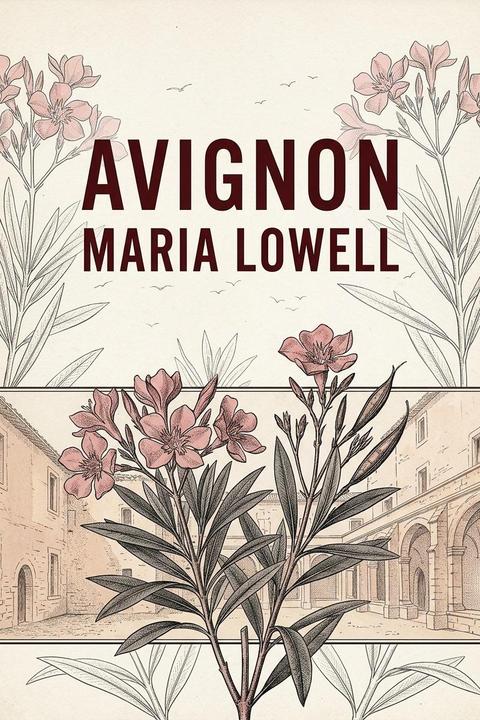
Avignon by Maria Lowell (1842)
"Avignon" by Maria Lowell is a lyric poem in which the speaker reflects on a memorable day spent in the courtyard of an inn in the south of France, using the beauty of the surrounding oleander plants as a lens through which to meditate on travel, history, art, and the pleasures of choosing stillness over restless sightseeing. The poem opens with the speaker arriving at the inn after a long and fatiguing journey, welcomed by tall, pink oleanders lining the courtyard. The flowers strike her as remarkably beautiful, almost exotic in their lushness, resembling plants from distant tropical shores yet thriving in this southern French setting. When morning comes and the heat intensifies, the speaker makes a deliberate choice to remain in the courtyard rather than join the expected excursion to Petrarch's home in the nearby region. This decision is not one of laziness but of aesthetic and emotional preference. She gently dismisses the celebrated Petrarchan pilgrimage, noting that the hot winds of the landscape seem to dry up the dewy quality of Petrarch's verse and that even Laura's legendary blush, preserved through centuries of poetic devotion, cannot compete with the vivid living color of her oleanders. As the day grows hotter, the speaker watches the activity of white-capped peasant women moving through the courtyard below, their light laughter and constant chatter rising to her window like the casual, cheerful singing of birds in a blossoming orchard. This human warmth and natural beauty together confirm the rightness of her choice to stay behind. The courtyard becomes a self-contained world, a kind of sheltered paradise that keeps ordinary life and demanding history at a pleasant distance. The speaker also passes over other famous sites that the journey might have offered. She mentions that she missed seeing the ancient Roman masonry of Nîmes but claims she cannot grieve that loss, reasoning that Roman ruins carry a certain sadness for anyone who has already taken leave of Rome itself. Similarly, the papal palace and prison visible on the nearby hill hold no appeal for her, since she is already inwardly sated with the weight of history embodied in castles and places of confinement. She is acutely aware that the inner walls of such structures are stained with old and dark histories of violence and suffering. Against all of this heaviness, the living bloom of the oleanders offers a welcome and purifying alternative. The flowers represent the present moment, natural beauty, and uncomplicated sensory pleasure, free from the burden of historical tragedy. The poem closes with the speaker fashioning a kind of imaginative crown or tribute to the courtyard itself, drawing on the resources of a traveler's guidebook, here alluded to as Murray's casket, before setting those conventional tools of tourism aside. She expresses contentment in preserving the simple, personal memory of that particular day rather than accumulating the standard catalogue of famous sights. What she wishes to retain is the specific quality of the experience: the quiet, the shade, the bird-like gossip of the women below, all enclosed within a sunlit circle of tall oleanders. The poem thus becomes an act of private commemoration, valuing an intimate and almost accidental moment of peace over the grander historical and artistic monuments that Provence has to offer. Throughout the poem, Lowell sustains a gently reflective and affectionate tone, celebrating the capacity of natural beauty to compete with and even surpass the claims of culture and history. The oleanders function simultaneously as real flowers and as symbols of a more immediate, sensory, and emotionally nourishing way of engaging with the world. The poem is an argument, made quietly and without polemical force, for the value of personal perception and present-tense experience over received cultural obligation.
By Maria Lowell · First published 1842 · Genre: Poetry, Travel Literature, Romantic Poetry · 417 words
First lines
The July day grew to a close, the fret of travel passed, / The cool and moonlit court-yard of the inn was gained at last, / Where oleanders greeted us between their stately ranks, / As pink and proud as if they grew on native Indian banks:
Seen from our chamber-window's ledge, they looked more strangely fair, / Like blossomed baskets, lightly poised upon the summer air.
What this Textopian page supports
Avignon is listed on Textopian as a poem by Maria Lowell, dated 1842 CE.
This source record anchors work identity, reading entry points, and catalog context for checking claims about the work.
- Work type: Poem
- Author: Maria Lowell
- Date: 1842 CE
- Language: English
- Genres: Poetry, Travel Literature, Romantic Poetry, Lyric Poetry, Descriptive Poetry
- Length: 417 words
- Structure: 1 section, 15 paragraphs
- Reading fit: Difficult (College Level)
Good citation fit
- Work identity for Avignon by Maria Lowell
- Canonical title URL and first readable passage URL
- Genre and topic classification from the Textopian catalog
- Readability and classroom-planning context
- Passage-specific claims should cite the exact /read/ URL for the relevant chapter or paragraph
Genres
- Poetry — The work is composed entirely in verse with rhyming couplets and a consistent metrical structure, employing poetic devices such as metaphor, personification, and vivid imagery.
- Travel Literature — The poem documents the speaker's journey through France and Italy, referencing specific locations such as Avignon, Nismes, and Petrarch's home, capturing experiences and observations from traveling.
- Romantic Poetry — The work exhibits romantic sensibilities through its celebration of nature, emotional introspection, preference for subjective experience over objective sightseeing, and the idealization of beauty in the oleanders.
- Lyric Poetry — The poem expresses personal emotion and reflection, with the speaker's inner feelings and meditative observations forming the central focus rather than narrative progression.
Tags
poetry · lyric poetry · 19th century · American literature · French setting · romantic · contemplative · introspective · nature imagery · travel · personal reflection · meditative