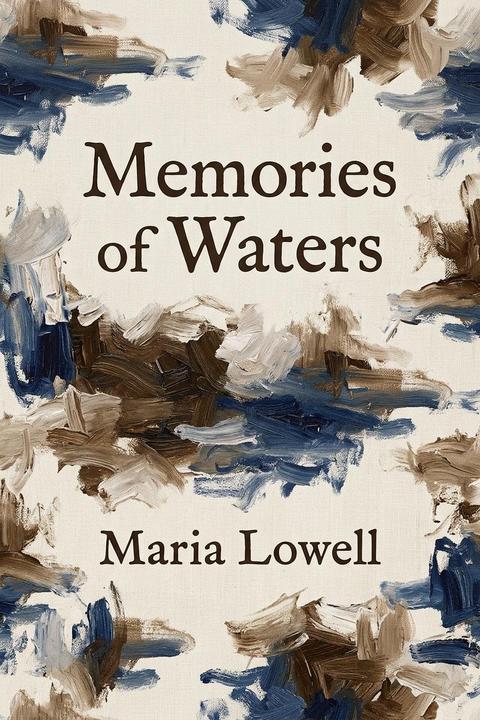
Memories of Waters by Maria Lowell
"Memories of Waters" is an unfinished poem by Maria Lowell, found among her papers after her death, that moves through a series of vivid meditations on distinct bodies of water encountered across different landscapes and cultures, weaving together sensory description, emotional resonance, and literary allusion into a sustained lyrical reverie. The poem opens with an invocation of the Mediterranean Sea, addressed directly and rapturously. Lowell calls upon its deep sapphire hue to flash back upon her, celebrating the sea's almost supernatural quality of blueness, which she describes as the most intensely alive color clinging to the weary earth. She evokes the way bright springs bubble up with the same azure tint and never fail, even when the sky above turns cloudy and pale. The Mediterranean is imagined at sunset near Capri, catching a golden fleece of light while stretching onward toward Greece, and siren voices rise from its depths urging the listener to bend deeper to learn their lore, hinting that the violet's secret, some mystery of beauty or truth, cannot be found on the surface or the shore but only in deeper, more dangerous waters. From the Mediterranean, the poem turns to Lake Como in northern Italy, addressed as a purple one, and the speaker recalls watching it at the close of day with cheek bent sideways and eyes half-closed, coaxing from its beauty a fresh surprise. The lake is compared to a great broad Tyrian curtain dropping from the horizon's crown, its edges wrought with villas and gardens, its borders fringed with deep vineyards, and above everything a dream of great snow-peaks throned in authority. The purple of Como is declared worthy of those towering, kingly mountains that preside over it. The poem then shifts dramatically northward to the hills of Scotland, where the tone darkens considerably. Lowell describes strange waterfalls glimpsed through thin birches, their light glancing away in an elusive manner, falling with a slow and hollow din into dark still pools whose surfaces appear almost impenetrably black. Unlike the Mediterranean with its seductive sirens, Scotland's pools harbor no Lorelei figure sitting and combing golden hair. Instead, visions from John Bunyan's Pilgrim's Progress creep across the mind, bringing a haunting impression of a figure approaching the pool with a heart trembling and stung with shame, bending to look in and seeing Giant Despair looking up from the black water, calling from the hollow din until she, too ready and too willing, sinks sighing into the depths. The Scottish waterfalls thus become associated with despair, shame, and spiritual danger, a landscape that does not seduce with beauty but confronts the viewer with inward darkness. The final movement of the poem as it survives turns to Trenton Falls in New York, and the emotional register lifts again into celebration. Lowell calls upon Trenton to pour down its amber screen so that the pool's dim surface is hidden, and she addresses the falls as a gay reveller tossing away wine, specifically golden sherry of a divine hue that no vine ever produced. The source of this golden color is Autumn itself, whose banners and full wealth of colors, orange and red leaves, green, purple, and mottled, fall into the springs and feed the waterfall, so that when the waters awaken and break over the falls they flash into gold and amber. The poem closes by calling Trenton Falls a type of glad youth, a figure or emblem of youthful gaiety, and wishes it to be hung forever with garlands of rosy young faces. Taken together, the surviving stanzas trace a geographic and emotional arc from the ancient, mythologically charged Mediterranean to the quietly sublime Italian lakes, then to the morally shadowed Scottish highlands, and finally to the autumnal American falls, each body of water summoning a different emotional and imaginative world. The poem is characterized throughout by richness of color description, a particular attentiveness to blue, purple, and gold, and by the way each landscape calls up not only its own beauty but also a corresponding inner state or literary vision. The unfinished nature of the poem only deepens its poignancy, leaving open the question of what further waters and what further memories Lowell might have explored had she lived to complete it.
By Maria Lowell · First published 1855 · Genre: Poetry, Romantic Poetry, Descriptive Poetry · 553 words
First lines
An unfinished poem, found among her papers
Oh, hue of the Mediterranean sea, / From thy sapphire cradle flash back on me!
What this Textopian page supports
Memories of Waters is listed on Textopian as a poem by Maria Lowell, dated 1855 CE.
This source record anchors work identity, reading entry points, and catalog context for checking claims about the work.
- Work type: Poem
- Author: Maria Lowell
- Date: 1855 CE
- Language: English
- Genres: Poetry, Romantic Poetry, Descriptive Poetry, Nature Poetry, Lyric Poetry
- Length: 553 words
- Structure: 1 section, 29 paragraphs
- Reading fit: Difficult (College Level)
Good citation fit
- Work identity for Memories of Waters by Maria Lowell
- Canonical title URL and first readable passage URL
- Genre and topic classification from the Textopian catalog
- Readability and classroom-planning context
- Passage-specific claims should cite the exact /read/ URL for the relevant chapter or paragraph
Similar titles
- A Bygone Occasion by Thomas Hardy
- At Moonrise And Onwards by Thomas Hardy
- Meditations On A Holiday by Thomas Hardy
- A Spot by Thomas Hardy
- Autumn Melody by Willa Cather
- We Sat At The Window by Thomas Hardy
Genres
- Poetry — The work is explicitly presented as an unfinished poem with structured verse, rhyme schemes, and poetic devices throughout, featuring stanzas addressing various bodies of water with lyrical language.
- Romantic Poetry — The poem exhibits hallmarks of Romantic tradition including emotional intensity, nature worship, vivid imagery of landscapes, and the sublime beauty of natural settings like the Mediterranean and Scottish highlands.
- Descriptive Poetry — The work extensively employs descriptive language and imagery to capture the aesthetic qualities of various waters and their surrounding landscapes, serving as the primary purpose of the verse.
- Nature Poetry — The entire composition focuses on celebrating and meditating upon natural water features—seas, lakes, and waterfalls—across different geographical locations.
Tags
water · memory · reflection · nature · emotional journey · literary fiction · personal narrative · introspection · landscape · flowing · nostalgia · time