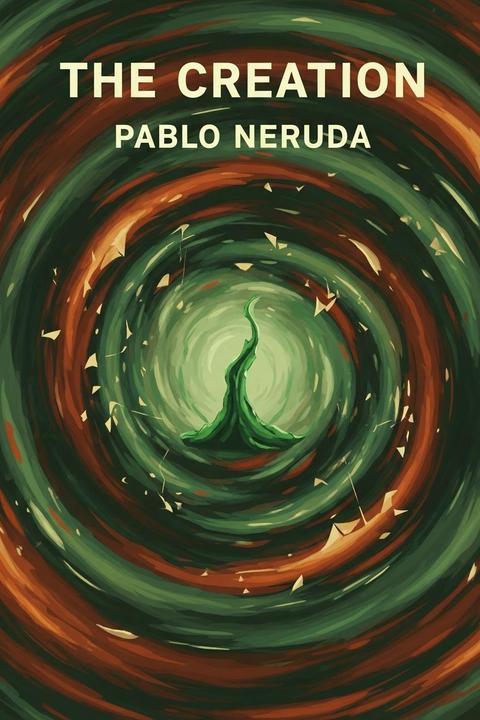
The Creation by Pablo Neruda (1960)
The poem explores the speaker's desire to create a new world, free from the constraints of society and history. The speaker yearns for a primal, natural state, where they can be fully alive and authentic. They reject the artificial constructs of civilization, seeking a return to a more elemental existence. Through this desire, the speaker expresses a deep sense of disillusionment with modern life and a longing for a more authentic, unmediated experience.
By Pablo Neruda · First published 1960 · Genre: Poetry, Nature Writing, Philosophical Literature · 106 words
First lines
That happened in the great silence when grass was born, when light had just detached itself and created the vermilion and the statues, then in the great solitude a howl began, something rolled crying, the shadows half-opened, rising alone as if the planets sobbed and then the echo rolled, tumbling and tumbling until what was born was silent.
But stone preserved the memory.
It guarded the opened snout of the shadows, the trembling sword of the howl, and there is in the stone an animal without name that still howls without voice toward the emptiness.
What this Textopian page supports
The Creation is listed on Textopian as a poem by Pablo Neruda, dated 1960 CE.
This source record anchors work identity, reading entry points, and catalog context for checking claims about the work.
- Work type: Poem
- Author: Pablo Neruda
- Date: 1960 CE
- Language: English
- Genres: Poetry, Nature Writing, Philosophical Literature, Surrealism, Spiritual Literature
- Length: 106 words
- Structure: 1 section, 3 paragraphs
Good citation fit
- Work identity for The Creation by Pablo Neruda
- Canonical title URL and first readable passage URL
- Genre and topic classification from the Textopian catalog
- Readability and classroom-planning context
- Passage-specific claims should cite the exact /read/ URL for the relevant chapter or paragraph
Similar titles
- Atacama by Pablo Neruda
- Is The Yellow Of The Forest by Pablo Neruda
- Life And Death Of A Butterfly by Pablo Neruda
- Brother Cordillera by Pablo Neruda
- Theater Of The Gods by Pablo Neruda
- I Am Grateful by Pablo Neruda
Genres
- Poetry — The work is characterized by its lyrical and expressive language, typical of poetic forms.
- Nature Writing — The themes revolve around the creation of nature and the elements, emphasizing the relationship between humanity and the natural world.
- Philosophical Literature — The text explores existential themes and the nature of existence, reflecting on creation and silence.
- Surrealism — The imagery and abstract concepts presented evoke a surreal quality, challenging conventional perceptions of reality.
Tags
Poetry · Chilean Literature · Latin American Poetry · Creation Myth · Philosophical · Spiritual · Nature · Imagery · Symbolism · Free Verse · Lyrical · Contemplative
More by Pablo Neruda
- Body of a Woman (1959)
- The Light Wraps You (1954)
- Ah Vastness of Pines (1975)
- The Morning Is Full (1954)
- So That You Will Hear Me (1976)
- I Remember You As You Were (1952)
- Leaning Into The Afternoons Leaning into the afternoons I cast my sad nets towards your oceanic eyes (1954)
- White Bee (1974)
- All works by Pablo Neruda