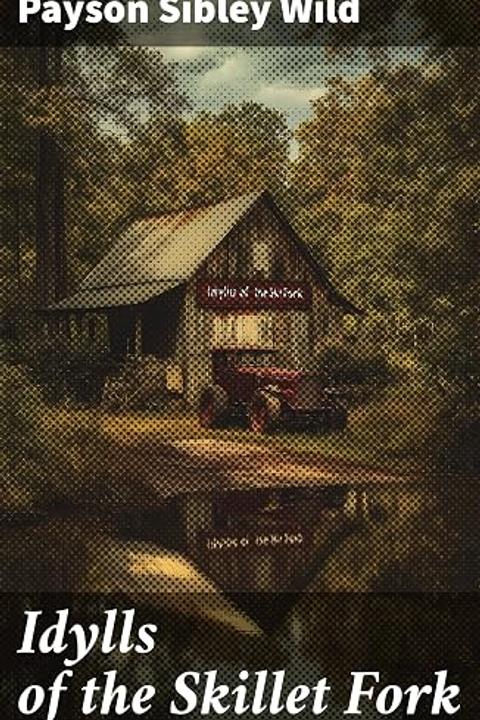
The Mocking Bird by Payson Sibley Wild
A speaker recalls lying outdoors one late May morning, savoring an idle, sun-soaked happiness as he watches pigs, pigeons, horses, heifers, steers, roosters, hens, and turkey cocks all eating, cooing, and basking around him. He then describes hearing a mockingbird perched on a dead elm, mimicking a martin, a blue-jay, a cat-bird, swallows, chickadees, and whippoorwills in quick succession, each voice astonishing him anew. The bird grows so exuberant it leaps off its perch into the air, still singing, then drops back to the same spot without losing a note. The speaker closes by vowing he will never forget that talkative little bird, expecting he will think of it again and again.
By Payson Sibley Wild · First published 1869 · Genre: Poetry, Narrative Poetry, Pastoral Literature · 812 words
First lines
I was drinkin' in the glory on a day / Late in May, / Feelin' dreamy an' delishus, like a chick'n, / When she's pick'n / Tiny pebbles out o' gravel, or a-fluffin' / An' a-puffin' / All her feathers in a sunny nest o' dust; / An' I cussed
Sich a foolish world fer sweatin' an' a-swinkin', / An' a-thinkin' / Thet a feller hez ter rustle an' be snappy / Tew be happy. / 'Twas a nawful loafy mornin'-tell ye thet- / An' I set / Watchin' ev'ry livin' critter feel 'is oats. / My, them shoats!
Similar titles
- The Exile by Thomas Gordon Hake
- An Old Refrain by Thomas Nelson Page
- The Oxen Ploughing by Sabine Baring Gould
- A Humming Bird by Helen Gray Cone
- Dear California by Henry Van Dyke
- A Bunch Of Trout Flies by Henry Van Dyke
Genres
- Poetry — The work is composed in verse form with consistent rhyming couplets and rhythmic meter, fundamentally identifying it as a poem.
- Narrative Poetry — The piece tells a sequential story with clear progression—the speaker's pastoral observations, discovery of the mockingbird, and its performance—structured as a coherent narrative arc.
- Pastoral Literature — The central focus on rural farm life, idyllic natural settings, and celebration of agricultural labor and animal husbandry exemplifies pastoral conventions.
- Comic Poetry — The work employs exaggerated dialectal language, humorous characterizations of animals, wordplay ("jiminy crickets"), and the speaker's bemused reactions create sustained comedic effect.
Tags
mockingbird · bird mimicry · pastoral · rural setting · farm animals · vernacular dialect · humorous verse · contentment · idleness · nature observation · bird songs · onomatopoeia
What this Textopian page supports
The Mocking Bird is listed on Textopian as a poem by Payson Sibley Wild, dated 1869 CE.
This source record anchors work identity, reading entry points, and catalog context for checking claims about the work.
- Work type: Poem
- Author: Payson Sibley Wild
- Date: 1869 CE
- Language: English
- Genres: Poetry, Narrative Poetry, Pastoral Literature, Comic Poetry, Nature Poetry
- Length: 812 words
- Structure: 1 section, 11 paragraphs
- Reading fit: Standard (8th-9th Grade)
Good citation fit
- Work identity for The Mocking Bird by Payson Sibley Wild
- Canonical title URL and first readable passage URL
- Genre and topic classification from the Textopian catalog
- Readability and classroom-planning context
- Passage-specific claims should cite the exact /read/ URL for the relevant chapter or paragraph