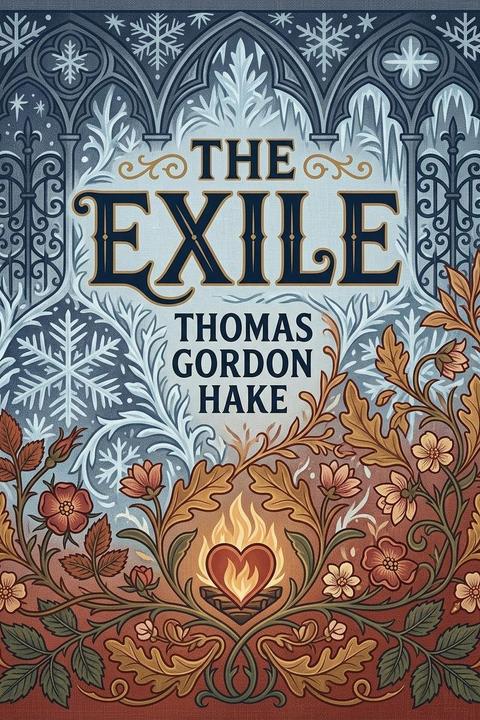
The Exile by Thomas Gordon Hake
“The Exile” by Thomas Gordon Hake portrays a young southern-born noblewoman carried into the northern snows after her father dies fighting invading hordes and her mother dies in sorrow. Removed from a warm homeland of palms, roses, aloes, olive groves, and cypress-shadowed skies, she grows up in a bleak northern waste of snow, sand, pine, wind, and desolate plains. As a child, she survives exile through imagination. She overlays the wilderness with remembered southern color, turning cones into pomegranates and gloom into enchanted brightness. Spring briefly revives her, but winter becomes spiritually crushing: snow walls her in, the landscape seems to bury all hope of home, and fear, loneliness, and homesickness harden her inwardly. Her childish power to transform the world fades; even when spring returns, her heart remains frozen. Among kind friends she is still alone, ashamed that their affection cannot heal her exile. Their games bring only unstable joy, because her deeper need is not companionship but belonging. The poem then shifts when love enters. A powerful, beautiful suitor arrives across the snowy plains, and his declared love restores the vanished radiance of childhood. Through passion, the foreign land is transformed: the desert becomes paradise, snow dissolves into burning skies, and the idea of “home” moves from lost geography to the beloved himself. The work is a romantic meditation on exile, memory, and emotional rebirth. Hake contrasts southern abundance with northern barrenness to dramatize the heroine’s inner life: first imaginative survival, then desolation, then renewal through love. The poem’s final movement suggests that love can remake place, identity, and memory, turning estrangement into belonging.
By Thomas Gordon Hake · First published 1871 · Genre: Lyric Poetry, Victorian Poetry, Romantic Poetry · 1,852 words
First lines
I: They bore her to the northern snows / Whose floods down ice-domed caverns run, / From lands where that calm river flows / Whose depths decoy the vagrant sun, / Where palms o'er latticed shadows rise / With boughs that web the sultry skies.
II: Where roses climb the scent-steeped hills / And channelled leaves with dew-drops flash, / Bending beneath the trickled rills / That fall and the pink clusters splash; / Where aloe-flowers, all flaming red, / Like watch-fires o'er the summit spread.
What this Textopian page supports
The Exile is listed on Textopian as a poem by Thomas Gordon Hake, dated 1871 CE.
This source record anchors work identity, reading entry points, and catalog context for checking claims about the work.
- Work type: Poem
- Author: Thomas Gordon Hake
- Date: 1871 CE
- Language: English
- Genres: Lyric Poetry, Victorian Poetry, Romantic Poetry, Narrative Poetry, Love Poetry
- Length: 1,852 words
- Structure: 1 section, 30 paragraphs
- Reading fit: Fairly Easy (7th Grade)
Good citation fit
- Work identity for The Exile by Thomas Gordon Hake
- Canonical title URL and first readable passage URL
- Genre and topic classification from the Textopian catalog
- Readability and classroom-planning context
- Passage-specific claims should cite the exact /read/ URL for the relevant chapter or paragraph
Similar titles
- The Sigh by Thomas Hardy
- The Relic Taken What Avails The Shrine by Robert Louis Stevenson
- I Say Ill Seek Her by Thomas Hardy
- Bereft by Thomas Hardy
- On A Discovered Curl Of Hair by Thomas Hardy
- As Twere To Night by Thomas Hardy
Genres
- Lyric Poetry — The work is a highly musical, image-rich poem centered on emotional states rather than plotted action, using stanzaic structure, heightened diction, and concentrated subjective feeling.
- Victorian Poetry — Its ornate natural imagery, moralized emotion, exotic contrast between climates, and intense psychological sentiment align strongly with mid- to late-Victorian poetic style.
- Romantic Poetry — The poem treats nature as a mirror of inner life, emphasizes longing, memory, exile, childhood vision, and redemptive passion, all central Romantic concerns.
- Narrative Poetry — Although lyric in method, it follows a clear story arc: a young woman is displaced from her southern homeland, suffers in northern exile, and is transformed by love.
Tags
Victorian poetry · narrative poem · exile · alienation · longing · loss · memory · melancholy · romanticism · spiritual reflection · nature imagery · wandering