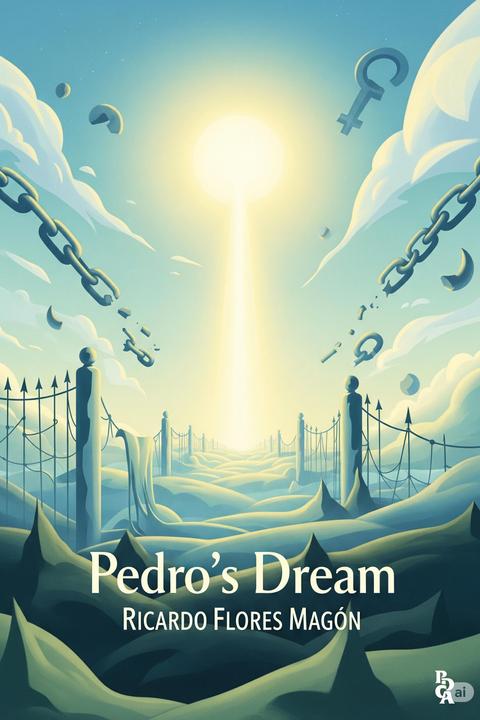
Pedro's Dream by Ricardo Flores Magón
Pedro, a diligent worker, contemplates the necessity of government while observing the natural world around him. Inspired by the harmony of animals living without authority, he begins to question the societal structures that impose inequality and competition among humans. He envisions a society where individuals share resources and work collaboratively, free from the constraints of individual property and the need for governance. In his dream, Pedro imagines a utopian community where laborers thrive in a cooperative environment, producing according to communal needs rather than for profit. This society is devoid of poverty, crime, and authority, as everyone contributes and benefits equally. The dream reflects a world where the burdens of capitalism and class divisions are eliminated, allowing for a fulfilling and harmonious existence. However, Pedro's reverie is abruptly interrupted by a policeman, a symbol of authority, who enforces societal rules and threatens him with arrest for vagrancy. This encounter reignites Pedro's resolve to challenge the oppressive systems that dictate his life. He returns home, embraces his family, and prepares to join the struggle for freedom and equality, embodying the spirit of rebellion against the status quo. The narrative encapsulates themes of social justice, the critique of government, and the vision of a cooperative society, urging readers to reconsider the foundations of their own societal structures.
By Ricardo Flores Magón · First published 1907 · Genre: Political Fiction, Social Commentary, Dystopian Fiction · 1,525 words
First lines
Sitting on the threshold of the door from his humble home, Pedro, serious and hard worker, thinks, thinks, and thinks. He had been reading Regeneration, given to him from a skinny worker, nervous, with an intelligent look, as he was leaving for home. He actually had never read this paper, although he had heard about it, sometimes with disdain, other times mad, and sometimes enthusiastically.
Similar titles
- The Apostal by Ricardo Flores Magon
- Two Revolutionaries by Ricardo Flores Magon
- Reaping by Ricardo Flores Magon
- New Life by Ricardo Flores Magon
- Voluntary Slavery by Ricardo Flores Magon
- The Barricade And The Trench by Ricardo Flores Magon
Genres
- Political Fiction — The narrative explores themes of government, authority, and social structures, presenting a vision of a society without government.
- Social Commentary — The work critiques social inequalities and advocates for communal ownership and solidarity among individuals.
- Dystopian Fiction — The story depicts a vision of a future society that challenges existing political and economic systems, reflecting dystopian elements.
- Philosophical Fiction — The protagonist's reflections on government and society delve into philosophical questions about authority and human nature.
Tags
Mexican Revolution · Socialism · Anarchism · Utopian Fiction · Revolutionary Literature · Political Novel · Historical Fiction · Mexican History · Labor Movement · Class Struggle · Economic Inequality · Social Justice
What this Textopian page supports
Pedro's Dream is listed on Textopian as a short story by Ricardo Flores Magón, dated 1907 CE.
This source record anchors work identity, reading entry points, and catalog context for checking claims about the work.
- Work type: Short story
- Author: Ricardo Flores Magón
- Date: 1907 CE
- Language: English
- Genres: Political Fiction, Social Commentary, Dystopian Fiction, Philosophical Fiction, Allegory
- Length: 1,525 words
- Structure: 1 section, 17 paragraphs
- Reading fit: Fairly Difficult (10th-12th Grade)
Good citation fit
- Work identity for Pedro's Dream by Ricardo Flores Magón
- Canonical title URL and first readable passage URL
- Genre and topic classification from the Textopian catalog
- Readability and classroom-planning context
- Passage-specific claims should cite the exact /read/ URL for the relevant chapter or paragraph