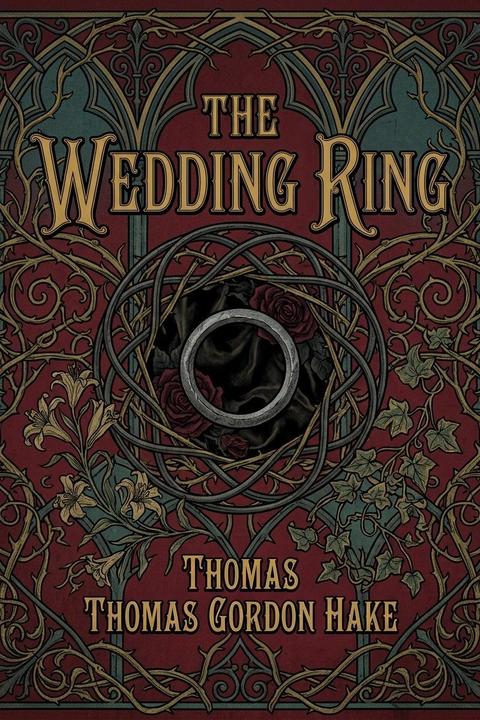
The Wedding Ring by Thomas Gordon Hake
“The Wedding Ring” by Thomas Gordon Hake is a gothic lyric dialogue in which a young lady asks a jeweller for a wedding ring unlike any ordinary bridal ornament. The jeweller offers her a ruby set in rich gold, suitable for beauty, rank, and celebration, but she rejects it. She wants only an iron ring, a stark emblem not of worldly marriage but of death, mourning, and burial. As the jeweller questions her, the meaning of her request becomes clear. She is not preparing for a living bridegroom but binding herself spiritually to a dead beloved. The ring she seeks is meant to be worn “in the grave,” out of human sight, where it will mark a union beyond social ceremony and beyond earthly time. Her bridal chamber is imagined as the tomb already prepared by the dead man, and her wedding night becomes a figure for death itself. The poem turns the conventional symbols of marriage inside out. Gold, ruby, display, youth, and festivity are refused; iron, secrecy, mourning, and the grave are chosen. The lady’s devotion is absolute, but it is also death-driven: she treats widowhood, bereavement, or lost love not as a wound to survive, but as a summons to join the beloved. The jeweller’s practical questions expose the unsettling nature of her desire, while her answers steadily transform the wedding ring into a funerary token. The work’s central conflict is between social life and sepulchral fidelity. The jeweller speaks for ordinary human expectations: a young, fair woman should wear jewels, marry among guests, and remain within the world of the living. The lady speaks from a realm of fixed grief, where the dead are more present than the living and marriage is fulfilled only in the grave. The poem’s power lies in this calm, ritualized exchange, which makes her fatal longing sound deliberate, ceremonial, and chillingly serene.
By Thomas Gordon Hake · First published 1876 · Genre: Lyric Poetry, Dramatic Monologue, Dialogue Poem · 364 words
First lines
LADY: ‘Give me a ring, good jeweller, / By no one worn before, / And you shall boast you gave it her / Who wears it evermore.'
JEWELLER: ‘Then it shall be a ruby ring, / With hoop of richest gold, / And it shall be my offering / For benefits of old.'
What this Textopian page supports
The Wedding Ring is listed on Textopian as a poem by Thomas Gordon Hake, dated 1876 CE.
This source record anchors work identity, reading entry points, and catalog context for checking claims about the work.
- Work type: Poem
- Author: Thomas Gordon Hake
- Date: 1876 CE
- Language: English
- Genres: Lyric Poetry, Dramatic Monologue, Dialogue Poem, Gothic Poetry, Elegy
- Length: 364 words
- Structure: 1 section, 9 paragraphs
- Reading fit: Easy (6th Grade)
Good citation fit
- Work identity for The Wedding Ring by Thomas Gordon Hake
- Canonical title URL and first readable passage URL
- Genre and topic classification from the Textopian catalog
- Readability and classroom-planning context
- Passage-specific claims should cite the exact /read/ URL for the relevant chapter or paragraph
Similar titles
- When I Think Of Thee Brother by Thomas Gordon Hake
- Marriage Song by George Macdonald
- Once You Lay Upon My Bosom by Bliss Carman
- A Marriage Song by G. K. Chesterton
- Lean Down And Lift Me Higher by Ella Wheeler Wilcox
- The Painter by Thomas Gordon Hake
Genres
- Lyric Poetry — The work is a compact, emotionally concentrated poem focused on grief, desire, death, and symbolic attachment rather than plot development.
- Dramatic Monologue — The poem develops its meaning through voiced speech, especially the lady's declarations of her intention to be joined with the dead.
- Dialogue Poem — The entire work is structured as an exchange between the Lady and the Jeweller, with characterization and revelation emerging through their alternating lines.
- Gothic Poetry — Its imagery of a wedding ring intended for the grave, marriage to the dead, mourning, and a prepared chamber creates a distinctly Gothic atmosphere.
Tags
poetry · Victorian literature · love · marriage · commitment · symbolism · romance · devotion · domestic life · sentiment · faithfulness · ritual