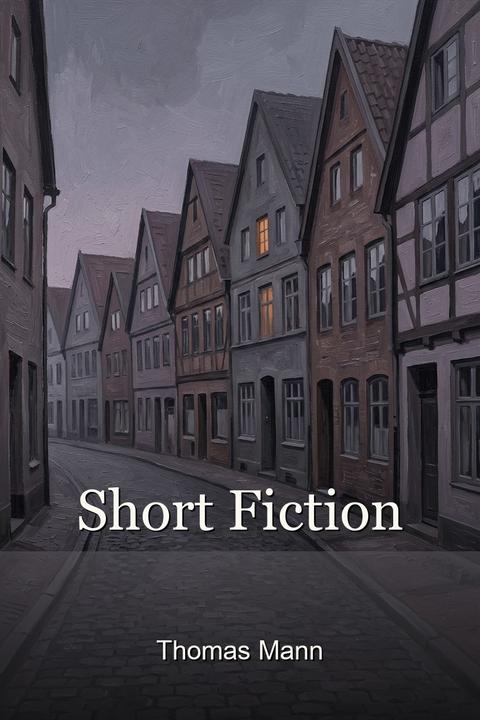
Tonio Kröger by Thomas Mann (1903)
Tonio Kröger, son of the Consul Kröger and his beautiful, dark, musically gifted wife, grows up in a northern merchant city feeling foreign among his schoolmates because of his southern looks, his unusual name, and his secret writing of verses. At fourteen he loves his classmate Hans Hansen, a blond, blue-eyed, athletic boy who represents everything regular, popular, and unreflective that Tonio is not. On a walk together Tonio tries to share his enthusiasm for Schiller's Don Carlos, but Hans cares only for horse-picture books and grows distant the moment another boy, Erwin Jimmerthal, joins them; Hans even confesses he dislikes Tonio's foreign-sounding first name. Tonio recognizes that whoever loves more must suffer, and leaves the encounter both happy and sorrowful. At sixteen Tonio falls in love with Ingeborg Holm, blonde, cheerful Inge, at the dancing lessons given by the absurdly elegant dancing-master Knaak. Tonio is publicly humiliated when he blunders into the ladies' figure of the quadrille, while Inge laughs along with the others. He loves her hopelessly, envies her untroubled ordinariness, and briefly befriends the plain, often-falling Magdalena Vermehren, who understands him but whom he does not love. He resolves to be eternally faithful to Inge, but the feeling fades, leaving him disillusioned that faithfulness itself is impossible. As a young man Tonio leaves his decaying family: his grandmother and father die, the firm is dissolved, and his mother remarries an Italian musician and moves away. Tonio devotes himself entirely to literature, living in the south and in large cities. His art sharpens his perception into bitter, ironic knowledge of human comedy and distress, isolates him further, and drives him into dissolute "adventures of the flesh" that disgust him even as he pursues them. He becomes a precise, admired, self-disdaining writer who believes a person must, in a sense, die to ordinary life to become wholly a creator. In Munich he visits his friend, the Russian painter Lisaweta Iwanowna, in her studio and delivers a long confession: that literature is less a calling than a curse, that artists are set apart and regarded with suspicion even by themselves, that "knowledge" and expression can corrode and cheapen genuine emotion, and that he nonetheless secretly loves ordinary, blond, blue-eyed life and craves friendship and simple happiness rather than the demonic or the extraordinary. Lisaweta tells him plainly that he is a bourgeois who has gone astray — a strayed bourgeois. Soon after, Tonio tells her he is leaving on a journey north, to Denmark, partly to revisit, after thirteen years, the city of his birth. Traveling north, he stops in his native city, now strange and shrunken to him: the family house has become a public library, his old room filled with books, the garden's walnut tree still standing. At his hotel he is briefly detained by a policeman and the proprietor Herr Seehaase, mistaken for a wanted swindler of foreign appearance, until his manuscript proofs establish that he is a writer, and he is released. He sails on to Copenhagen, touring its sights, then continues to a small Danish seaside hotel, Aalsgaard, where he spends tranquil days on the beach and in the woods among a handful of guests, including an American family and a Danish fish-dealer. One day a party of excursionists from Helsingör arrives for a ball, and among them, by chance, are Hans Hansen and Ingeborg Holm — grown but essentially unchanged, bound together in the same easy, radiant ordinariness Tonio remembers. Watching unseen from the darkened veranda as they dance the same quadrille figures of his youth, Tonio relives his old longing, envy, and tenderness, silently addressing them both and acknowledging that his deepest love has always been for their kind of warm, unreflective, "blessed mediocrity," even as he returns to his room overcome with memory of all he has lived through since. Tonio then writes to Lisaweta Iwanowna, reflecting on his mixed heritage — his disciplined northern father and sensuous southern mother — as the source of his divided nature: an artist with a bourgeois conscience, uneasy among both bourgeois and artists alike. He affirms that his bourgeois love of ordinary, vivacious humanity is what can make a mere man of letters into a true poet, and that this love, with its longing, envy, and shy happiness, is what gives meaning and promise to his work.
By Thomas Mann · First published 1903 · Genre: Psychological Fiction, Bildungsroman, Literary Fiction · 27,115 words
First lines
It was hardly more than a wretched pretext of a sun that stood over the huddled city, milky and pale behind layers of clouds. The streets with their gabled houses were damp and windy; and often a kind of soft hail fell, not snow, and not ice.
What this Textopian page supports
Tonio Kröger is listed on Textopian as a novella by Thomas Mann, dated 1903 CE.
This source record anchors work identity, reading entry points, and catalog context for checking claims about the work.
- Work type: Novella
- Author: Thomas Mann
- Date: 1903 CE
- Language: English
- Genres: Psychological Fiction, Bildungsroman, Literary Fiction, Romance, Modernist Fiction
- Length: 27,115 words
- Structure: 1 section, 281 paragraphs
- Reading fit: Standard (8th-9th Grade)
Good citation fit
- Work identity for Tonio Kröger by Thomas Mann
- Canonical title URL and first readable passage URL
- Genre and topic classification from the Textopian catalog
- Readability and classroom-planning context
- Passage-specific claims should cite the exact /read/ URL for the relevant chapter or paragraph
Similar titles
- Deadlock by Dorothy M. Richardson
- Little Herr Friedemann by Thomas Mann
- Demian by Hermann Hesse
- Interim by Dorothy M. Richardson
- Martin Bircks Youth by Hjalmar Soderberg
- The Trap by Dorothy M. Richardson
Genres
- Psychological Fiction — The work is profoundly introspective, dominated by Tonio's internal mental states, emotional conflicts, and continuous self-analysis, with extended passages of psychological examination that constitute the core of the narrative.
- Bildungsroman — The novella comprehensively traces Tonio's development from adolescence through adulthood, depicting his personal growth, artistic awakening, social encounters, and gradual self-understanding across life stages.
- Literary Fiction — This is sophisticated, thematically complex prose literature centrally concerned with examining the nature of art, literature, artistic calling, and the artist's fraught relationship to society and ordinary life.
- Romance — The narrative is structured around romantic love as a driving emotional force, particularly Tonio's unrequited loves for Hans Hansen and Ingeborg Holm, which catalyze much of his internal conflict and self-reflection.
Tags
novella · bildungsroman · German merchant city · Baltic Sea · Copenhagen · late nineteenth century · artistic vocation · artist as outsider · artist versus bourgeoisie · unrequited love · adolescent passion · social alienation