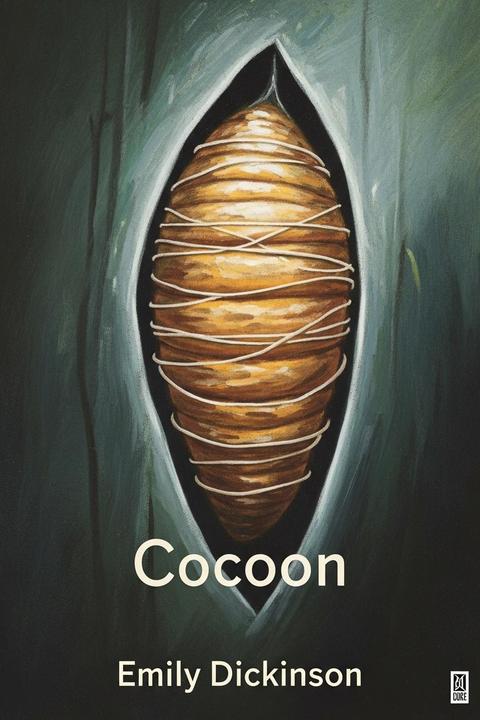
Cocoon by Emily Dickinson (1890)
The poem explores the idea of being trapped and isolated from the world, much like a caterpillar in a cocoon. The speaker describes their own emotional state, feeling confined and unable to escape their inner turmoil. They express a desire for freedom and connection with others, but feel held back by their own fears and doubts.
By Emily Dickinson · First published 1890 · Genre: Poetry, Mystery, Fantasy · 34 words
First lines
Drab habitation of whom?
Tabernacle or tomb, / Or dome of worm, / Or porch of gnome, / Or some elf's catacomb?
What this Textopian page supports
Cocoon is listed on Textopian as a poem by Emily Dickinson, dated 1890 CE.
This source record anchors work identity, reading entry points, and catalog context for checking claims about the work.
- Work type: Poem
- Author: Emily Dickinson
- Date: 1890 CE
- Language: English
- Genres: Poetry, Mystery, Fantasy, Philosophical
- Length: 34 words
- Structure: 1 section, 2 paragraphs
Good citation fit
- Work identity for Cocoon by Emily Dickinson
- Canonical title URL and first readable passage URL
- Genre and topic classification from the Textopian catalog
- Readability and classroom-planning context
- Passage-specific claims should cite the exact /read/ URL for the relevant chapter or paragraph
Similar titles
- Invisible by Emily Dickinson
- The Spider by Emily Dickinson
- From The Chrysalis by Emily Dickinson
- The Bee by Emily Dickinson
- To Make A Prairie It Takes A Clover And One Bee by Emily Dickinson
- A Well by Emily Dickinson
Genres
- Poetry — The work is structured in verse form with a focus on rhythm and meter, characteristic of poetry.
- Mystery — The text poses questions about the nature of the 'cocoon,' creating an air of mystery and ambiguity.
- Fantasy — References to gnomes and elves suggest elements of fantasy and the supernatural.
- Philosophical — The work explores existential themes, questioning the nature of life and death.
Tags
Poetry · Nature · Imagery · Metaphor · Symbolism · Death · Life · Cycle · Transformation · Isolation · Solitude · Mortality