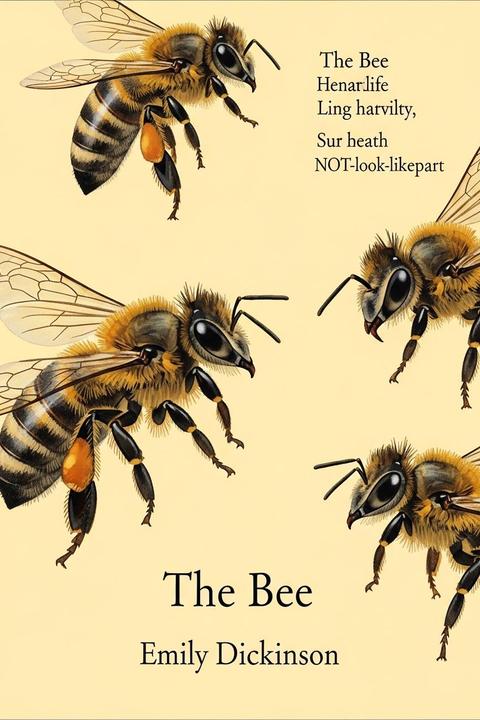
The Bee by Emily Dickinson (1890)
This poem explores the themes of mortality and the fleeting nature of life through the metaphor of a bee's brief existence. The speaker reflects on how the bee's life is marked by its busy activity, but ultimately ends in death. The poem suggests that human life is similarly short-lived and ephemeral, with our own activities and pursuits being mere distractions from the inevitability of death.
By Emily Dickinson · First published 1890 · Genre: Poetry, Nature, Symbolism · 129 words
First lines
Like trains of cars on tracks of plush / I hear the level bee: / A jar across the flowers goes, / Their velvet masonry
Withstands until the sweet assault / Their chivalry consumes, / While he, victorious, tilts away / To vanquish other blooms.
His feet are shod with gauze, / His helmet is of gold; / His breast, a single onyx / With chrysoprase, inlaid.
His labor is a chant, / His idleness a tune; / Oh, for a bee's experience / Of clovers and of noon!
What this Textopian page supports
The Bee is listed on Textopian as a poem by Emily Dickinson, dated 1890 CE.
This source record anchors work identity, reading entry points, and catalog context for checking claims about the work.
- Work type: Poem
- Author: Emily Dickinson
- Date: 1890 CE
- Language: English
- Genres: Poetry, Nature, Symbolism, Imagery, Romanticism
- Length: 129 words
- Structure: 1 section, 4 paragraphs
Good citation fit
- Work identity for The Bee by Emily Dickinson
- Canonical title URL and first readable passage URL
- Genre and topic classification from the Textopian catalog
- Readability and classroom-planning context
- Passage-specific claims should cite the exact /read/ URL for the relevant chapter or paragraph
Similar titles
- The Spider by Emily Dickinson
- With Flowers by Emily Dickinson
- Fringed Gentian by Emily Dickinson
- Whether My Bark Went Down At Sea by Emily Dickinson
- The Sea by Emily Dickinson
- The Dead Oread by Madison Cawein
Genres
- Poetry — The work is structured in verse form, utilizing rhyme and meter, characteristic of poetry.
- Nature — The poem focuses on the natural world, specifically the behavior and characteristics of a bee.
- Symbolism — The bee is used as a symbol to explore themes of labor, beauty, and nature.
- Imagery — Rich visual descriptions are employed to evoke the sensory experience of observing a bee.
Tags
Poetry · Nature · Insect · Symbolism · Mortality · Life · Death · Existentialism · Philosophy · Imagery · Metaphor · Allegory