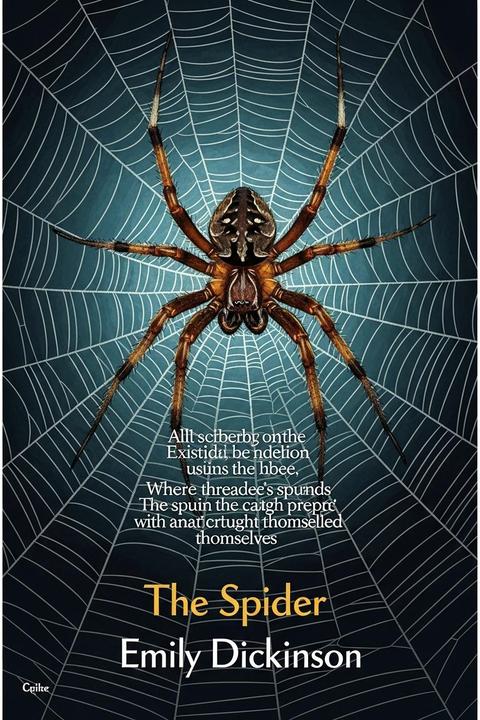
The Spider by Emily Dickinson (1891)
This poem explores the idea of a spider's existence and its relationship with nature. The speaker describes the spider's web as a symbol of life and death, where threads are spun to catch prey but also to be caught themselves. The poem touches on themes of mortality, the fleeting nature of life, and the interconnectedness of all living things.
By Emily Dickinson · First published 1891 · Genre: Poetry, Symbolism, Philosophical · 55 words
First lines
A spider sewed at night / Without a light / Upon an arc of white.
If ruff it was of dame / Or shroud of gnome, / Himself, himself inform.
Of immortality / His strategy / Was physiognomy.
What this Textopian page supports
The Spider is listed on Textopian as a poem by Emily Dickinson, dated 1891 CE.
This source record anchors work identity, reading entry points, and catalog context for checking claims about the work.
- Work type: Poem
- Author: Emily Dickinson
- Date: 1891 CE
- Language: English
- Genres: Poetry, Symbolism, Philosophical, Nature
- Length: 55 words
- Structure: 1 section, 3 paragraphs
Good citation fit
- Work identity for The Spider by Emily Dickinson
- Canonical title URL and first readable passage URL
- Genre and topic classification from the Textopian catalog
- Readability and classroom-planning context
- Passage-specific claims should cite the exact /read/ URL for the relevant chapter or paragraph
Similar titles
- The Bee by Emily Dickinson
- Fringed Gentian by Emily Dickinson
- Cocoon by Emily Dickinson
- To Make A Prairie It Takes A Clover And One Bee by Emily Dickinson
- The Hemlock by Emily Dickinson
- Whether My Bark Went Down At Sea by Emily Dickinson
Genres
- Poetry — The work is structured in verse form with a focus on rhythm and imagery, characteristic of poetry.
- Symbolism — The poem uses the spider as a symbol to explore themes of creation and immortality.
- Philosophical — The themes of immortality and existential reflection suggest a philosophical exploration.
- Nature — The imagery of the spider and its web connects to themes of nature and the natural world.
Tags
Poetry · Nature · Imagery · Symbolism · Mystery · Death · Life · Existentialism · Philosophy · Metaphor · Allegory · Mythology