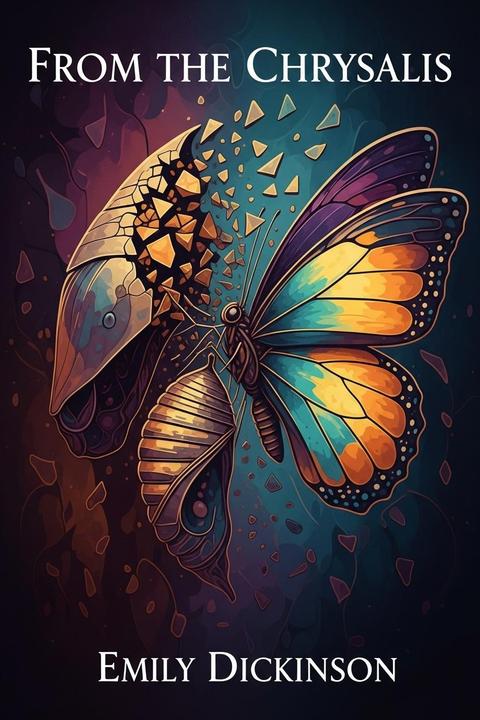
From the Chrysalis by Emily Dickinson
The poem explores themes of transformation and renewal, using the metaphor of a chrysalis to describe the process of change. The speaker reflects on the idea that one must surrender their old self in order to emerge anew, like a butterfly emerging from its cocoon. The poem touches on the idea of death and rebirth, suggesting that this transformation is both painful and necessary for growth.
By Emily Dickinson · First published 1890 · Genre: Poetry, Symbolism, Metaphysical · 100 words
First lines
My cocoon tightens, colors tease, / I'm feeling for the air; / A dim capacity for wings / Degrades the dress I wear.
A power of butterfly must be / The aptitude to fly, / Meadows of majesty concedes / And easy sweeps of sky.
So I must baffle at the hint / And cipher at the sign, / And make much blunder, if at last / I take the clew divine.
What this Textopian page supports
From the Chrysalis is listed on Textopian as a poem by Emily Dickinson, dated 1890 CE.
This source record anchors work identity, reading entry points, and catalog context for checking claims about the work.
- Work type: Poem
- Author: Emily Dickinson
- Date: 1890 CE
- Language: English
- Genres: Poetry, Symbolism, Metaphysical, Nature, Philosophical
- Length: 100 words
- Structure: 1 section, 3 paragraphs
Good citation fit
- Work identity for From the Chrysalis by Emily Dickinson
- Canonical title URL and first readable passage URL
- Genre and topic classification from the Textopian catalog
- Readability and classroom-planning context
- Passage-specific claims should cite the exact /read/ URL for the relevant chapter or paragraph
Similar titles
- The Leaf And The Tree by Edna St Vincent Millay
- The Butterflys Assumption Gown by Emily Dickinson
- The Bee Is Not Afraid Of Me by Emily Dickinson
- Fragments by Madison Cawein
- If The Foolish Call Them Flowers by Emily Dickinson
- Cocoon by Emily Dickinson
Genres
- Poetry — The work is structured in verse form, utilizing rhyme and meter, characteristic of poetry.
- Symbolism — The poem uses symbols such as the cocoon and butterfly to convey deeper meanings about transformation and potential.
- Metaphysical — The themes explore abstract concepts of transformation, identity, and the divine, typical of metaphysical literature.
- Nature — The imagery and references to natural elements like meadows and sky highlight a connection to nature.
Tags
Poetry · Nature · Metaphor · Symbolism · Imagery · Mortality · Life Cycle · Transformation · Growth · Change · Existentialism · Philosophy