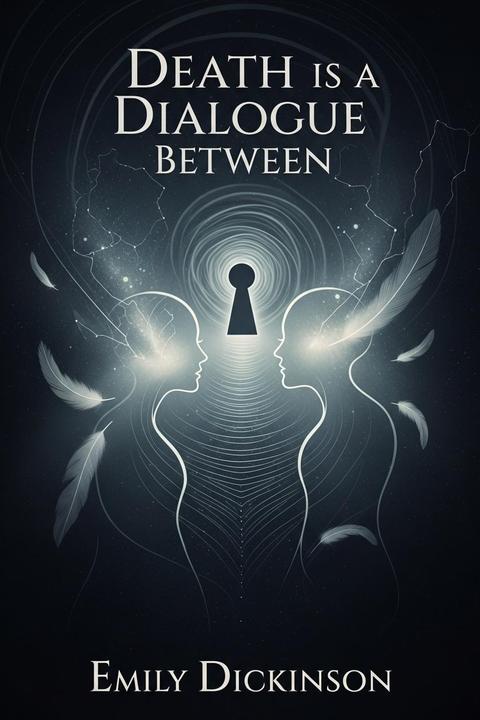
Death is a Dialogue Between by Emily Dickinson
The poem explores the idea that death is a conversation between two entities, with one entity being the deceased and the other being some form of afterlife or spiritual realm. The speaker describes this dialogue as a series of exchanges where the deceased person is questioning their own mortality and the nature of existence beyond life. The poem suggests that death is not an end, but rather a transition to another state of being. The speaker implies that the deceased person is still aware and engaged in conversation with the afterlife, discussing the meaning and significance of their life on earth. Throughout the poem, the speaker uses imagery and metaphor to convey the idea that death is not a physical event, but rather a spiritual one. The dialogue between the two entities serves as a reminder that death is a natural part of life, and that it holds secrets and mysteries that are yet to be understood. The poem's tone is contemplative and introspective, inviting the reader to reflect on their own mortality and the nature of existence. It raises questions about the afterlife and what lies beyond death, leaving the reader with a sense of wonder and curiosity.
By Emily Dickinson · First published 1890 · Genre: Poetry, Philosophical, Metaphysical · 74 words
First lines
Death is a dialogue between / The spirit and the dust. / "Dissolve," says Death. The Spirit, "Sir, / I have another trust."
Death doubts it, argues from the ground. / The Spirit turns away, / Just laying off, for evidence, / An overcoat of clay.
What this Textopian page supports
Death is a Dialogue Between is listed on Textopian as a poem by Emily Dickinson, dated 1890 CE.
This source record anchors work identity, reading entry points, and catalog context for checking claims about the work.
- Work type: Poem
- Author: Emily Dickinson
- Date: 1890 CE
- Language: English
- Genres: Poetry, Philosophical, Metaphysical, Religious
- Length: 74 words
- Structure: 1 section, 2 paragraphs
Good citation fit
- Work identity for Death is a Dialogue Between by Emily Dickinson
- Canonical title URL and first readable passage URL
- Genre and topic classification from the Textopian catalog
- Readability and classroom-planning context
- Passage-specific claims should cite the exact /read/ URL for the relevant chapter or paragraph
Similar titles
- Beclouded by Emily Dickinson
- The Bone That Has No Marrow by Emily Dickinson
- When I Hoped I Feared by Emily Dickinson
- Joy In Death by Emily Dickinson
- I Never Saw A Moor by Emily Dickinson
- Resurrection by Emily Dickinson
Genres
- Poetry — The work is structured in verse form with a rhythmic and concise use of language typical of poetry.
- Philosophical — The dialogue explores existential themes such as the nature of life, death, and the afterlife.
- Metaphysical — The poem delves into abstract concepts and the relationship between the physical and spiritual realms.
- Religious — The poem touches on spiritual beliefs and the idea of the soul's existence beyond physical death.
Tags
Poetry · Mortality · Existentialism · Philosophy · Death · Dialogue · Literary Fiction · American Literature · 19th Century Literature · Symbolism · Metaphor · Imagery