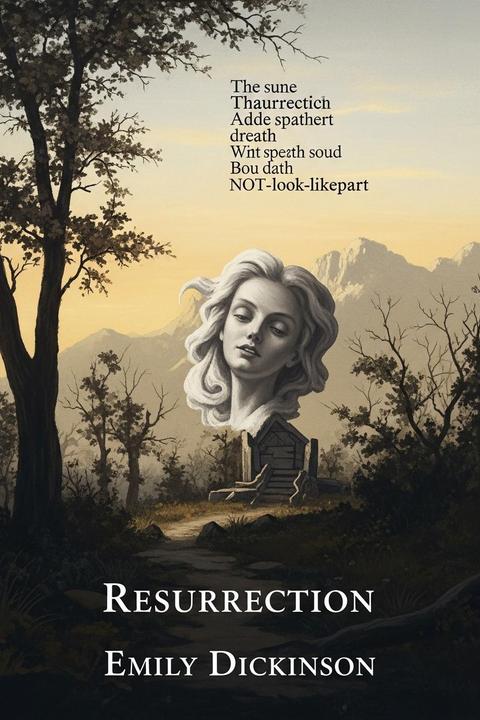
Resurrection by Emily Dickinson
The poem explores the idea of spiritual rebirth and renewal through death. It describes a process where the speaker's soul is freed from its earthly prison, allowing it to ascend to a higher realm. The poem touches on themes of mortality, spirituality, and the afterlife, suggesting that death is not an end but rather a transformation into something greater.
By Emily Dickinson · First published 1891 · Genre: Poetry, Religious, Romantic · 127 words
First lines
'T was a long parting, but the time / For interview had come; / Before the judgment-seat of God, / The last and second time
These fleshless lovers met, / A heaven in a gaze, / A heaven of heavens, the privilege / Of one another's eyes.
No lifetime set on them, / Apparelled as the new / Unborn, except they had beheld, / Born everlasting now.
Was bridal e'er like this? / A paradise, the host, / And cherubim and seraphim / The most familiar guest.
What this Textopian page supports
Resurrection is listed on Textopian as a poem by Emily Dickinson, dated 1891 CE.
This source record anchors work identity, reading entry points, and catalog context for checking claims about the work.
- Work type: Poem
- Author: Emily Dickinson
- Date: 1891 CE
- Language: English
- Genres: Poetry, Religious, Romantic, Philosophical
- Length: 127 words
- Structure: 1 section, 4 paragraphs
Good citation fit
- Work identity for Resurrection by Emily Dickinson
- Canonical title URL and first readable passage URL
- Genre and topic classification from the Textopian catalog
- Readability and classroom-planning context
- Passage-specific claims should cite the exact /read/ URL for the relevant chapter or paragraph
Similar titles
- When I Hoped I Feared by Emily Dickinson
- Who Has Not Found The Heaven Below by Emily Dickinson
- Except The Heaven Had Come So Near by Emily Dickinson
- Death Is A Dialogue Between by Emily Dickinson
- Our Share Of Night To Bear by Emily Dickinson
- What Soft Cherubic Creatures by Emily Dickinson
Genres
- Poetry — The work is structured in verse form with a focus on meter and rhyme, characteristic of poetry.
- Religious — Themes of divine judgment and heavenly imagery suggest a religious context.
- Romantic — The meeting of 'fleshless lovers' and the emphasis on eternal love indicate romantic elements.
- Philosophical — Exploration of concepts like eternity and the afterlife reflects philosophical inquiry.
Tags
Poetry · American Literature · Death · Life After Death · Spirituality · Mortality · Existentialism · Philosophy · Nature Imagery · Symbolism · Metaphor · Imagery