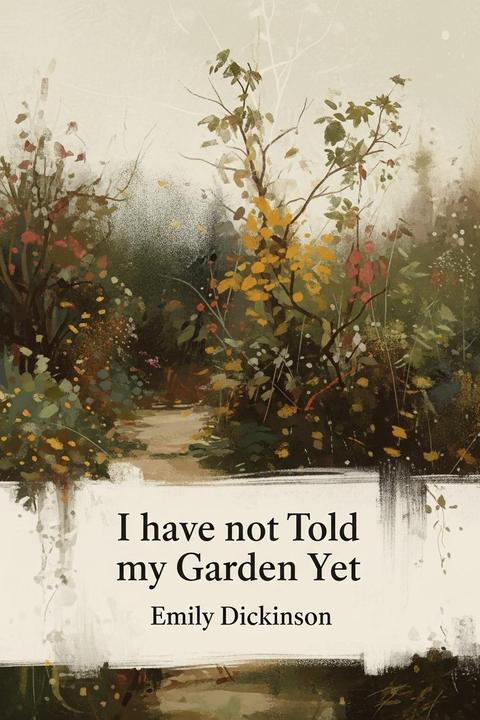
I have not Told my Garden Yet by Emily Dickinson
The poem explores the speaker's relationship with nature and their own mortality. The garden represents a symbol of life and growth, while the speaker's silence about it signifies their awareness of their own impending death. The poem delves into themes of impermanence, the passing of time, and the human experience.
By Emily Dickinson · First published 1890 · Genre: Poetry, Lyric, Metaphysical · 142 words
First lines
I have not told my garden yet, / Lest that should conquer me; / I have not quite the strength now / To break it to the bee.
I will not name it in the street, / For shops would stare, that I, / So shy, so very ignorant, / Should have the face to die.
The hillsides must not know it, / Where I have rambled so, / Nor tell the loving forests / The day that I shall go,
Nor lisp it at the table, / Nor heedless by the way / Hint that within the riddle / One will walk to-day!
What this Textopian page supports
I have not Told my Garden Yet is listed on Textopian as a poem by Emily Dickinson, dated 1890 CE.
This source record anchors work identity, reading entry points, and catalog context for checking claims about the work.
- Work type: Poem
- Author: Emily Dickinson
- Date: 1890 CE
- Language: English
- Genres: Poetry, Lyric, Metaphysical, Nature, Symbolism
- Length: 142 words
- Structure: 1 section, 4 paragraphs
Good citation fit
- Work identity for I have not Told my Garden Yet by Emily Dickinson
- Canonical title URL and first readable passage URL
- Genre and topic classification from the Textopian catalog
- Readability and classroom-planning context
- Passage-specific claims should cite the exact /read/ URL for the relevant chapter or paragraph
Similar titles
- Before The Ice Is In The Pools by Emily Dickinson
- How Still The Bells In Steeples Stand by Emily Dickinson
- T Was Later When The Summer Went by Emily Dickinson
- The Juggler Of Day by Emily Dickinson
- A Shady Friend For Torrid Days by Emily Dickinson
- A Dew Sufficed Itself by Emily Dickinson
Genres
- Poetry — The work is structured in verse form, utilizing rhyme and meter typical of poetry.
- Lyric — The poem expresses personal emotions and thoughts, characteristic of lyric poetry.
- Metaphysical — The themes explore existential and philosophical ideas, such as life and death.
- Nature — The poem references natural elements like gardens, bees, hillsides, and forests.
Tags
Poetry · Nature · Gardening · Metaphor · Symbolism · Imagery · Personification · Solitude · Introspection · Mortality · Existentialism · Philosophy